Canada Tourist Visa Refused? 7 Real Reasons Indians Get Rejected (and How to Fix Them)
Last reviewed: 10 September 2026 · Verified against current VFS Global India fees
Nearly 60% of Canada tourist visa applications from Indians are refused. We break down the 7 real reasons behind every refusal — with anonymised client stories and exact fixes for each.

Rajesh stared at the email from IRCC, his hands cold. "We are unable to approve your application for a temporary resident visa..."
Three years of savings. His sister's wedding in Toronto in six weeks. A refusal letter that gave no real explanation — just a checklist of vague reasons.
Rajesh is not alone. If you've been refused — or you're afraid of being refused — this article will show you exactly what goes wrong, and exactly how to fix it.
At SureShot Visa, we've reviewed hundreds of Canadian tourist visa refusals from Indian applicants. And here's the uncomfortable truth we've learned: the reasons for refusal are almost always predictable — and almost always preventable.
But here's the good news: applicants who understand the real reasons behind refusals — and prepare carefully — often see dramatically higher approval rates. So let's break down the seven most common reasons Indian applicants are refused, through the real (anonymised) stories of people we've helped.
Weak Ties to India
This is the number one reason Canadian tourist visas are refused. IRCC officers are trained to ask one question above all: "Will this person go back?" If your answer isn't strong enough, you're refused — it's that simple.
Strong ties come in four forms:
- Economic ties — stable job, business, property, investments
- Family ties — spouse, children, elderly parents depending on you
- Social ties — ongoing studies, community role, long-term rental
- Legal ties — assets registered in your name, business ownership
Financial Documentation That Raises Red Flags
Having money isn't enough. IRCC wants to see that the money is genuinely yours and has been yours for a while. Sudden deposits, round-figure transfers, and "staged" balances are the fastest path to refusal.
- Show 6 months of organic banking activity — regular salary credits, normal spending, steady savings growth
- If you must deposit a lump sum, document the source (property sale deed, FD maturity, gift affidavit)
- Attach ITRs for the last 2–3 years — these are gold for Indian applicants
- Include Form 16, salary slips, business GST returns where applicable
Purpose of Visit Is Vague or Unconvincing
A tourist visa application without a specific, believable plan looks suspicious. The officer's job is to assess genuineness — and vague answers feel like hiding something.
- Prepare a day-by-day itinerary — even a simple one (Niagara Falls, CN Tower, family visit in Brampton, return)
- Provide hotel bookings or a host invitation letter from a Canadian citizen/PR with their status proof
- Include return flight reservation (many travel agents issue refundable bookings)
- Write a cover letter explaining why this trip, why now — anniversary, child's graduation, specific event
Your application deserves more than guesswork.
One missed document, one weak line in your cover letter, and three years of dreams turn into a refusal stamp. We've seen it happen too many times.
Poor or Non-Existent Travel History
Canada weighs your travel history heavily. Applicants who have previously travelled to "hard" countries — the US, UK, Schengen area, Australia — and returned on time are seen as lower risk. First-time travellers face stricter scrutiny.
- Before applying for Canada, consider building travel history with Singapore, Thailand, Malaysia, UAE, or a Schengen country
- If you already have travel history, highlight it clearly in your cover letter — all entry/exit stamps, trip purposes, returns on time
- First-time travellers should compensate with extra-strong ties and financial evidence
- A prior US B1/B2 visa is the single strongest positive signal you can show
Too Many Relatives in Canada (Dual Intent Concern)
This one feels unfair — but it's reality. The more immediate family you have settled in Canada, the harder the officer's job becomes. They worry you might overstay and apply for PR through family sponsorship.
- Don't hide your family — disclose all of them honestly (lying gets you permanently banned)
- Double down on ties to India: property in your name, business you actively run, dependent parents at home, agricultural land
- Write a specific, time-bound purpose — "attending grandchild's first birthday on [date], returning for harvest season on [date]"
- Show that previous family visits abroad always ended with you returning on time
Employment or Business Red Flags
IRCC wants to see that your job or business is stable enough that you have real reasons to return. Recent job switches, very new businesses, freelancers without contracts, and self-employed applicants without clean financials are all red flags.
- Employed applicants: include NOC (No Objection Certificate) from employer, employment contract, leave approval letter, latest 6 months of salary slips
- Self-employed/business owners: include GST registration, business registration, last 3 years' ITR, CA-certified financials, client contracts
- Freelancers: show client invoices, contracts, tax returns showing consistent income
- If you recently changed jobs, explain why in your cover letter and show the new role is stable and senior
Documentation Mistakes, Missing Papers, or Worse — Fake Documents
IRCC officers process hundreds of applications a day. Anything that looks inconsistent, incomplete, or forged is an instant refusal — and in the case of fake documents, a 5-year ban from Canada.
- Triple-check every date, number, name spelling across all documents
- Never submit anything you did not personally verify — some agents fabricate bank statements or employment letters, and you face the consequences, not them
- Make sure translations are certified by accredited translators
- Follow IRCC's document checklist precisely — missing one item can cause a refusal
💸 Money Trap: The $100 Notarization Myth
Here's something that pains us every single week at SureShot Visa. An Indian applicant asks their Canadian cousin, brother, or friend to spend CAD $80–100 getting the invitation letter notarized by a Canadian notary public — because they believe this will make the application "stronger."
For a standard Canada tourist visa application from India, notarization is not required by IRCC, and it does not make your visa more likely to be approved.
What Canada's official website actually says
On the official IRCC page "Letter of Invitation for Visitors to Canada" (canada.ca, last updated January 2025), the word "notarized" does not appear even once. The page lists exactly what a letter of invitation should contain:
- Complete name, date of birth, address, and phone of the visitor
- Relationship between host and visitor
- Purpose of the trip and how long they plan to stay
- Where they'll stay, and who pays for what
- Arrival and departure dates
- Host's name, DOB, Canadian address, job, and citizenship/PR status
- A photocopy of a document proving the host's status in Canada
That's it. No notary seal. No sworn affidavit. No $100 Canadian notary fee.
"A letter of invitation doesn't guarantee that we'll issue a visa. Visa officers assess you to decide whether you meet the terms of Canada's immigration law."
— canada.ca, official IRCC page on invitation letters
Translation: the visa decision rests almost entirely on your financial strength, ties to India, travel history, and purpose of visit — not on how fancy a stamp your invitation letter has.
What actually strengthens an invitation letter
- A clear, honest, detailed letter covering every point IRCC lists
- Proof of the host's status in Canada — PR card, citizenship certificate, or copy of Canadian passport
- Proof of the host's financial capacity if they're paying (pay stubs, Notice of Assessment, bank statements)
- Proof of the relationship between host and applicant (family photos over time, chat history, past visits, official family documents)
- A believable purpose with specific dates and events (wedding card, birth announcement, graduation invitation)
When is notarization actually worth considering?
- Business invitations — IRCC explicitly says "some visa offices may need these letters to be notarized." Contact the relevant visa office first — don't assume.
- Specific local visa office requirements in rare cases. Again — check first, don't spend blindly.
- Super Visa for parents/grandparents — a signed and witnessed letter may be advised, but even here a $100 notary fee is typically overkill.
For a standard tourist visa application from India — leisure trip, visiting family, attending a wedding — that $80–100 is money better spent on a proper travel insurance policy, a good cover letter drafted by experts, or simply saved for the trip itself.
Why You Can't Win This Alone — Or With a "One-Man-Army" Agent
By now, you've realised something important: a Canada tourist visa file isn't one document — it's five different specialised areas stitched into a convincing narrative. Financial, legal, employment, travel history, and the cover letter. Each one requires a completely different kind of expertise.
This is exactly why the two most common approaches fail almost every time:
❌ The YouTube DIY Trap: Why Free Advice Won't Get You a Canada Visa
YouTube videos and blog articles give you generic advice. But the officer reviewing your application doesn't care about the average applicant — they care about your specific profile. A single IT engineer from Pune, a businessman from Ludhiana with a sudden deposit, and a mother visiting her student son in Toronto each need completely different strategies — and no generic video can give you that.
What you'll never learn from YouTube:
- How to explain an 8-lakh cash deposit without triggering red flags
- How to write a cover letter that directly addresses the concern the officer has about your profile
- How to present a recent job change as a promotion, not instability
- Which documents to include — and, crucially, which ones not to submit
❌ The "One-Man-Army" Consultant Problem
Solo consultants — whether they call themselves "immigration experts," "visa lawyers," or "case specialists" — have one unavoidable limitation: no single person can be a real expert in everything.
Think about what your visa file actually contains:
- Your financial documents (bank statements, ITRs, Form 16, balance sheets) need an eye trained to spot what an IRCC officer will flag — that's the work of a Chartered Accountant, not a general agent.
- Your legal documents (property papers, affidavits, marriage certificates, NOCs) need to be vetted for legal enforceability and correctness — that's a lawyer's job, not an agent's.
- Your cover letter must be written by someone who deeply understands how officers for your specific country read applications — a Canada cover letter is written very differently from a Schengen or UK one.
You wouldn't ask your family doctor to perform heart surgery. You wouldn't trust a criminal lawyer with corporate tax filing. So why would you trust a single person to be accountant, lawyer, writer, and strategist — all for the most important application of your life?
Why a Team Always Beats a Solo Consultant
- Same person writes the SOP, reviews your bank statements, and drafts affidavits
- Generalist knowledge across every area — depth in none
- One perspective, one bias, one set of eyes checking your file
- No cross-verification before submission
- Missed errors become refusal reasons
- Qualified CAs review every financial document
- Lawyers handle legal and property documentation
- Country-specific writing teams craft your cover letter
- Multiple specialist eyes on your file before it's ever submitted
- Each document meets its domain's highest standard
📋 The Ultimate Canada Tourist Visa Checklist
Everything you need to maximise your approval chances
Meet the SureShot Visa Team — Not One Agent, a Full Panel of Experts
When you hand us your case, it doesn't go to "one immigration consultant." It goes through a coordinated chain of specialists — each one an expert in their specific domain. Here's who actually works on your file:
Chartered Accountants
Experienced CAs review every financial document — bank statements, ITRs, Form 16, balance sheets, source-of-funds — the way an IRCC officer will read them.
Legal Experts
Qualified lawyers vet every legal document — property papers, marriage certificates, affidavits, NOCs — for accuracy, enforceability, and compliance.
Country-Specific Cover Letter Team
A dedicated writing team that focuses only on Canada applications. They know how IRCC officers read cover letters — and exactly what must be in yours.
Case Analysis Experts
Before anyone writes a single word, senior case analysts study your complete profile, identify weaknesses, and build a custom strategy for your file.
Document QA Team
A separate quality-assurance team cross-verifies every date, number, name, and detail across your entire file before submission.
Refusal Recovery Specialists
Already been refused? Our refusal-recovery team orders GCMS notes, pinpoints exactly what went wrong, and rebuilds a targeted reapplication strategy.
Dedicated Case Manager
One named point of contact from the moment you sign on until you collect your visa. No handoffs, no confusion — just clear updates.
Post-Submission Support
We don't vanish after submission. Biometrics guidance, additional document requests, follow-ups with VFS — we handle it all until your decision.
This is the real difference: When you work with us, your file isn't handled by one person juggling five roles. It's handled by specialists — each an expert in their area — checking each other's work before your application ever reaches IRCC.
Frequently Asked Questions
Can I reapply for a Canada tourist visa after refusal?
Yes — there's no mandatory waiting period. But reapplying without addressing the reasons for refusal almost always leads to another rejection. Get your GCMS notes first, understand what went wrong, and fix those specific issues.
How long does Canada tourist visa processing take from India?
Currently around 50–90 days from India, but it varies. Apply at least 3 months before your intended travel date. Biometrics appointments can add another 1–2 weeks.
Is there a Canada tourist visa "approval guarantee"?
No honest consultant can guarantee a visa — the decision rests entirely with the IRCC officer. Anyone promising a "guaranteed" or "sure shot" approval is misleading you. What a good consultant can do is maximise your chances by preparing a complete, convincing application.
How much money should I show for a Canada tourist visa?
There's no official minimum, but a general rule is ~CAD 100/day per person (roughly ₹6,000/day), plus flight and accommodation costs. For a 10-day trip, this usually means showing ₹3–5 lakhs of stable funds — though your case details matter more than the exact number.
Do I need to show return flight tickets?
A flight reservation (not a paid ticket) is recommended. Do not buy non-refundable tickets before your visa is approved — if refused, you lose the money.
Can SureShot Visa help if I've already been refused twice?
Yes. We regularly handle cases with 2+ refusals. The process is different — we order GCMS notes, identify exactly what went wrong, and rebuild the application from the ground up. Success is not guaranteed, but the odds improve dramatically with the right strategy.
Don't Let a Preventable Mistake Cost You Canada
A single refusal stays on your record forever. Your next application deserves careful, expert preparation — not guesswork. Talk to a SureShot Visa expert today. First consultation is free.
Or visit our consultation page to book a time slot.
Disclaimer: This article is for informational purposes only. Visa rules, fees, and processing times change frequently — always verify current requirements on the official IRCC website (canada.ca/immigration) or consult the SureShot Visa team for expert, case-specific guidance. With dedicated Chartered Accountants, legal experts, and country-specialist writers under one roof, our domain expertise ensures your file is assessed and prepared with the depth no single consultant can provide. Names in stories have been changed to protect client privacy.
Need help?
We'll handle your visa file end-to-end.
Documents, VFS slots, embassy filing — by a licensed consultant.
We answer within 5 minutes
Full Country Guide
Canada Visa from India — fees, documents, processing time
Everything you need on one page: VFS centres, visa types, fee breakdown, doc checklist.

Written by
Narinder ChahalFounder, SureshotVisa · B.Tech, Computer Science (2008)
Narinder Chahal founded SureshotVisa with a simple belief: a visa file should be clear, honest and backed by strong documents. After moving to Canada in 2014, he has helped Indian and international applicants understand visa filing, refusal concerns, document gaps and immigration-related issues.
Full profileRelated Guides

Canada Tourist Visa Show Money from India: Requirements
Learn how much show money you need for a Canada tourist visa from India, whose name it should be in, and how long funds must remain in your account.
Read guide
Can You Take Your Dog to Canada from India? The 2026 Pet Guide
Yes — your dog can come to Canada, and the paperwork is simpler than you fear. The one document CFIA cares about, the airline choice that trips people up, and the timeline to start now.
Read guide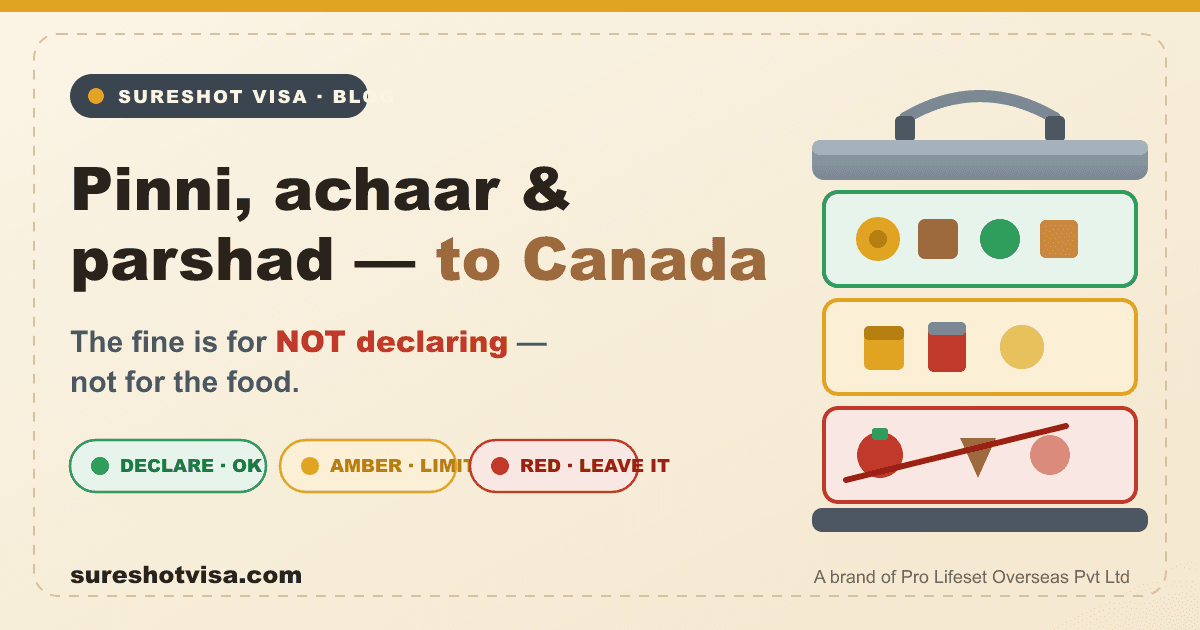
Pinni, Achaar & Parshad to Canada: What You Can Actually Pack (2026)
Yes, you can carry many Indian foods to Canada — but the fine is for NOT declaring, not for the food. The green / amber / red guide to packing your maa-ke-haath sweets without a CA$1,300 surprise.
Read guide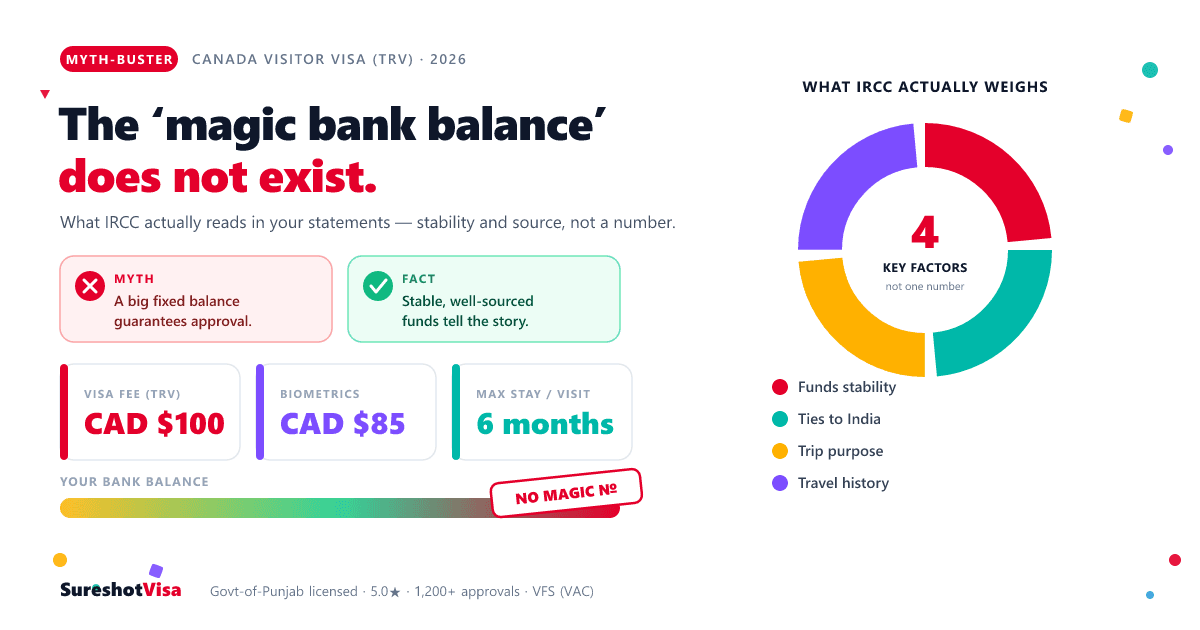
Canada Visitor Visa Bank Balance Myths, Busted (2026)
There is no magic bank balance number for a Canada visitor visa. Six myths against what IRCC officers actually read in your six-month statements.
Read guide