

Canada Visa Refused Due to Family Ties: Return Anchors, Evidence Map & Reapply Strategy
Canada visa refused due to family ties? A visual guide for Indian applicants: return anchors atlas, evidence matrix, weak-file autopsy and reapply strategy.

Last reviewed: 10 September 2026 · Verified against official embassy and visa-centre sources
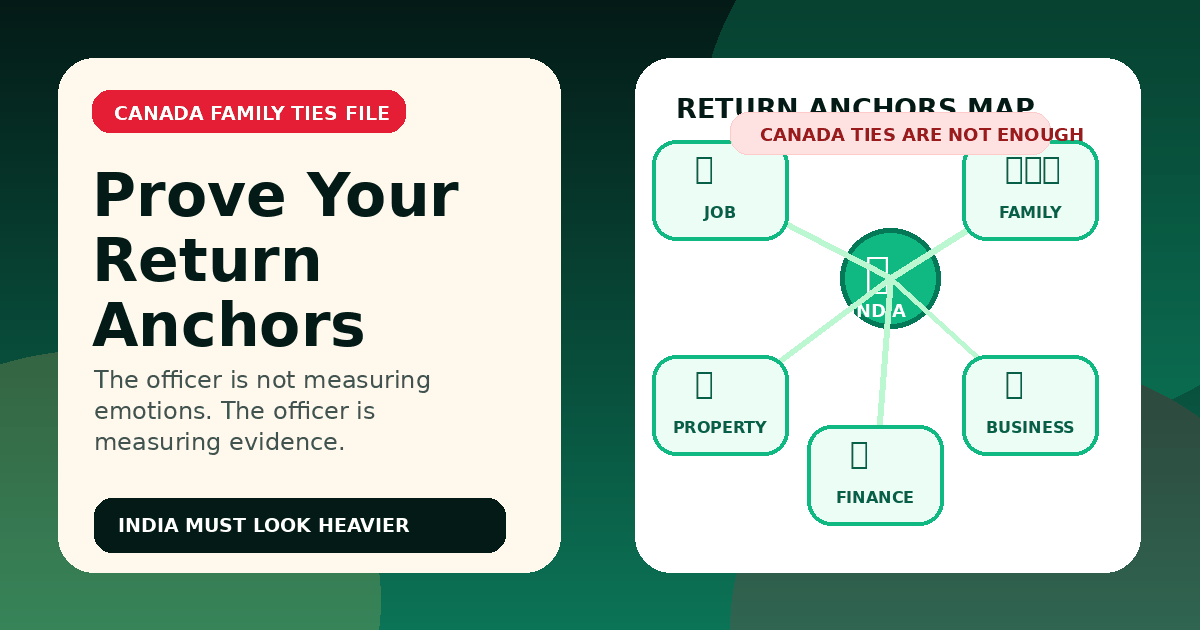
Quick answer: A Canada visa refused due to family ties usually means the officer was not satisfied that your job, home, financial assets, family, responsibilities or overall life in India will take you back after the visit.
Family ties are not emotions. They are return anchors.
Many applicants write “I have strong family ties in India,” but the file mostly proves the opposite: the inviter in Canada is documented properly, while the India-side responsibilities are barely explained.
Return anchors atlas
India-centred life map
The application should show that your life continues in India after the visit.
INDIA
The officer’s hidden question
“After this applicant enters Canada, what is strong enough in India to make them leave Canada on time?”
Canada vs India tie balance
Weak file autopsy
Weak pattern
- Canada inviter fully documented
- Long stay requested without strong reason
- India spouse/children/parents not proven clearly
- Property mentioned but not explained
- Job/business/pension proof weak
- Previous refusal ignored
Stronger pattern
- Short, realistic visit duration
- Canada invitation + India responsibilities
- Family proof in India attached
- Property/business/job proof organised
- Return date and reason clearly explained
- New evidence directly addresses the refusal
Evidence matrix
Reapply timeline
Was it only family ties, or also purpose / funds / travel history?
List Canada pull vs India anchors.
Documents for job, family, property, business, pension.
Make the visit short, temporary and evidence-backed.
FAQs
Not automatically. The problem starts when Canada ties look stronger than India ties and the file does not prove why you will return.
Spouse documents, children’s records, dependent-parent proof, job, business, property, agriculture, pension and financial responsibilities can all help.
Yes — but add new evidence that directly addresses the refusal reason.
Property helps, but it is stronger alongside job, business, family, income and purpose proof.
No. Hiding relatives can create misrepresentation issues. Disclose honestly and prove your India ties.
Often yes. A shorter, realistic visit can reduce doubt.
Official reference: IRCC visitor-eligibility guidance states applicants must convince an officer they have ties — such as a job, home, financial assets or family — that will take them back to their home country, that they will leave Canada at the end of the visit, and that they have enough money. Official source.
Need help?
We'll handle your visa file end-to-end.
Documents, VFS slots, embassy filing — by a consultant at our licensed firm.
A consultant at our licensed firm replies today
We answer within 5 minutes
Full Country Guide

Written by
Narinder ChahalFounder, SureshotVisa · B.Tech, Computer Science (2008)
Narinder Chahal founded SureshotVisa with a simple belief: a visa file should be clear, honest and backed by strong documents. After moving to Canada in 2014, he has helped Indian and international applicants understand visa filing, refusal concerns, document gaps and immigration-related issues.
Full profileRelated Guides

Canada Tourist Visa Show Money from India: Requirements
Canada · Read guide
Can You Take Your Dog to Canada from India? The 2026 Pet Guide
Canada · Read guide
Pinni, Achaar & Parshad to Canada: What You Can Actually Pack (2026)
Canada · Read guide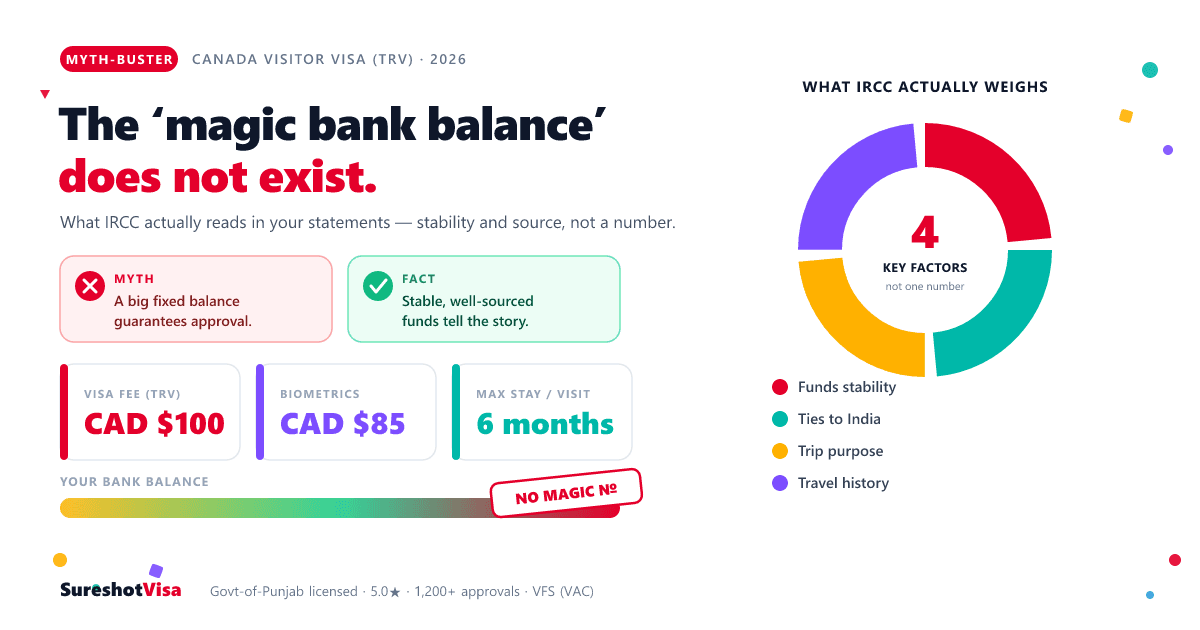
Canada Visitor Visa Bank Balance Myths, Busted (2026)
Canada · Read guide