Canada Tourist Visa Show Money from India: Requirements
Last reviewed: 10 September 2026 · Verified against current VFS Global India fees
Learn how much show money you need for a Canada tourist visa from India, whose name it should be in, and how long funds must remain in your account.


The single biggest reason genuine Indian tourists get refused for a Canada visitor visa is not the itinerary or the hotel booking — it is the show money that looks arranged, borrowed, or unexplained. This guide breaks down exactly how much funds to show, in whose name they should sit, and how long the balance must remain untouched before you apply.
There is no official minimum — but weak, freshly-deposited funds are the top refusal trigger.
First, the truth: Canada has no fixed "show money" figure
Unlike some countries that publish a per-day amount, IRCC (Immigration, Refugees and Citizenship Canada) does not print a rupee figure you must hit. The visa officer instead asks one practical question: can this person comfortably fund their trip and return home without working illegally in Canada?
That means the "right" amount is tied to your specific trip. A 10-day visit staying with relatives needs far less proof than a 30-day self-funded tour across Toronto, Banff and Vancouver. So before you fixate on a number, calculate your actual trip cost.

A realistic cost calculator for a Canada tourist trip
| Expense | Per day (approx) | 15-day trip |
|---|---|---|
| Accommodation | ₹8,000–15,000 | ₹1.2–2.2 lakh |
| Food | ₹2,500–4,000 | ₹40,000–60,000 |
| Local transport | ₹1,500–3,000 | ₹25,000–45,000 |
| Sightseeing / activities | ₹2,000–4,000 | ₹30,000–60,000 |
| Return flight (fixed) | — | ₹80,000–1.4 lakh |
| Buffer + emergencies | — | ₹50,000+ |
For a solo 15-day self-funded trip, you are realistically looking at ₹3.5–5 lakh of demonstrated funds. If a Canadian relative is hosting and covering some costs, your personal show money can be lower — but you still need to show you are not travelling on empty.
How much show money should you actually keep?
Here is the practical rule of thumb our team at SureshotVisa uses when preparing files from India:
- Self-funded short trip (7–10 days): ₹2–3 lakh liquid in your account
- Self-funded standard trip (15–21 days): ₹3.5–5 lakh liquid
- Longer or multi-city trip (30 days): ₹5–7 lakh liquid
- Sponsored by relative in Canada: ₹1.5–2.5 lakh of your own + sponsor's proof
Showing more than you need is not automatically better. A ₹40 lakh balance in a student's account with no income source raises more doubt than ₹4 lakh backed by a steady salary. Consistency beats size.
In whose name must the funds sit?
This is where many applications quietly fall apart. The cleanest, strongest case is money in your own name — the primary applicant's savings or salary account. When funds are in someone else's name, the officer must connect two dots instead of one, and every extra dot is a chance for doubt.
Weak fund ownership
- Money only in a friend's account "for show"
- Large deposit from an unrelated third party
- Joint account where you are not the earner
- Cash suddenly appearing days before applying
- Funds transferred out right after statement printed
Strong fund ownership
- Savings in your own name, built over months
- Salary credited regularly to your account
- Spouse/parent as declared sponsor with relationship proof
- FDs in your name shown alongside savings
- Business income flowing into your current account
When someone else is funding you
It is completely legitimate for a spouse, parent, or child settled in Canada to fund your trip. The key is to declare it openly rather than disguise their money as yours:
- Spouse funding wife/husband: Show marriage certificate + spouse's bank statement + spouse's income proof.
- Parents funding an adult child: Show birth certificate/relationship proof + parent's account.
- Canadian relative sponsoring: Add an invitation letter, their Canadian bank statement, proof of status (PR card / citizenship / work permit), and their job letter.
The mistake is dumping ₹5 lakh from your father into your account two days before applying and calling it "your savings." Officers see this pattern daily. Declaring your father as a sponsor is honest and defensible — hiding it is not.
How long must the money sit? The 6-month statement rule
IRCC and Canadian visa application centres typically expect a 6-month bank statement. But it is not the length of the statement that decides your case — it is the stability across those six months.
Build early
Start growing your balance at least 3–6 months before you apply. Sudden money is the number one red flag.
Keep it stable
Let the healthy balance sit. Avoid draining the account right before you print the statement.
Explain big credits
Any large deposit (₹1 lakh+) should have a paper trail — bonus, FD maturity, property sale, gift deed.
Print fresh
Get a bank-stamped statement dated within 7–10 days of submitting your application.
The ideal picture is boring in the best way: a balance that has grown gradually, mirrors your declared income, and stays healthy right up to the day you apply. A statement that reads ₹15,000… ₹18,000… ₹22,000… ₹4,80,000 (one week before applying) tells the officer the money was arranged. That single jump can sink an otherwise strong file.
Canada Tourist Visa Show Money Requirements from India
Financial proof benchmarks and timeline guidelines for visa approval
Covers living expenses plus return airfare
Strengthens application and shows financial stability
Demonstrates genuine savings, not borrowed money
Joint accounts acceptable but primary name mandatory
When funds meet guidelines and source is verified
Source: SureshotVisa consultant desk
Documents that prove your funds are real
Show money is never just one document. IRCC believes a story, not a screenshot. Build a bundle that supports itself:
- 6-month bank statement — stamped and signed by the bank, showing your name, account number and address
- Salary slips (last 3 months) if you are employed
- Income Tax Returns (last 2 years, with acknowledgement)
- Form 16 for salaried applicants
- Fixed Deposit certificates in your name
- Employment/leave letter confirming your job and approved leave dates
- Business proof — GST returns, business registration, current account statement (for self-employed)
- Property or asset documents as secondary ties to India
Notice how these overlap: your bank statement should match your salary slips, which match your ITR. When three documents tell the same financial story, the officer trusts all three.
The 6 most common show-money mistakes from India
Last-minute lump sum. A large deposit days before applying screams "arranged funds." Build your balance months ahead instead.
Funds don't match income. A ₹25,000 salary with ₹20 lakh floating in savings and no explanation invites suspicion, not confidence.
Borrowed money on display. Showing a friend's account or a loan-funded balance with no ownership link is easily spotted and refused.
Draining the account after printing. Officers may notice the balance was withdrawn; some applicants have been asked for updated statements at interview.
Unexplained third-party transfers. Money from an unrelated person, unexplained, looks like a paid arrangement. Always document the source and relationship.
Ignoring ties to India. Money proves you can afford the trip — it does not prove you will return. Weak home ties sink files with strong balances.
Money proves affordability — ties prove your return
This is the part most applicants underestimate. A visitor visa is refused under section 179 when the officer is not satisfied you will leave Canada at the end of your stay. Show money answers "can you afford it?" — but you must separately answer "why will you come back?"
Strengthen your return story with:
- A stable job with an approved-leave letter naming your rejoining date
- A running business with regular income
- Property, family, or dependents in India
- A clear, dated, round-trip itinerary — not an open-ended plan
- Previous international travel history (Schengen, UK, Dubai, Singapore) that you honoured
Strong funds + weak ties = refusal. Modest funds + strong ties + honest sponsor = a genuinely competitive file. Balance both sides.
Sample cover letter explaining your funds
A short, honest cover letter helps the officer connect your documents. Adapt this template to your situation — never copy figures you cannot back up:
To,
The Visa Officer
Immigration, Refugees and Citizenship Canada

Subject: Explanation of funds for temporary resident visa (visitor)

Respected Sir/Madam,

I, [Full Name], holding Indian passport no. [XXXXXXX], am applying
for a Canada tourist visa to visit [city/purpose] from
[dd/mm/yyyy] to [dd/mm/yyyy].

I am employed as [designation] at [company] since [month/year],
with a monthly salary of INR [amount], credited to my
[Bank] savings account no. [XXXX].

For this trip I have set aside INR [total] across:
 - Savings account balance: INR [amount]
 - Fixed deposit no. [XXXX]: INR [amount]

My six-month bank statement, salary slips, Form 16 and ITRs for
AY [year] are enclosed and reflect a consistent, self-generated
balance. No funds have been arranged for the purpose of this
application.

I have strong ties to India, including my employment (approved
leave letter enclosed), my family, and my residence at [address].
I fully intend to return to India on completion of my visit.

I request you to kindly consider my application. I am available
for any further clarification.

Sincerely,
[Full Name]
[Date] | [Phone] | [Email]
Quick answers to real questions we get
Can I show a fixed deposit instead of savings?
Yes, and it strengthens your case — but pair it with a liquid savings balance too. A visa officer wants to see money you can actually spend on the trip, not just locked-away assets.
My relative in Canada is paying. Do I still need show money?
Keep some funds of your own (₹1.5–2.5 lakh) for credibility, and add your sponsor's Canadian bank statement, income proof, status document and an invitation letter. A fully-sponsored applicant with zero personal funds looks less independent.
Is a credit card limit accepted as show money?
It can be a supporting element, but it is not a substitute for real, owned funds. Officers weigh actual liquid savings far more heavily than an unused credit limit.
How recent should the statement be?
Dated within 7–10 days of submission, stamped and signed by your bank, covering the full six months. An old or unstamped statement often gets flagged.
Not sure if your funds and file are strong enough?
Our licensed team in Patiala reviews your bank statements, ties and documents before you apply — and tells you honestly what to fix. We prepare files properly; we never promise approvals, because no honest consultant can.
SureshotVisa is a brand of Pro Lifeset Overseas Pvt Ltd, a Government of Punjab licensed immigration consultancy based in Patiala. This article is general guidance for Indian applicants and is not legal advice. Visa decisions rest solely with IRCC.
Need help?
We'll handle your visa file end-to-end.
Documents, VFS slots, embassy filing — by a licensed consultant.
We answer within 5 minutes
Full Country Guide
Canada Visa from India — fees, documents, processing time
Everything you need on one page: VFS centres, visa types, fee breakdown, doc checklist.

Written by
Narinder ChahalFounder, SureshotVisa · B.Tech, Computer Science (2008)
Narinder Chahal founded SureshotVisa with a simple belief: a visa file should be clear, honest and backed by strong documents. After moving to Canada in 2014, he has helped Indian and international applicants understand visa filing, refusal concerns, document gaps and immigration-related issues.
Full profileRelated Guides

Can You Take Your Dog to Canada from India? The 2026 Pet Guide
Yes — your dog can come to Canada, and the paperwork is simpler than you fear. The one document CFIA cares about, the airline choice that trips people up, and the timeline to start now.
Read guide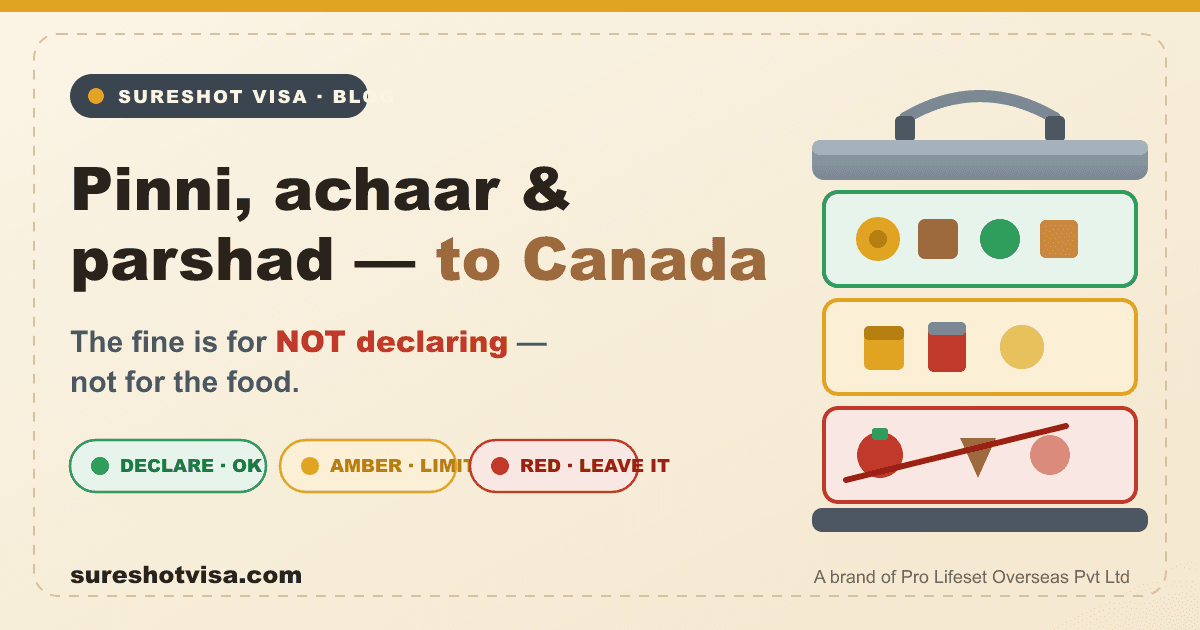
Pinni, Achaar & Parshad to Canada: What You Can Actually Pack (2026)
Yes, you can carry many Indian foods to Canada — but the fine is for NOT declaring, not for the food. The green / amber / red guide to packing your maa-ke-haath sweets without a CA$1,300 surprise.
Read guide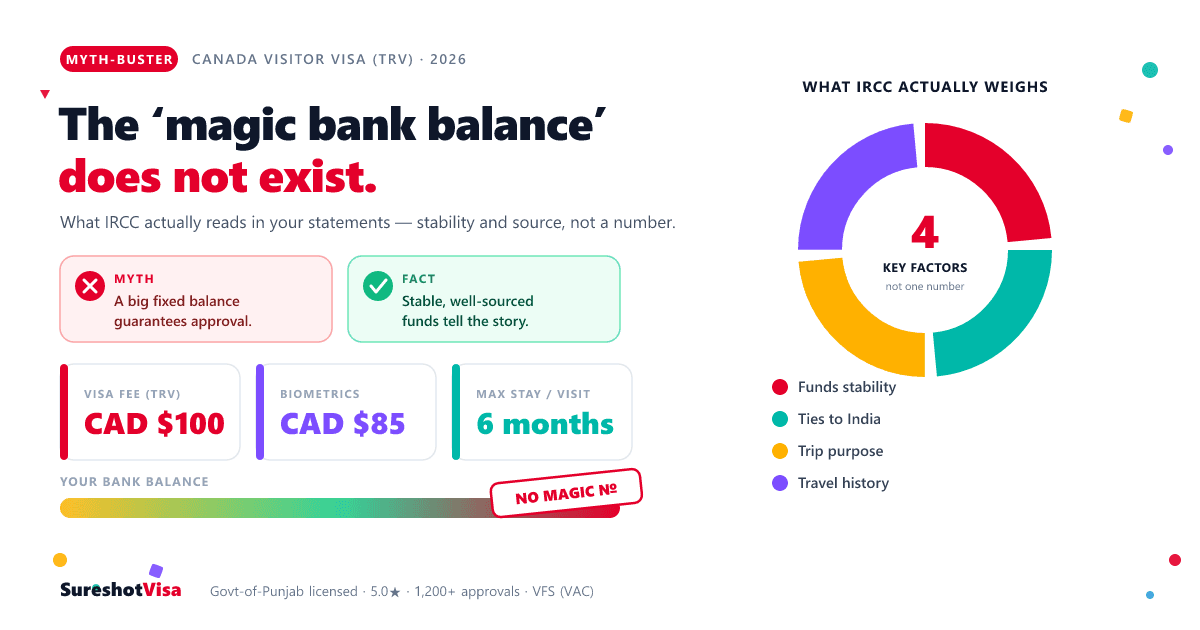
Canada Visitor Visa Bank Balance Myths, Busted (2026)
There is no magic bank balance number for a Canada visitor visa. Six myths against what IRCC officers actually read in your six-month statements.
Read guide
Canada Visitor Visa Refused? The Honest 2026 Reapply Guide for Indians
Your Canada visitor visa was refused. Now what? A clear, India-first 2026 guide to reading your refusal, getting GCMS notes, and deciding whether to reapply, request reconsideration, or seek judicial review.
Read guide