One Name, No Surname on Your Passport? How to Apply for Any Visa (2026)
Last reviewed: 10 September 2026 · Verified against current VFS Global India fees
A blank surname field on an Indian passport confuses almost every visa form. Here is exactly how single-name (mononym) applicants handle US, Canada, UK and Schengen applications — and the one rule that actually matters.

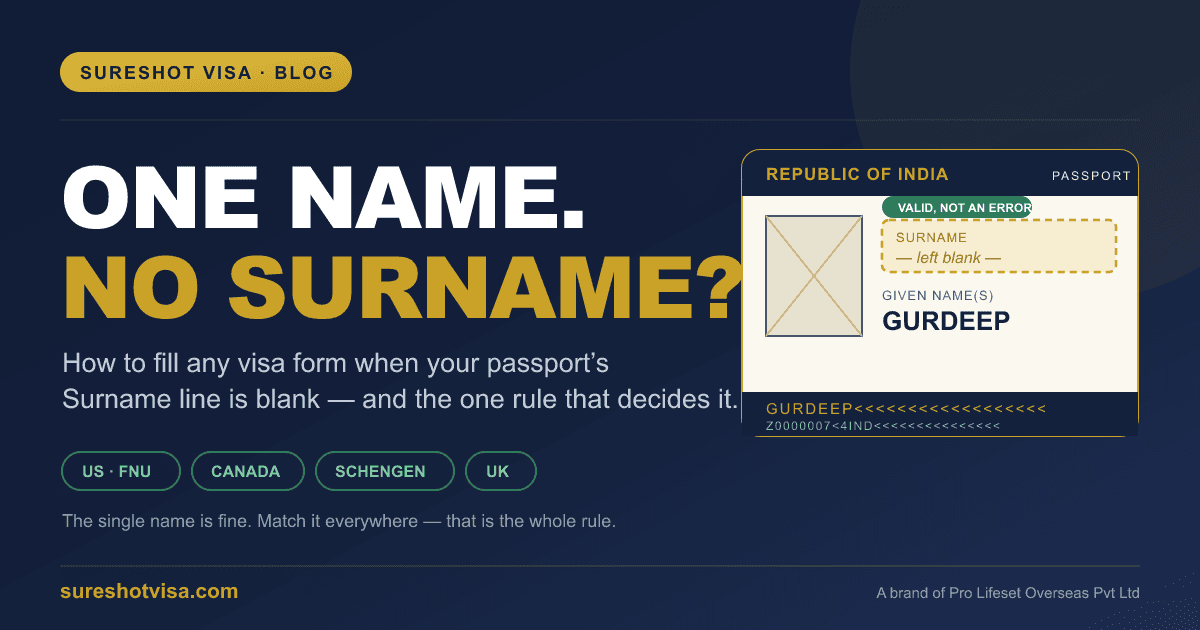
Passport names · Single-name / mononym holders · 2026
One name. No surname. And a visa form that demands two.
Open an Indian passport where the Surname line is blank, start an online visa form, and the whole thing turns hostile: it insists on a given name and a surname, and you have exactly one name for both. Take a breath. This is common, it is completely valid, and there is a calm, correct way to handle it for the US, Canada, the UK and Schengen.
The one thing to hold on to: your single name is never the problem. The only thing that causes trouble is that name being spelled or split differently across your passport, your form and your ticket.A blank surname line is valid — not a glitch
Across Punjab and much of South India, plenty of people carry a single name — one word that is the entire legal name.
The Indian passport system allows exactly this. When someone has one name, the Surname field is simply left blank and the name is printed on the Given Name(s) line. It is a recognised, valid passport, issued deliberately that way — not an error, not something a clerk forgot to fill. No embassy, consulate or immigration office treats a single-name passport as a defect; they are issued and accepted routinely.
So where does the panic come from? From the forms. Almost every online visa system was built to require two separate name boxes — a given name and a surname — because most of the world files names that way. Give it one name and it throws a red error, refuses to submit, or forces you to guess. That guess is the only real risk, and it is entirely manageable once you see how the pieces fit together.
Your one name, mapped into a two-field form
The passport is the master copy. Whatever line your name sits on, the form copies it there — the empty box is the one you handle by the system's rule.
Match the passport line for line · handle the empty box by each system's rule · never invent a second name
That is the whole trick, in one picture. The name goes where your passport prints it. The other box — the one your passport leaves empty — is the only thing that changes from country to country, and every system has a settled way to deal with it.
A single name is a solved problem for machines
Before you worry about web forms, it helps to know that the systems that actually matter at a border already handle single names perfectly. Look at the bottom of any passport data page: that band of capital letters and < chevrons is the machine-readable zone (MRZ). Scanners at immigration and inside airline systems read that, not the pretty page above it.
The MRZ stores your name as two parts — a primary identifier (the family name / surname) and a secondary identifier (given names) — separated by a double chevron <<. The single < characters are just fillers padding the line to a fixed length; they are not missing data. When you have one name, it fills a single identifier and the other is simply left empty. This is designed in: the international passport standard specifically provides for people with one name.
The name line, decoded
Same format for everyone — the double chevron marks where the surname ends and given names begin.
Worth knowing: the machine zone and the printed page do not always place a one-name person on the same line. That is exactly why you copy your name from what is printed on your passport, field by field — never from a rule you read online. At the counter, the scanner has no trouble with you at all. The friction lives only in human-facing web forms that were built to demand two boxes.
How each country expects you to enter it
Same principle everywhere — put the name on the line the passport uses, and manage the empty box — but each system phrases its rule a little differently. Here is the settled handling for the four applications Indian travellers file most. Scroll the table sideways on a phone.
| System | Where your one name goes | The empty field | Keep in mind |
|---|---|---|---|
| United StatesDS-160 | On the line the passport prints it — exactly as shown. | Where the given-name line is empty, the common convention is the placeholder FNU ("First Name Unknown"), or repeating your name. Follow the DS-160 help text. | FNU is normal and expected — it does not mean anything is wrong. Keep it identical to your passport and ticket. |
| CanadaIRCC | Enter your name exactly as printed on the passport. | If a name field is blank on your passport, leave it blank on the form — IRCC has guidance for single-name applicants. | Mirror the document. Do not add or split anything IRCC hasn't seen on the passport. |
| SchengenUniform form | Generally the single name in "Surname (Family name)", field 1. | The "First name(s)" box is commonly left blank, or filled per the form's instructions. | Consulates follow national guidance — check the specific country's form help before you submit. |
| United KingdomOnline visa | Enter your one name in the field the form directs; the service has a note for no-surname applicants. | The other box may take the same name or be left blank per the on-screen guidance. | Keep it identical to your passport and to any eVisa / share-code spelling. |
Systems and their help text change, and the wording can differ by consulate and by year. Treat the table as the direction to look, not gospel — the safe move is always to read the specific form's own guidance for single-name / no-surname applicants, and to make every entry match your passport. When in doubt, we fill these fields for people every week and can do it with you.
One spelling, everywhere — that is the whole game
Forget the folklore. The single non-negotiable rule for a one-name applicant is consistency: your name must read identically across every document in the file.
A refusal or a delay almost never comes from the single name itself. It comes from the name appearing one way on the passport, a slightly different way on the visa form, and a third way on the air ticket. Make all of them agree, character for character, and the mononym stops being a story at all.
the passport is the master · everything else copies it exactly
The single-name consistency checklist
- Passport data page is the master. Every other document copies it, letter for letter — same name, same field, same spelling.
- Visa form matches the passport line. Name on the line it is printed; handle the empty box by the system's rule (see the table above).
- Air ticket / PNR reads as the passport does. Airlines sometimes duplicate the name or add a placeholder in their own system — but what shows on your ticket should match your passport. A mismatch here is a boarding problem, not only a visa one.
- Bank statements, ITRs, invitation letter and hotel bookings all carry the one exact spelling — no variations.
- No "helpful" additions. Don't expand one name into two, don't add a middle name, don't invent initials the passport doesn't show.
Below are the three mismatches we actually see cause trouble — and the calm fix for each.
✗ Ticket booked with a made-up surname
Someone splits the one name into a "first" and "last" just to get past the airline form. Now the ticket and passport disagree.✓ Book to match the passport
Enter the name as the airline system best allows to mirror your passport; if it forces two fields, follow the carrier's stated method rather than inventing a name.✗ Two visa forms, two different splits
A US form gets one arrangement, a Schengen form another, and the story stops matching across applications and documents.✓ One decision, applied everywhere
Decide the handling once — anchored to the passport — and repeat it identically on every form and every supporting document.✗ New passport mid-process
A freshly split name lands while an application, a ticket and bank proof still carry the old single name.✓ Change on your own timeline
If you must split the name, do it when nothing is in flight — then re-align every downstream document to the new passport before you file.Thinking of splitting your name on a new passport?
You can. When you renew or reissue a passport, you can request that your name be recorded with a separate given name and surname, and some families do exactly this so forms stop fighting them. It is a legitimate option — but the timing matters more than people expect.
If you already have a visa application in progress, a ticket booked, and bank statements and an invitation letter carrying your current single name, a freshly split name creates the very mismatch this whole page warns against. Changing your name is a project of its own — new passport first, then patiently re-aligning every downstream document to it.
If a trip is near, the calmer path is almost always to travel on the name you already have and handle any split later, on your own timeline. The fix for "the form won't accept my name" is correct field handling, not a rushed new passport. Get advice before you change anything — a change made to solve a form problem can quietly create three new ones.
None of this makes a single name a barrier to any visa. It is not. A mononym holder can get a US, Canada, UK, Schengen or any other visitor, tourist or study visa like anyone else. It simply needs the name entered correctly on two-field forms and kept identical across the file — which is ordinary, everyday work. If you'd rather not wrestle the forms yourself, our document guides walk through the paperwork, and you can hand the whole file to us.
Single-name visa FAQs, answered straight
Is a passport with no surname valid for a visa?
Yes, entirely. A blank surname is a legitimate Indian passport, not an error, and single-name applicants get every kind of visitor, tourist and study visa. The only thing you manage is how the one name is entered on two-field forms, and keeping it identical across all your documents.
The visa form won't let me leave the surname blank. What do I put?
Follow that form's own help text — systems differ. Some accept the single name in one field with the other left blank; the US convention often uses the placeholder "FNU" or repeats the name; IRCC records it exactly as printed on the passport. Whatever you enter, it must match your passport and your ticket.
What does FNU mean on a US visa?
FNU stands for "First Name Unknown." US systems use it as a placeholder in the given-name field when a passport carries the name on the surname line with no given name. It is standard, expected, and does not mean anything is wrong with your name.
My air ticket needs a first and last name but my passport has one. What do I do?
Match the passport as closely as the airline system allows. Carriers sometimes duplicate the name or add a placeholder in their booking system, but the goal is that your ticket reads as your passport does, so check-in, boarding and immigration all line up. Don't invent a surname that isn't on the passport.
Should I get my name split into first and last on a new passport?
You can request it on reissue, but avoid changing it in the middle of a live application or a booked trip — a new split name can clash with documents already made in your single name. If you want the split, do it when nothing is in flight, then re-align every document. Get advice first.
Can SureshotVisa handle a single-name visa file?
Yes. Field-by-field name handling and document consistency are part of every file we prepare — for the US, Canada, UK, Schengen and more. We make sure your one name is entered correctly on each form and reads identically across the whole file, so your single name isn't what trips up the application.
Let us fill the name fields — and check the whole file for one clean spelling.
SureshotVisa is a Government-of-Punjab licensed consultancy (Lic. No. 849/DC/PTA/PLA/LC-3/2024). For ₹499 we review your complete profile — passport, forms, ticket, funds, ties, documents — and give you a written visa-possibility report with an honest Yes / Maybe / No, plus the exact field handling for your single name across every application. Refundable, and credited in full to any service.
+91 97803 01303Prefer WhatsApp? The green button at the bottom of your screen reaches the same desk.
Notes on sources. Filed 08 July 2026. Name-field handling reflects the published guidance and form help text of the US Department of State (DS-160), IRCC (Canada), the Schengen uniform application form, UK Visas and Immigration, and the machine-readable-zone conventions of the ICAO travel-document standard (Doc 9303) as of the publication date. Form wording and single-name conventions differ by system, consulate and year and change without notice — verify the current help text for your specific application, and confirm airline name rules with your carrier, before you rely on any entry.
This article is for information only and does not guarantee a visa. Every application is assessed on its own merits, and decisions rest solely with the relevant authority.
© 2026 Sureshot Visa · A brand of Pro Lifeset Overseas Pvt Ltd · Patiala, Punjab
Need help?
We'll handle your visa file end-to-end.
Documents, VFS slots, embassy filing — by a licensed consultant.
We answer within 5 minutes

Written by
Rohit GirDocumentation & Financial Profile Support · M.Com (2022)
Rohit Gir supports the team with document review, financial-profile organisation and applicant communication. He helps ensure that income proof, bank statements, business documents, salary records and supporting evidence are presented clearly and consistently.
Full profileRelated Guides

No Objection Certificate (NOC) for a Visa — What It Must Say, and What Ruins It
One page from your employer quietly answers the officer's biggest question: will this person come back? Most NOCs answer the opposite. The four facts it must contain, the layout, and the five things that break it.
Read guide
Does a UK Invitation Letter Need an Apostille? No — Here's What It Actually Needs
There is no UKVI requirement to apostille or notarise a visitor invitation letter, and chasing one costs weeks you may not have. What the letter must contain, when legalisation genuinely applies, and why the letter is not what decides your case.
Read guide
Switzerland Visitor Visa Cost from India 2026 — Every Rupee, Honestly
The €90 fee is the small part. Here is the real all-in cost of a Switzerland Schengen visa from India — and the far larger number that only has to sit in your account, not leave it.
Read guide
Culturally Arranged Marriage Visa for New Zealand — The 2026 Guide for Indian Families
New Zealand has a visa built for arranged marriages, and most families never hear about it. The three-month rule that cuts both ways, the evidence that actually decides your case, and why letters from your own family are not enough.
Read guide