Switzerland Visitor Visa Cost from India 2026 — Every Rupee, Honestly
The €90 fee is the small part. Here is the real all-in cost of a Switzerland Schengen visa from India — and the far larger number that only has to sit in your account, not leave it.

Last reviewed: 10 September 2026 · Verified against official embassy and visa-centre sources

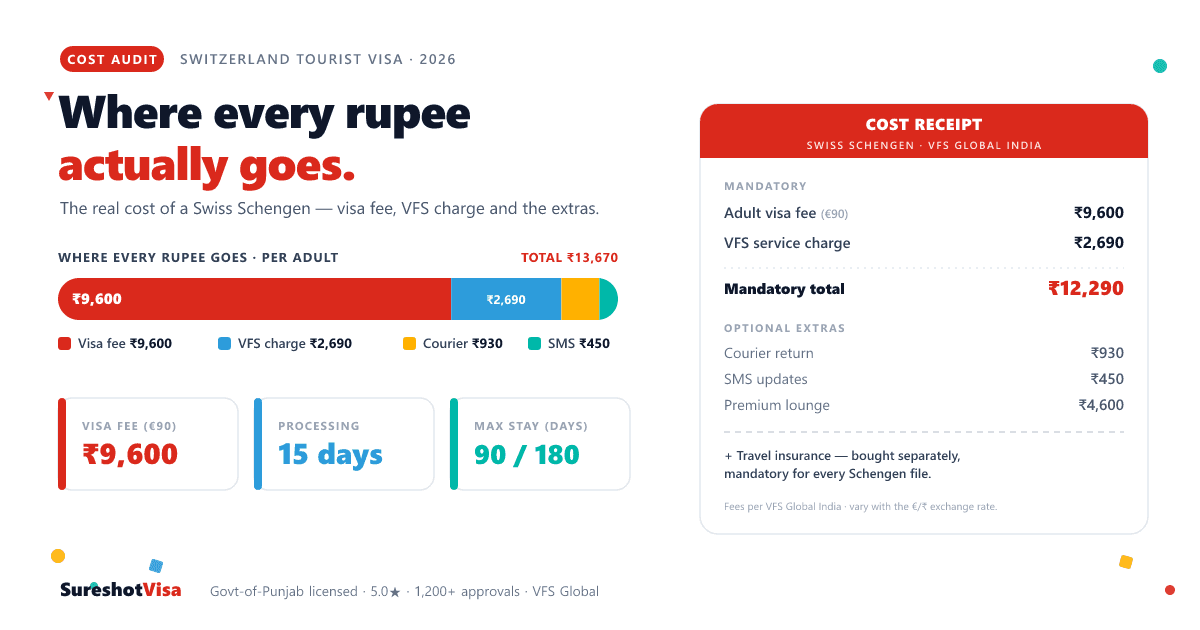
Search "Switzerland visa fee" and you get one number: €90. Then you apply, and discover the service charge, the insurance, the photographs, the courier, and the trip to the visa centre. None of it is hidden — it is just never added up in one place.
So here is the honest total, split into two piles that people constantly confuse: money you spend, which is gone whatever the decision, and money you show, which stays in your own bank account and is simply evidence that you can afford the trip.
What you actually spend
These are real, non-refundable costs. If your visa is refused, this money does not come back — which is precisely why the file needs to be right the first time.
Two of those lines are fixed and identical whoever files your application: the €90 and the VFS charge. Nobody can discount them, and any agent who says they can is describing something that is not happening.
Children cost less — sometimes nothing
The VFS service charge and insurance still apply to children, so "free" applies to the embassy fee only. For a family of four with two small children, the saving is real but smaller than it first looks.
The fee is fixed. The refusal is not. Almost everything that decides your case costs nothing to get right.
The number that is not a cost at all
Here is where most families get needlessly frightened. Switzerland, like every Schengen state, wants to see that you can fund your own trip. That is a bank balance you show — not a fee, not a deposit, not money anyone takes from you.
How much you need to show depends on your trip length, whether accommodation is paid, and whether anyone is sponsoring you. There is no single magic figure, and any agent quoting one without asking how long you are going for is guessing. What matters far more than the amount is that the money looks genuine: sitting there for months, consistent with your income, not deposited in a lump the week before you applied.
Where the money is actually wasted
Not on the fee. On refusals — because every rupee above is spent again on the next attempt, and the second application starts from a worse position than the first.
Frequently asked questions
Is the €90 fee refunded if my visa is refused?
No. The Schengen visa fee pays for the processing of your application, not for a successful outcome — so it is consumed the moment your file is assessed, whichever way the decision goes. The VFS service charge is not refunded either, and neither is your insurance premium once issued.
This is exactly why the honest way to think about a refusal is not "I lost ₹9,900" but "I lost roughly ₹13,500 and I now have a refusal on my travel record that makes the next application harder." The second half of that sentence is the expensive part.
How much bank balance do I need for a Switzerland visa?
There is no single published figure, and be sceptical of anyone who gives you one without asking a question first. What you must demonstrate is that you can fund your specific trip — which depends on how many days you are travelling, whether your hotels and flights are already paid, whether you are staying with family, and whether someone in Switzerland is sponsoring part of the cost.
Far more important than the total is the shape of the money. A balance that has grown steadily and matches your declared income is convincing. The same amount deposited in one transfer ten days before you applied is the single most common reason a financially comfortable applicant gets refused. Show six months of history, and be able to explain any unusual credit in it.
Can I use any travel insurance, or does it have to be a specific one?
Any insurer is fine as long as the policy meets the Schengen rule: minimum €30,000 of medical cover, valid throughout the entire Schengen area, and covering your whole stay including repatriation. That is the standard, and it is the same for every Schengen country.
The mistakes we see are small and avoidable. A policy that starts on your arrival date but ends the day before your return flight leaves a gap. A corporate policy with a lower cover limit. A policy in a family member's name rather than the traveller's. Buy it for a couple of days wider than your stated travel dates and read the cover figure before paying — the difference in premium is negligible and the difference in outcome is not.
Is Switzerland harder than other Schengen countries?
The rules are the same — Switzerland applies the common Schengen code, the fee is identical, and the documentation is broadly standard. What differs between countries is appointment availability and how busy a particular mission is in a given season, and that changes month to month rather than being a fixed property of the country.
The more useful question is which country you should be applying to at all. Schengen rules say you apply to the country of your main destination — where you will spend the most nights — or, if the trip is evenly split, your point of first entry. Choosing a country because its appointments look easier, when you plan to spend most of your trip elsewhere, is a well-known pattern that officers recognise and it damages otherwise good applications.
Does paying more get me a faster or safer decision?
No. The embassy fee is fixed and buys processing, not priority. Some visa centres sell optional convenience services — premium lounges, courier returns, form-filling help — and those genuinely make your visit more comfortable, but they have no bearing whatsoever on the officer's decision or on how quickly it is made.
What actually shortens your timeline is applying early enough that appointment availability is not your bottleneck, and submitting a file so complete that nobody has to write to you asking for a missing document. A request for further information can add weeks. Preventing one is free.
Want the exact number for your trip?
Tell us your travel dates, how many people are going and where you are staying. We will give you the real all-in figure — government fees at cost, our fee stated separately — before you commit to anything.
Fees quoted are the published Schengen consular fee and typical Indian visa-centre service charges at the time of writing; INR equivalents move with the exchange rate and centre charges vary by mission. Confirm current figures before you apply, or ask us to check them for your case. SureshotVisa prepares and files applications — visa decisions rest entirely with the mission.
Need help?
We'll handle your visa file end-to-end.
Documents, VFS slots, embassy filing — by a consultant at our licensed firm.
No obligation · A consultant at our licensed firm replies today
We answer within 5 minutes
Full Country Guide


Written by
Sherbir Singh GrewalDirector, Pro Lifeset Overseas Pvt Ltd · B.Tech, Information Technology (2007)
Sherbir Singh Grewal supports applicants across visa-file preparation, document organisation and case coordination. His approach is practical: understand the applicant's real situation first, then build the documents around a consistent, believable story.
Full profile