Pinni, Achaar & Parshad to Canada: What You Can Actually Pack (2026)
Last reviewed: 15 July 2026 · Verified against current VFS Global India fees
Yes, you can carry many Indian foods to Canada — but the fine is for NOT declaring, not for the food. The green / amber / red guide to packing your maa-ke-haath sweets without a CA$1,300 surprise.

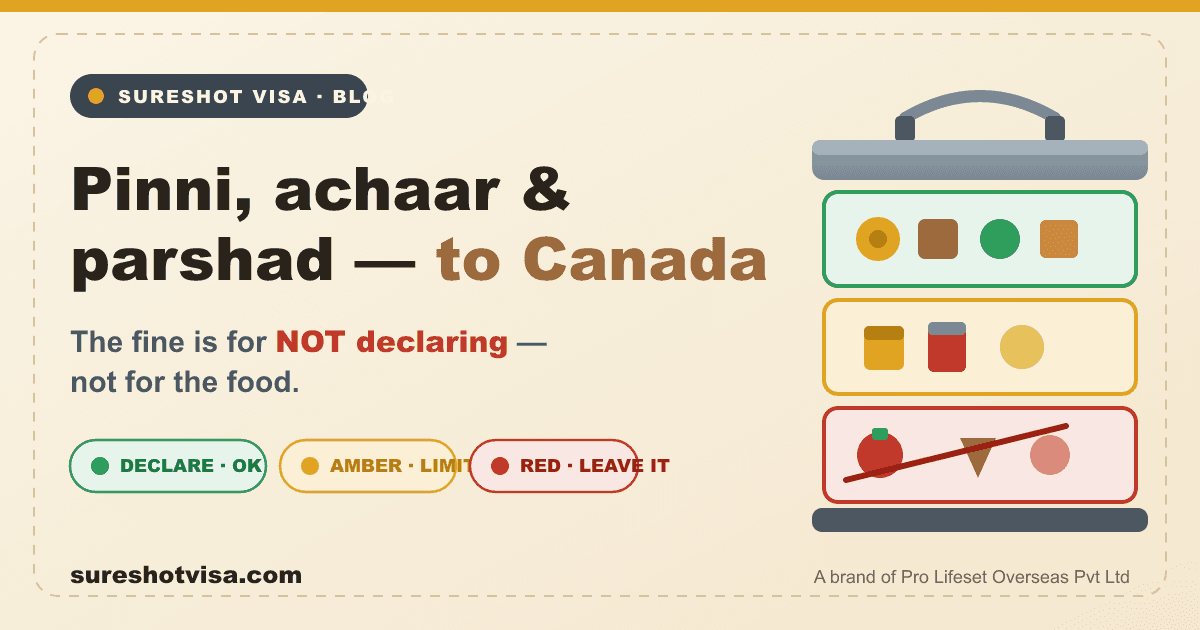
Visiting the kids · Canada · CBSA / CFIA · 2026
Pinni, achaar & parshad to Canada: what you can actually pack.
Every mother packing for Toronto or Surrey asks the same question at the last minute — will they take away my pinni? The honest answer surprises most people, and it is worth reading before you tape that box shut.
Short answer: you can carry many Indian foods. The fine is for not declaring — not for the food itself.Declare everything. That single habit is the whole game.
The box of ghee-soaked pinni your mother pressed into your suitcase is probably fine. What gets people fined is trying to hide it.
When you land in Canada, the border agency (CBSA) and the food-and-plant regulator (CFIA) ask you to declare every food, plant and animal product you are carrying — on the arrival kiosk, the declaration card, or verbally if an officer asks. This is not a suggestion. It is the golden rule, and everything else in this guide sits underneath it.
Here is the part almost nobody understands until it is too late: the monetary penalty is for failing to declare, not for the food. Even a food that would have been waved through can trigger a fine — commonly cited at around CA$1,300 or more — if it is found undeclared in your bags. Declare the same item honestly and the worst case is simply that the officer keeps it. No fine. No note against your name.
Read those two lanes again. The difference between keeping your food and paying a five-figure-rupee fine is one honest tick on a form. That is the entire message of this page — the rest is just knowing what usually clears and what usually does not, so you pack light and declare with confidence.
The tiffin, unpacked into three zones
Picture your steel tiffin opened on the customs bench. Sort everything inside it into three trays before you even reach the airport — green travels well, amber travels with conditions, red is better left in Patiala.
The three-tray tiffin
Everything must still be declared — even the green tray.
✓ Green & amber can ride along — you just declare them. Red is the tray that ruins a trip.
Twelve foods, sorted by colour
These are the items that fill every visiting-parent's suitcase. Colours are a practical guide, not a promise — the officer at the desk always has the final say, and rules shift with the item, its origin and quantity. When in doubt, keep it sealed, keep it labelled, and declare it.
Packaged pinni
GreenCommercially sealed, shelf-stable, vegetarian. A sweet like this is generally low-risk — sealed and declared, it usually travels.
Packaged mithai & sweets
GreenShelf-stable, factory-sealed boxes fare best. Milk-heavy fresh sweets are riskier — see the dairy card.
Namkeen & packaged snacks
GreenSealed, labelled vegetarian snacks in personal quantities are generally among the easiest items to bring.
Whole & ground spices
GreenDried, packaged masalas are typically fine. Still declare them — spices count as a food product too.
Tea, sealed
GreenPackaged tea is generally low-risk. Loose, unlabelled tea in a plastic bag invites questions, so keep the box.
Sealed commercial ghee
AmberFactory-sealed, labelled ghee in a small personal amount is usually lower-risk — but it is dairy-derived, so quantity limits can apply. Declare it.
Sealed commercial pickle
AmberVegetarian achaar in a sealed, labelled jar in a small amount is usually acceptable. Oil-heavy and no meat is the safer choice.
Dairy items
AmberMany dairy products face limits and several are restricted. Sealed and small has the best chance; fresh paneer or milk sweets often do not clear.
Homemade pickle / achaar
RedNo label, no commercial packaging — the hardest to assess and often refused. Painful, we know. Buy a sealed jar there instead.
Fresh fruit & vegetables
RedFresh produce is commonly restricted or prohibited for pest and disease reasons. Leave the mangoes and the methi at home.
Meat & poultry
RedMeat and poultry products — including many with meat masala or non-veg fillings — are frequently prohibited. This is the highest-risk tray.
Seeds & live plants
RedSeeds, saplings and live plants are tightly controlled. Even ajwain or methi seeds meant for planting can be refused. Don't risk it.
These colours are guidance built on published CBSA and CFIA rules — not guarantees. The exact outcome depends on the item, its country of origin and the quantity, and the rules change. Before you pack anything you are unsure about, check CFIA's AIRS tool or CBSA guidance, or ask us.
The five-line packing checklist
Do these five things and you turn a stressful bag-check into a thirty-second formality. Treat it like a boarding ritual — tick each line before you close the suitcase.
Before you tape the box shut
CBSA / CFIAKeep the labels intact. An officer can read a sealed, labelled jar in seconds. A mystery packet in cling film takes far longer and is easier to refuse.
Choose commercial packaging. Where you can, pick the factory-sealed version over the homemade one — it is the single biggest thing that moves an item from red toward green.
Keep the receipts. A shop bill shows the item is commercial and shows the quantity. Tuck them into the same bag as the food.
Declare on the form — and out loud. Tick "food" on the arrival declaration, and if an officer asks, say yes. Declaring is what keeps a fine off the table entirely.
Check AIRS before you pack. For anything on the amber or red trays, look it up in CFIA's Automated Import Reference System first. Two minutes now saves a seizure later.
Notice that none of these tips is about smuggling anything cleverly. They are all about making an honest declaration easy to approve. That is the mindset that gets your mother's ghee to your kitchen in Brampton.
Carrying Indian food to Canada, answered straight
Can I bring homemade pinni or ladoo to Canada?
You can try, and you must declare it. Commercially packaged, shelf-stable, vegetarian sweets are generally lower-risk and often clear. Purely homemade, unlabelled versions are harder for an officer to assess and may be refused — but declaring them is always safe. Hiding them is what creates a penalty.
Is the CA$1,300 fine for carrying food, or for something else?
For not declaring it. The penalty — commonly cited at roughly CA$1,300 or more — applies to undeclared food, plant or animal products, even ones that would have been allowed. Declare the same item and the worst outcome is that the officer keeps it, with no fine.
What happens if I declare a food that turns out not to be allowed?
The officer simply takes it. You surrender the item and walk on — no fine, no record. That is the whole reason declaring always beats hiding: honesty caps your worst case at losing the food.
Can I carry sealed ghee and pickle?
Commercial, sealed, vegetarian ghee and pickle in small personal quantities are usually lower-risk, but they must be declared and can face quantity limits. Homemade versions without labels are riskier and may be refused. When possible, carry the factory-sealed jar and keep the receipt.
What should I simply leave at home?
Fresh fruit and vegetables, meat and poultry products, most fresh dairy, and any seeds or live plants. These are commonly restricted or prohibited and rarely worth the space. Buy them fresh in Canada instead.
Where do I check the current rule for a specific item?
Use CFIA's AIRS (Automated Import Reference System) and CBSA's traveller guidance before you pack. Rules depend on the item, its origin and quantity, and they change — so verify rather than rely on what worked for a relative last year.
Does any of this affect my visitor visa?
A declared item that gets refused at the border has no bearing on your visa. Deliberately hiding goods is a different matter and best avoided entirely. Your visa is decided before you fly, so get that part right first — our Canada visitor visa from India guide covers documents, funds and ties. This page is only about a smooth arrival once you land.
Get the Canada visitor-visa file right, then pack the pinni.
Sureshot Visa is a Government-of-Punjab licensed consultancy (Lic. No. 849/DC/PTA/PLA/LC-3/2024). For ₹499 we review your full profile — purpose, funds, ties, documents — and hand you a written visa-possibility report with an honest Yes / Maybe / No and the exact fixes, before you spend embassy fees. Refundable, and credited in full to any service.
+91 91155 80911Prefer WhatsApp? The green button at the bottom of your screen reaches the same desk.
Notes on sources. Filed 08 July 2026. Food, plant and animal import rules reflect published guidance from the Canada Border Services Agency (CBSA) and the Canadian Food Inspection Agency (CFIA), including the CFIA Automated Import Reference System (AIRS), as of the publication date. The penalty figure is a commonly cited amount for undeclared products and can be higher. Rules depend on the exact item, its country of origin and quantity, and they change without notice — verify the current rule in CFIA's AIRS and CBSA traveller guidance before you rely on it, or ask us.
This article is for information only and does not guarantee a visa. Every application is assessed on its own merits, and decisions rest solely with the relevant authority.
© 2026 Sureshot Visa · A brand of Pro Lifeset Overseas Pvt Ltd · Patiala, Punjab
Need help?
We'll handle your visa file end-to-end.
Documents, VFS slots, embassy filing — by a licensed consultant.
We answer within 5 minutes
Full Country Guide
Canada Visa from India — fees, documents, processing time
Everything you need on one page: VFS centres, visa types, fee breakdown, doc checklist.

Written by
Narinder ChahalFounder, SureshotVisa · B.Tech, Computer Science (2008)
Narinder Chahal founded SureshotVisa with a simple belief: a visa file should be clear, honest and backed by strong documents. After moving to Canada in 2014, he has helped Indian and international applicants understand visa filing, refusal concerns, document gaps and immigration-related issues.
Full profileRelated Guides

Canada Tourist Visa Show Money from India: Requirements
Learn how much show money you need for a Canada tourist visa from India, whose name it should be in, and how long funds must remain in your account.
Read guide
Can You Take Your Dog to Canada from India? The 2026 Pet Guide
Yes — your dog can come to Canada, and the paperwork is simpler than you fear. The one document CFIA cares about, the airline choice that trips people up, and the timeline to start now.
Read guide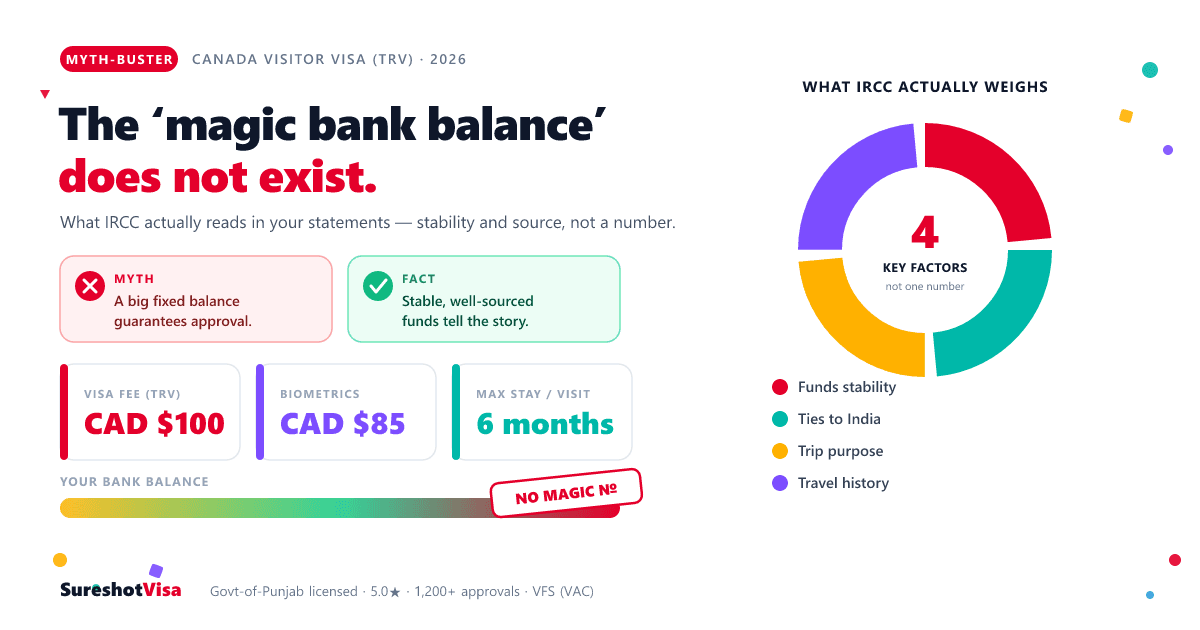
Canada Visitor Visa Bank Balance Myths, Busted (2026)
There is no magic bank balance number for a Canada visitor visa. Six myths against what IRCC officers actually read in your six-month statements.
Read guide
Canada Visitor Visa Refused? The Honest 2026 Reapply Guide for Indians
Your Canada visitor visa was refused. Now what? A clear, India-first 2026 guide to reading your refusal, getting GCMS notes, and deciding whether to reapply, request reconsideration, or seek judicial review.
Read guide