Refused? It's not the end of your Canada trip.
Last reviewed: 15 July 2026 · Verified against current VFS Global India fees
Your Canada visitor visa was refused. Now what? A clear, India-first 2026 guide to reading your refusal, getting GCMS notes, and deciding whether to reapply, request reconsideration, or seek judicial review.

Picture the email. Three short paragraphs, one regulation number, and a sentence that begins "I am not satisfied." No phone call, no explanation, no second chance offered. For a tourist visa to visit your daughter in Brampton or attend a cousin's wedding in Calgary, that one line can undo months of planning. The instinct is to immediately upload the same documents and hit submit again. That instinct is exactly how people collect their second and third refusals.
The good news: a Canada visitor visa refusal is almost never about you being banned. It's about an officer not being convinced. Convincing them is a fixable problem — but only if you first understand what they actually decided. Let's walk through it.
Half of all visitor visas are now refused. You are not unlucky — you're average.
This matters because it reframes the problem. A refusal in 2026 doesn't mean your file was uniquely bad. It means Canada's bar moved, and a file that would have sailed through in 2022 now gets a hard "no."
Canada visitor visa (TRV) approval rate — the trend
Meet IRPR 179(b) — the line that decides your file
Open your refusal letter. Somewhere in it is a reference to paragraph 179(b) of the Immigration and Refugee Protection Regulations. IRCC itself confirms the vast majority of visitor refusals come down to this single test.
"I am not satisfied that you will leave Canada at the end of your stay as required by paragraph 179(b)…"
Read that carefully. The officer isn't saying you lied or that your documents are fake. They're saying they don't believe you'll come home. The entire burden is on you to prove you will — not on them to prove you won't. This is Canada's version of the US 214(b) standard.
The letter then lists "factors." These are deliberately generic, and they almost never tell you which one actually killed the file. Here's what each phrase really means:
- "Travel history" — you haven't travelled abroad enough for them to trust you'll return.
- "Family ties in Canada and country of residence" — your family in Canada is seen as a stronger magnet than your ties in India.
- "Purpose of visit" — they don't buy your stated reason, or don't think it justifies the length of stay.
- "Personal assets and financial status" — weak roots in India: no property, business, or savings to pull you back.
- "Current employment situation" — your job doesn't look stable enough to compel a return.
- "Limited employment prospects" — the most damaging. It means the officer thinks you have nothing to come back to.
The refusal code cheat-sheet
Different code, different fix. Match the code in your letter to the officer's underlying concern before you do anything else.
| Code | What it means | The officer's real worry |
|---|---|---|
| R179(b) | Temporary intent | You may not leave Canada after your stay |
| R183 | Financial requirements | Not enough funds to support the visit |
| A16(1) | Documentation | Insufficient or incomplete documents |
| R11(1) | Eligibility | Missing forms or required documents |
| A22(2) | Travel history | Poor compliance with previous visas |
| A40(1)(a) | Misrepresentation | Inaccurate or false information — the most serious |
Don't reapply blind. Get the officer's notes first.
The refusal letter is a summary. The officer's real reasoning lives in the GCMS notes (Global Case Management System) — line-by-line internal commentary on your funds, your ties, your credibility, and any system flags your file triggered. Reapplying without reading these is like rewriting an exam without knowing which questions you failed.
1 · File an ATIP request
GCMS notes are released through an Access to Information and Privacy (ATIP) request to IRCC.
2 · Who can file it
Must be filed by a Canadian citizen, permanent resident, or someone physically in Canada — using consent form IMM 5744, your passport copy, and your application number. A relative in Canada, a licensed representative, or a paid ATIP service can do it for you.
3 · Wait ~30 days
Notes arrive as a PDF, typically in about a month (delays happen in busy periods).
4 · Fix every concern — not just the obvious one
GCMS notes usually list multiple worries. The classic mistake is fixing the loudest one and ignoring the rest. Address them all.
You have exactly three options. Picking the wrong one wastes months.
A visitor visa refusal has no formal appeal — there's no hearing at the Immigration Appeal Division like there is for some PR and sponsorship cases. Your three real choices are below.
Reapply
A brand-new application that directly fixes the weaknesses. Right when the refusal was about weak evidence — thin funds, unexplained deposits, weak home ties, or missing documents.
Only works if you bring new, materially stronger evidence. Same file = same result.
Fastest legitimate routeReconsideration request
A written submission asking IRCC to reopen the same file. Strongest when there's a clear factual error — e.g. your statements clearly showed enough funds but the letter says "insufficient."
It's discretionary — the officer isn't obligated to reopen. Works for overlooked evidence, not "you weighed it wrong."
No guarantee · discretionaryJudicial review
The only true legal challenge — at the Federal Court of Canada. The court doesn't re-weigh your evidence; it checks whether the decision was reasonable and fair.
Strict deadlines: 15 days if refused inside Canada, 60 days if outside. Only a Canadian immigration lawyer (not a consultant) can represent you here.
Complex · lawyer requiredHow to rebuild a file that actually flips the decision
"I added more documents" almost never works. Specific fixes do. Here's the structure that turns a refusal into an approval.
- Prove your funds are real and stable. Six-plus months of consistent balances — not a single fat deposit dropped in last week. Document the source of any large credit (sale deed, FD maturity, gift with relationship proof).
- Anchor yourself in India. Employer letter with sanctioned leave and a confirmed return date, property papers, a running business, dependent parents — concrete reasons the trip has to be temporary.
- Make the purpose specific and time-bound. Exact dates, a real itinerary, return flight intent, and a clear "I'm back by X because Y." Vague open-ended trips get refused.
- Handle "family in Canada" head-on. If a PR/citizen relative is your host, don't hide it — that's misrepresentation. Instead, over-prove your reasons to return and keep the visit short and dated.
- Disclose every past refusal. Canada, US, UK, Schengen, Australia — all of it. The system already knows. In your cover letter, briefly explain what's changed since the refusal.
- Get a second set of eyes before you submit. The person who built the refused file often can't see its blind spots. A structured review catches the gaps that cost you the first time.
5 mistakes that guarantee a second refusal
- Reapplying within days, same documents. Nothing changed for the officer, so nothing changes in the decision.
- Skipping the GCMS notes. You end up fixing a problem the officer never had, while ignoring the one they did.
- Switching visa type as a "workaround." Applying for a visitor visa right after a study permit refusal (or vice versa) doesn't reset anything — IRCC sees both, and the same 179(b) doubt carries over.
- Hiding a previous refusal. Misrepresentation under s.40 IRPA → potential 5-year ban. Never worth it.
- A single large "arranged" deposit. Unexplained money is read as borrowed-for-show, not as genuine savings.
Not sure which of the three paths is yours?
Send us your refusal letter on WhatsApp. We'll tell you — honestly — whether your file is worth reapplying, whether a GCMS request is your real first step, or whether you need a licensed Canadian lawyer for judicial review.
A plain-English read of your refusal and your realistic next move — no jargon, no false promises.
Frequently asked questions
Not in the formal sense. A visitor visa (TRV) refusal can't go to the Immigration Appeal Division — that's reserved for certain PR, sponsorship, and removal cases. Your real options are to reapply with stronger evidence, file a reconsideration request, or seek judicial review at the Federal Court.
Typically about 30 days after an ATIP request to IRCC, which costs CAD $5. The request must be filed by a Canadian citizen, PR, or someone physically in Canada — so most India-based applicants use a relative in Canada, a licensed representative, or a paid ATIP service.
There's no mandatory waiting period — you can reapply anytime unless your letter says otherwise. But the right time is when you've read your GCMS notes and genuinely fixed the weaknesses. Reapplying within days with the same file almost always fails again.
No. Government processing fees are non-refundable, and a fresh application means paying them again (plus biometrics, if required). That's exactly why you want the file to be genuinely stronger before resubmitting.
It can. Most visa forms — Canada, US, UK, Schengen, Australia — ask whether you've ever been refused anywhere. You must disclose it honestly. A past refusal isn't an automatic disqualifier, but failing to declare it is treated as misrepresentation.
No. A visitor visa is a discretionary decision made by an IRCC officer — no agent, consultant, or lawyer can guarantee it, and anyone who does should be a red flag. What a good consultant can do is materially strengthen your file and your odds. We focus on that, honestly.
Need help?
We'll handle your visa file end-to-end.
Documents, VFS slots, embassy filing — by a licensed consultant.
We answer within 5 minutes
Full Country Guide
Canada Visa from India — fees, documents, processing time
Everything you need on one page: VFS centres, visa types, fee breakdown, doc checklist.

Written by
Narinder ChahalFounder, SureshotVisa · B.Tech, Computer Science (2008)
Narinder Chahal founded SureshotVisa with a simple belief: a visa file should be clear, honest and backed by strong documents. After moving to Canada in 2014, he has helped Indian and international applicants understand visa filing, refusal concerns, document gaps and immigration-related issues.
Full profileRelated Guides

Canada Tourist Visa Show Money from India: Requirements
Learn how much show money you need for a Canada tourist visa from India, whose name it should be in, and how long funds must remain in your account.
Read guide
Can You Take Your Dog to Canada from India? The 2026 Pet Guide
Yes — your dog can come to Canada, and the paperwork is simpler than you fear. The one document CFIA cares about, the airline choice that trips people up, and the timeline to start now.
Read guide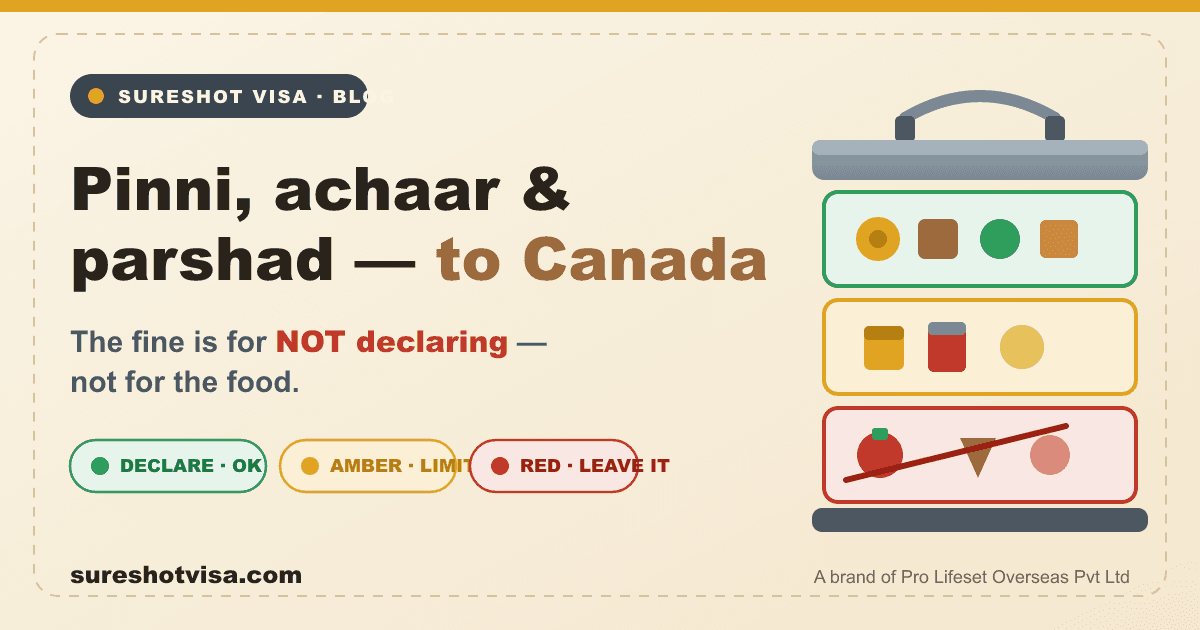
Pinni, Achaar & Parshad to Canada: What You Can Actually Pack (2026)
Yes, you can carry many Indian foods to Canada — but the fine is for NOT declaring, not for the food. The green / amber / red guide to packing your maa-ke-haath sweets without a CA$1,300 surprise.
Read guide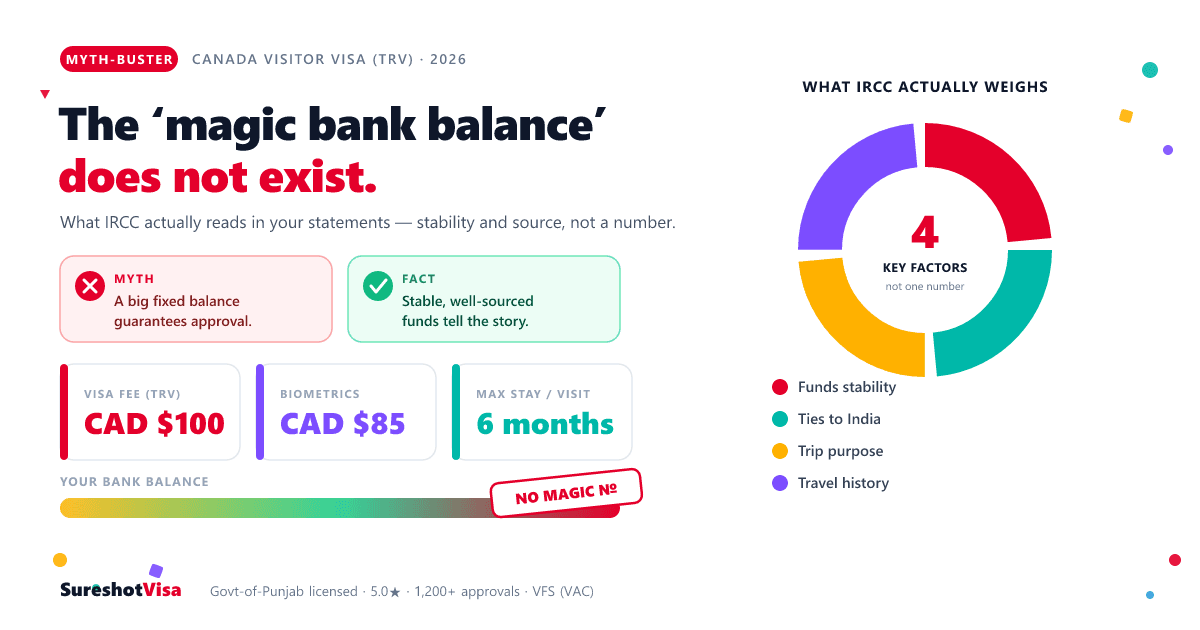
Canada Visitor Visa Bank Balance Myths, Busted (2026)
There is no magic bank balance number for a Canada visitor visa. Six myths against what IRCC officers actually read in your six-month statements.
Read guide