No Salary Slip? How Punjab’s Farmers Prove Income for a Schengen Visa (2026)
Last reviewed: 15 July 2026 · Verified against current VFS Global India fees
A farmer has no salary slip — and still gets the visa. Your J-form, fard, and harvest-season bank credits ARE your income proof. How to build a money story an officer trusts.

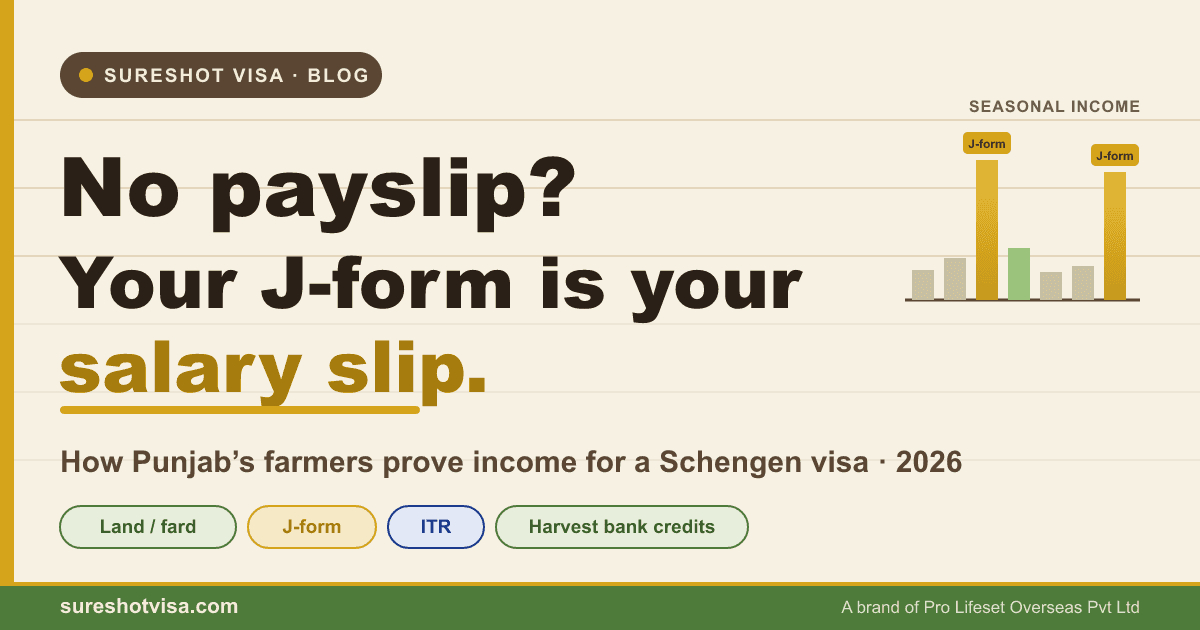
Schengen visa · Agricultural & self-employed income · 2026
No salary slip? Your J-form is your salary slip.
A farmer walks into our Patiala office already defeated — no payslip, no HR letter, sure the file is finished before it starts. It isn't. Land records, J-forms, mandi receipts, ITR and harvest-linked bank credits are a farmer's income proof, and a Schengen officer reads them every day. The trick is not to hide the way you earn. It is to explain it.
Short answer: a farmer proves income differently — and when the money story is coherent and sourced, an officer can read and trust it.A payslip is one kind of proof — not the only kind
Nobody in Malwa gets a monthly salary slip for growing wheat. That does not make you invisible to a consulate. It makes you self-employed — and consulates process self-employed applicants constantly.
Here is the thing the WhatsApp groups never explain. A Schengen consulate is not searching your file for the word "salary." Its financial test asks one plain question: can this person pay for this trip with money that is genuinely theirs? A salaried person answers that with a payslip and a salaried bank statement. A farmer answers it with land in their name, the J-forms from the mandi, the credits those sales put in the bank, and — the one that ties it all together — an income-tax return.
Different paperwork, same three answers. Once you see your documents as the farmer's translation of a salaried file rather than a poor substitute for one, the whole thing stops feeling like a weakness. In many ways a well-kept agricultural file is stronger than a salaried one, because land does something a payslip cannot — it anchors you to India.
Your farmer equivalent for every salaried document
Print this one and keep it in your file folder. For every document an employed applicant is expected to show, there is an agricultural equivalent that answers the same question. Match them one-for-one and nothing looks "missing."
Salaried document → your farmer equivalent
Same question answered, a different way of earning
Every gold arrow says the same thing: this answers the officer’s question, just in a farmer’s language.
Notice the fourth row does the heavy lifting. A salaried statement is easy to read because the credits are regular. Yours will not be — and that is fine, as long as every big credit carries its explanation with it. Which brings us to the shape of a farming bank statement.
Big at harvest, quiet between — and why that is normal
A salaried person’s statement is a gentle staircase: a similar credit on the same date every month. A farmer’s statement is not. It is flat for weeks, then a large deposit lands when the wheat is sold at the mandi, flat again, then another when the paddy goes. To an officer who has never farmed, an unexplained spike can read as staged money. The fix is not to hide the spike or smooth it out. The fix is to walk the J-form in beside it.
One farmer’s year, in credits
Illustrative pattern — not a data claim. Gold bars are harvest sales; each is backed by its J-form.
Read left to right, the quiet months are not a warning sign — they are the gap between crops. What turns the two tall bars from “suspicious” to “obvious” is the J-form sitting next to each one in the file.
So when you assemble the statement, annotate it. Against the April credit, place the rabi J-form. Against the October credit, the kharif one. If an arhtiya (commission agent) handled the sale, add the arhtiya’s statement. Now the officer isn’t guessing where a large sum came from — they are reading a receipt. A sourced deposit is an asset in your file. An unexplained one is a liability. Same rupees, opposite effect.
If you do only one thing after reading this page, start filing your income-tax return. Income with no ITR is the single biggest gap we see in farmer files — even where agricultural income is largely tax-exempt, a filed return is the document that turns “he says he earns from farming” into “here is his declared income on record.” It is the spine the whole file hangs on. File it, and keep filing it.
Fard / jamabandi: proof of funds AND proof you’ll come home
The jamabandi is the record of rights to your land maintained by the revenue department; the fard is the copy you take out of it — your name, the khasra numbers, the extent of the holding. Most farmer files under-use it. It is quietly one of the most powerful documents you own, because it answers two of the officer’s three questions at once.
Why land does a double duty
The same fard sits in two different pockets of your application, and pulls its weight in both.
Pocket 1 · Funds
It proves capacity
Owned agricultural land is a real, valuable asset that generates your income year after year. It shows the money in your account has a genuine source, and that you are not a person of no means.
Pocket 2 · Ties to India
It proves you’ll return
Land does not board a plane. A holding in your name in your village is one of the strongest return-intent signals there is — you have a living to come back to, rooted in the soil.
Every visitor visa officer weighs two things: can you afford the trip, and will you come back from it. Most documents speak to one or the other. Your land speaks to both in the same breath. Make sure the fard is recent, in your name, and — if the land is jointly held or in a parent’s name — carry the papers that show your share, so the story is clean.
Shopkeeper or self-employed? Your proof is different again
Plenty of Punjab applicants earn well without a salary slip and without a field — the kiryana store, the workshop, the trading firm, the small manufacturer. The logic is identical: replace the salaried documents with the ones that prove your earning is real and on the record.
GST registration & returns
If your business is GST-registered, your filed returns are a live, government-held record of turnover — a strong income proof for a trader or manufacturer.
Shop / firm registration
Udyam / MSME registration, a shop establishment licence or a partnership deed proves the business exists and is yours — the self-employed answer to an employment letter.
Current-account statements
Six months of the business current account shows money actually moving through the firm — supplier payments, customer credits, the rhythm of a real trade.
Your ITR
Again, the spine. A filed personal (and where relevant business) ITR is what makes the declared income believable rather than merely stated.
Notice the pattern in both cases — farmer or shopkeeper. There is always an asset/registration document (land, or firm registration), a transaction document (mandi J-forms, or current-account flow), and a tax document (the ITR). Cover those three legs and the stool stands.
The agricultural-file do & don’t board
Almost every farmer file we rescue got the money right and the story wrong. These are the moves that build trust — and the ones that quietly destroy it.
✓ Do
- File your ITR — and if you haven’t before, start now and keep going. It is the document that anchors everything.
- Link every big deposit to its J-form or mandi receipt, so each spike explains itself.
- Show land in your name with a recent fard — it proves funds and ties at once.
- Let the statement be seasonal. Lumpy is honest for a farmer; explained lumpiness beats fake smoothness.
✗ Don’t
- Don’t park an unexplained cash lump just before applying — a sudden mystery deposit is a classic red flag.
- Don’t use borrowed “show money” that leaves the account after the printout. Officers read the whole six months, not the last line.
- Don’t submit a statement with no harvest logic — big credits that match nothing in the file invite exactly the wrong question.
- Don’t hide that you’re a farmer. It is a strength. Present it proudly and completely.
The officer only ever wants three answers
Strip away the folklore and every funds decision comes down to the same three questions. A well-built farmer file answers all three on paper, before anyone has to ask.
Enough funds for flights, stay and expenses — evidenced by a stable statement, not a last-minute balance.
Every big credit traceable to a J-form, a sale, a documented source. Genuine and explained, not borrowed and blank.
Land, family, a running farm or business waiting at home. Ties that make a temporary trip the obvious plan.
That is the whole exam. A farmer with land, J-forms, harvest-linked credits and a filed ITR can answer every one of them — often more convincingly than a salaried applicant with none of that rootedness. The missing payslip was never the problem. A file that doesn’t connect the dots is. Connect them, and your farming is your case, not your weakness.
Farmer income & Schengen visa FAQs
Can a farmer get a Schengen visa without a salary slip?
Yes. There is no rule that income must be proven by a salary slip. A farmer proves income with land records, J-forms / mandi receipts, harvest-linked bank credits and ITR. When those documents tell one coherent, sourced money story, an officer can weigh them fairly — the missing payslip is not a disqualifier.
What documents prove a farmer’s income for a Schengen visa?
The core set is: land ownership records (fard / jamabandi), J-forms or mandi sale receipts, arhtiya statements if a commission agent handled sales, six months of bank statements showing the harvest credits, and — most importantly — your income-tax returns. Together they show capacity, source and ties.
My bank statement is lumpy because of harvest season. Is that a problem?
Not if it’s explained. Seasonal income is normal for farming — big credits at harvest, quiet months between. The problem is only an unexplained spike. Link each large deposit to its J-form or sale receipt and the pattern reads as a genuine farmer’s year rather than staged money.
Do I really need to file an ITR?
It is the single most valuable thing you can do for the file. Income with no ITR is the biggest gap we see in agricultural applications. A filed return puts your income on the government record and makes every other document more believable. If you have never filed, start now and keep filing each year.
I run a shop and am self-employed — what income proof do I show?
Replace the farmer’s documents with the business equivalents: GST registration and returns, shop or firm registration (Udyam / MSME, partnership deed), six months of current-account statements, and your ITR. The principle is identical — an asset/registration document, a transaction record, and a tax record.
Can SureshotVisa guarantee my Schengen visa?
No — and be careful of anyone who claims they can. The decision rests entirely with the consulate. What we control is the quality of the file: how your land, J-forms, statements and ITR are assembled and explained so an officer can trust the money story. We prepare it; the consulate alone decides it.
Let us read your farmer file the way an officer will.
SureshotVisa is a Government-of-Punjab licensed consultancy (Lic. No. 849/DC/PTA/PLA/LC-3/2024). For ₹499 we review your complete profile — land records, J-forms, bank statements, ITR, ties and purpose — and give you a written visa-possibility report with an honest Yes / Maybe / No and the exact fixes, before you spend consulate and VFS fees.
+91 91155 80911Refundable, and credited in full to any service.
Prefer WhatsApp? The green button at the bottom of your screen reaches the same desk.
Notes on sources. Filed 08 July 2026. Schengen short-stay financial-means requirements are set and assessed by the consulate of the member state you apply through (submitted via VFS Global in India), and vary by state and profile. Document authorities referenced: income-tax returns via the Income Tax Department of India; land records (fard / jamabandi) via Punjab’s revenue and land-records department; J-forms via the Punjab Mandi Board / APMC; GST via the GST Network; Udyam / MSME registration via the Ministry of MSME. The Schengen visa fee (commonly around €90 for adults, subject to change) is non-refundable, which is the practical argument for filing right the first time. Rules, fees and document specifications change without notice — verify the current requirements with the relevant consulate and VFS Global before you rely on them.
This article is for information only and does not guarantee a visa. Every application is assessed on its own merits, and decisions rest solely with the relevant authority.
© 2026 Sureshot Visa · A brand of Pro Lifeset Overseas Pvt Ltd · Patiala, Punjab
Need help?
We'll handle your visa file end-to-end.
Documents, VFS slots, embassy filing — by a licensed consultant.
We answer within 5 minutes

Written by
Sherbir Singh GrewalDirector, Pro Lifeset Overseas Pvt Ltd · B.Tech, Information Technology (2007)
Sherbir Singh Grewal supports applicants across visa-file preparation, document organisation and case coordination. His approach is practical: understand the applicant's real situation first, then build the documents around a consistent, believable story.
Full profileRelated Guides

Which Schengen Country to Apply Through from India
Learn the Schengen main-destination rule and discover which country to apply through from India for your visa application.
Read guide
Schengen Visa Refused — Insufficient Means of Subsistence: The Budget Lab
Schengen visa refused for insufficient means? A finance guide for Indians: trip-budget table, bank-statement credibility, sponsor proof, affordability and how to reapply.
Read guide
Schengen Visa Rejection Reasons for Indians: The Travel Evidence Board
Schengen visa rejected? A forensic visual guide for Indian applicants — main-destination logic, the refusal-code decoder, hotel-night and funds checks, return proof and a reapply self-audit.
Read guide
VFS ਅਪੌਇੰਟਮੈਂਟ / ਸਲਾਟ ਹੰਟਰ 2026 — ਅਸੀਂ ਤੁਹਾਡਾ ਸਲਾਟ ਫੜੀਏ
ਪਰਫ਼ੈਕਟ ਫ਼ਾਈਲ ਅਪੌਇੰਟਮੈਂਟ ਬਿਨਾਂ ਬੇਕਾਰ ਹੈ — ਤੇ ਸਲਾਟ ਸਕਿੰਟਾਂ 'ਚ ਗ਼ਾਇਬ ਹੋ ਜਾਂਦੇ। ਸਾਡੀ ₹1,999 ਅਪੌਇੰਟਮੈਂਟ / ਸਲਾਟ ਹੰਟਰ ਤੁਹਾਡੇ ਪ੍ਰਾਇਓਰਿਟੀ VFS/ਐਂਬੈਸੀ ਸੈਂਟਰ ਨੂੰ ਵਰਕਿੰਗ ਘੰਟਿਆਂ 'ਚ ਵਾਚ ਕਰਦੀ ਤੇ ਸਲਾਟ ਖੁੱਲ੍ਹਦੇ ਹੀ ਫੜਦੀ, 30 ਦਿਨ ਤੱਕ। ਸਾਡੇ ਨਾਲ ਫ਼ਾਈਲ ਕਰੋ ਤਾਂ FREE।
Read guide