Can You Wear a Turban in a Visa Photo? Rules by Country (2026)
Last reviewed: 10 September 2026 · Verified against current VFS Global India fees
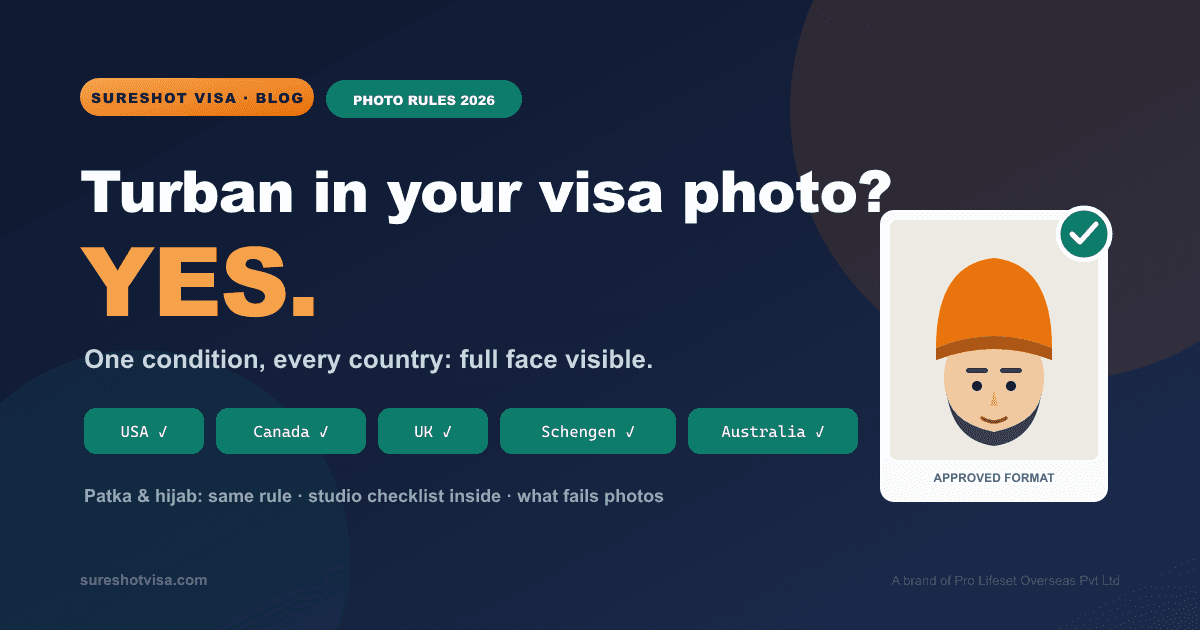
Yes — every major country allows a turban, patka or hijab in visa photos under the religious head-covering rule. The exact conditions for USA, Canada, UK, Schengen and Australia, plus the studio mistakes that cause rejections.

Visa photos · Religious head coverings · 2026
Can you wear a turban in a visa photo? Yes — here's every country's rule.
It is one of the most quietly asked questions in Punjab — often at the photo studio, five minutes before the VFS appointment. So let's answer it properly, country by country, with the one condition that every embassy on earth shares.
Short answer: turban, patka and hijab are all allowed — your full face must be clearly visible.Every country's photo rule is the same sentence
Visa photo standards worldwide follow one international specification — the ICAO photograph standard used for passports and visas. On head coverings, it says essentially this: coverings worn for religious reasons are permitted, provided the full face is clearly visible.
"Full face" has a precise meaning: your eyes, eyebrows, nose, mouth, cheeks and chin must all be visible, with no shadow falling across them and nothing slipping over the eyebrows. Wear your dastaar or dupatta exactly as you do daily — the camera just needs the face beneath it, clear and evenly lit.
The visibility test, in one picture
If everything inside the green zone is visible and shadow-free, the covering is fine.
✓ Eyes, eyebrows, nose, mouth, cheeks, chin — visible and shadow-free. That's the whole test.
Notice what the rule does not say. It does not limit the colour of the turban. It does not require any particular style. And nowhere — in any major country's specification — is a Sikh applicant required to remove the dastaar for a visa photograph.
The rule in each country's own words
Same principle everywhere, but each country phrases its condition slightly differently — and knowing the phrasing helps when a photo studio or a checklist confuses you.
United States
Allowed — religiousHead coverings are permitted only when worn daily for religious purposes. Full face visible; the covering must not cast shadows on the face.
Photo: 51 × 51 mm (2×2 in) · white background · no glasses
Canada
Allowed — religiousHead coverings worn for religious beliefs are accepted; the full facial features must be clearly visible.
Photo: 35 × 45 mm · plain white / light background
United Kingdom
Allowed — religiousHead coverings allowed for religious or medical reasons. Face visible from the bottom of the chin to the top of the forehead, both sides clear.
Photo: digital upload for most visas · 35 × 45 mm if printed
Schengen (all 29)
Allowed — religiousICAO-standard photos; religious head coverings accepted with the full face unobstructed and no shadows. Face fills roughly 70–80% of the frame.
Photo: 35 × 45 mm · recent (under 6 months) · matte, plain background
Australia
Allowed — religiousHead coverings worn for religious reasons are acceptable; the face must be visible from chin to crown-line, edge to edge.
Photo: 35 × 45 mm · neutral expression
UAE / Dubai eVisa
Allowed — religiousDigital photo with the eVisa application; religious head coverings accepted with the face fully visible. Typos and blurry photos are the real rejection risk here.
Photo: digital · white background · sharp and recent
The same religious exemption covers the patka worn by Sikh boys and the hijab — identical condition, full face visible. What no country accepts in a visa photo is a covering over the face itself: a niqab or veil must be lifted for the photograph, because the photo's entire legal job is to identify the face.
The do / don't board for the studio wall
In our filing work, the turban itself has never been the problem — the photograph of it sometimes is. These six tiles cover nearly every rejection we see:
✓ Wear it as you do daily
The exemption is for coverings worn as regular religious practice. Your everyday dastaar, tied normally, is exactly what the rule protects.✓ Any colour — contrast helps
No country restricts turban colour. Practical tip: against the required white background, a white or cream turban can blur at the edges — a darker colour photographs cleaner.✓ Even light, no shadows
Ask the studio for flat, even lighting. A shadow from the turban's edge across the forehead or eyes is the single most common technical rejection.✗ Covering over the eyebrows
If the band sits so low that the eyebrows disappear, the face-visibility test fails. Eyebrows in, always.✗ Loose ends near the face
A hanging larh or dupatta edge that crosses the cheek or chin line breaks the "both edges of the face visible" requirement. Pin it back for the photo.✗ Glasses, smiles, old photos
Not turban-related, but they sink photos daily: most countries now want glasses OFF, a neutral closed-mouth expression, and a photo taken within the last 6 months — never the one from your old visa.Two frame sizes cover almost every country
Schengen · Canada · UK · Australia and most others
United States — square 2×2 inch, its own standard
Say this at the photo studio (30 seconds)
- "Visa photo for [country] — 35×45 mm" (or "US visa — 2×2 inch").
- "White background, even lighting, no shadow on the face."
- "I'll keep the turban on — eyebrows to chin must be fully visible."
- "Neutral expression, no glasses, face about 70–80% of the frame."
- Check the result yourself before leaving: eyebrows visible? No shadow? Edges of the face clear?
At VFS, at biometrics, at the border
At the visa application centre, the same religious exemption applies to the live photo taken with your biometrics — the turban stays on, the operator photographs your face beneath it. Centres in India handle turbaned applicants all day, every day; this is routine, not an exception you must argue for.
Your beard needs no permission either. There is no rule anywhere requiring a trimmed or shaved face, and no requirement that today's photo match an older visa photo. You are photographed as you are.
Airport security is a separate system with its own screening rules — a security officer may ask for additional screening of a turban (in the US, you can request to pat it down yourself, in private if you prefer). That is a screening procedure, not a photo rule, and it has no bearing on your visa. One practical note for Amritdhari travellers: the kirpan cannot travel in cabin baggage on international flights — pack it in checked luggage.
If any centre staff or photo studio ever tells you the turban must come off for a visa photograph, they are wrong about the rule — every specification linked in the footnotes says otherwise. Ask them to check their own country checklist, or come to us and we'll handle the file end to end.
Turban & visa photo FAQs, answered straight
Can I wear a turban in my US visa photo?
Yes — the US permits head coverings worn daily for religious purposes. Your full face must be visible and the turban must not cast a shadow on it. The US photo is the square 2×2 inch format, and glasses must be off.
Is a turban allowed in Schengen, Canada, UK and Australia visa photos?
Yes, in all of them, under the same religious head-covering exemption. The shared condition: eyes, eyebrows, nose, mouth, cheeks and chin fully visible, no shadows, both edges of the face clear.
Does my son's patka follow the same rule?
Yes — a patka is a religious head covering and is treated exactly like a turban. Same visibility condition, same acceptance.
Is a hijab allowed in a visa photo?
Yes, under the same exemption and the same condition — the face itself must be fully visible. A niqab or any veil covering the face must be lifted for the photograph in every country, since the photo exists to identify the face.
Will I be asked to remove my turban at the VFS biometric appointment?
No. The live photo at the application centre follows the same religious exemption as the printed photo. Fingerprints and the face photo are taken with the turban on.
Do I need to look the same as my old visa photo — same turban colour, same beard?
No. Each application needs a recent photo (usually under six months old) of you as you are now. There is no matching requirement with old photos — but never reuse an old photo itself; that is a standard rejection.
Can SureshotVisa check my photos before I submit?
Yes — photo compliance is part of every document review we do. It is the cheapest item in the file and one of the most common reasons files bounce at the counter, so we check it every single time.
Get the whole file checked — photo to bank statement.
SureshotVisa is a Government-of-Punjab licensed consultancy (Lic. No. 849/DC/PTA/PLA/LC-3/2024). For ₹499 we review your complete profile — purpose, funds, ties, documents, photos — and give you a written visa-possibility report with an honest Yes / Maybe / No and the exact fixes, before you spend embassy fees. Refundable, and credited in full to any service.
+91 97803 01303Prefer WhatsApp? The green button at the bottom of your screen reaches the same desk.
Notes on sources. Filed 08 July 2026. Head-covering rules reflect the published photo specifications of the US Department of State, IRCC (Canada), UK Home Office, the ICAO-based Schengen photo standard, and the Australian Department of Home Affairs as of the publication date. Specifications change without notice — verify the current checklist for your specific country before your appointment, or ask us to.
This article is for information only and does not guarantee a visa. Every application is assessed on its own merits, and decisions rest solely with the relevant immigration authority.
© 2026 Sureshot Visa · A brand of Pro Lifeset Overseas Pvt Ltd · Patiala, Punjab
Need help?
We'll handle your visa file end-to-end.
Documents, VFS slots, embassy filing — by a licensed consultant.
We answer within 5 minutes
Written by
Rohit GirDocumentation & Financial Profile Support · M.Com (2022)
Rohit Gir supports the team with document review, financial-profile organisation and applicant communication. He helps ensure that income proof, bank statements, business documents, salary records and supporting evidence are presented clearly and consistently.
Full profileRelated Guides

No Objection Certificate (NOC) for a Visa — What It Must Say, and What Ruins It
One page from your employer quietly answers the officer's biggest question: will this person come back? Most NOCs answer the opposite. The four facts it must contain, the layout, and the five things that break it.
Read guide
Does a UK Invitation Letter Need an Apostille? No — Here's What It Actually Needs
There is no UKVI requirement to apostille or notarise a visitor invitation letter, and chasing one costs weeks you may not have. What the letter must contain, when legalisation genuinely applies, and why the letter is not what decides your case.
Read guide
Switzerland Visitor Visa Cost from India 2026 — Every Rupee, Honestly
The €90 fee is the small part. Here is the real all-in cost of a Switzerland Schengen visa from India — and the far larger number that only has to sit in your account, not leave it.
Read guide
Culturally Arranged Marriage Visa for New Zealand — The 2026 Guide for Indian Families
New Zealand has a visa built for arranged marriages, and most families never hear about it. The three-month rule that cuts both ways, the evidence that actually decides your case, and why letters from your own family are not enough.
Read guide