Refused Over a Spelling Mistake? How One Wrong Letter Sinks a Visa (2026)
Last reviewed: 10 September 2026 · Verified against current VFS Global India fees
A dropped middle name, a swapped passport digit, a date read as May 7 instead of 7 May — tiny mismatches cause real refusals. The 4-way cross-check that catches them before an officer does.

Document consistency · Every visa · 2026
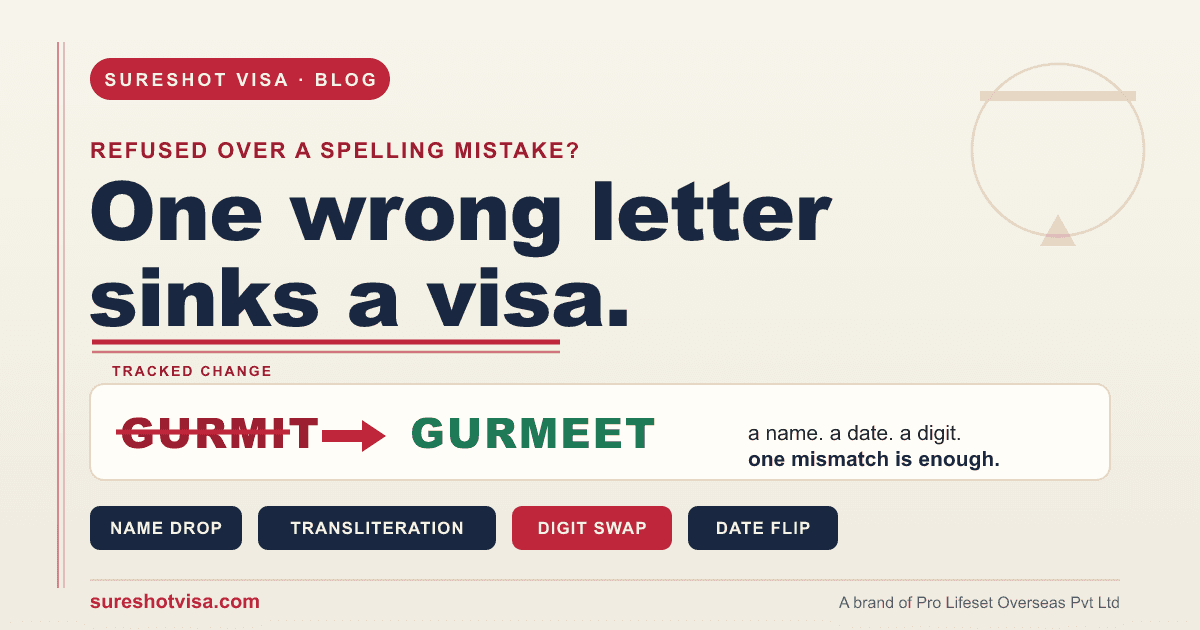
Refused over a spelling mistake? One wrong letter can sink a visa.
A dropped middle name. A swapped passport digit. A birthday the form read as May 7 instead of 5 July. Every fact was true — the file still didn't add up, and the officer had no way to tell an honest typo from a lie.
The hard truth: a genuine mistake is invisible to the system. On paper, an accidental slip looks exactly like a deliberate inconsistency — so consistency becomes the one defence you fully control.A typo has no expression. It can't say "I'm harmless."
The most dangerous mismatch in a visa file is the one nobody meant to make — because the machine reading it can't tell that you didn't mean it.
Here is the mechanism, and it is worth understanding before you touch a single form. Your file is not read as one document. It is read as a set that must agree with itself. The passport is checked against the application. The application is checked against the flight ticket. The ticket is checked against the invitation, the bank statements, the hotel booking and everything else you attach. The officer's job — and increasingly the system's job before the officer even opens it — is to look for the seam where two documents disagree.
When they find one, they don't see your intention. They see a gap. And a gap raises a question your paperwork usually cannot answer: which version is true, and why are there two? A middle name on the passport but missing on the form. A passport number with two digits swapped. A date of birth that reads as a different day in a different country's format. The underlying facts can be perfectly genuine and it still doesn't matter, because "genuine" is a thing that lives in your head, not on the page.
At best, that gap is a delay while someone asks you to clarify. At worst — and this is the part people underestimate — a serious or repeated mismatch can be read as misrepresentation: the suggestion that you gave inconsistent information on purpose. That is a far heavier finding than a simple refusal, and it can follow you into future applications. All of it, from a typo you'd have fixed in two seconds if anyone had pointed at it.
The 4-way match: everything points back to the passport
Think of the passport as the master copy. Every other document in your file is a photocopy of the same truth, and each one has to match the master exactly. Break one link and the whole set is now in question, not just the document that's wrong.
Passport at the centre. Three documents must agree.
match = green · mismatch = one broken link, one open question
Three of four agree. The ticket says GURMIT, the passport says GURMEET — and now an officer has to decide whether that fourth document belongs to the same person at all.
This is why "it's just a spelling mistake" is the wrong way to think about it. It is never just a spelling mistake. It is a contradiction inside a set of documents that were supposed to be identical — and a contradiction is precisely the thing the whole review is built to catch.
The classic mismatches, red-inked
None of these come from carelessness or dishonesty. They come from ordinary life — a name typed from memory, an old document spelt differently years ago, a date entered the way you've written it since school. Here are the four we see most, in wrong-and-right pairs.
The dropped middle name
Why it fails: the passport carries a middle or family name and the form drops it (or the other way round). The names are no longer identical, so the two documents may not read as the same person.
The transliteration slip
Why it fails: Punjabi and Hindi names have no single English spelling — Gurmeet, Gurmit, Gurmeat all sound right. But the passport spelling is now the only one that counts. Any document that spells it differently disagrees with it.
The swapped passport digit
Why it fails: two digits transposed while typing, and the number no longer points to your passport. This one is pure fat-finger — and one of the easiest for a system to flag instantly, because the number simply doesn't check out.
The date-of-birth flip
Why it fails: you typed 05/07/1994 meaning 5 July, but a form expecting US order read it as 7 May. Same eight characters, two different birthdays — explained in full below.
These mismatches love the documents you didn't fill in yourself: the airline ticket booked in a hurry, the hotel reservation under a nickname, the invitation letter your relative typed from memory. You proof-read the visa form ten times and never re-open the ticket. That's exactly where the crack usually is.
Where does your "surname" actually begin?
A specific, very Punjab-relevant trap deserves its own box: forms ask for surname and given name(s) separately, and different documents split the same name at different points. If your passport puts a name in the given-names field, every form must put it there too — not shuffle it into the surname box.
HARPREET and given name as KAUR SIDHU. The pieces are all there, but the split doesn't match the passport.
SIDHU, given names HARPREET KAUR — copied field-for-field, in the same order the passport uses.
Two honest notes for Sikh applicants. First, if your passport shows no surname — the surname field is blank and the full name sits in given-names — then follow the specific form's instructions for a blank surname rather than inventing one; guessing creates the very mismatch you're trying to avoid. Second, "Singh" and "Kaur" belong wherever your passport places them, and nowhere else. The rule is not what is customary — it is whatever your passport did, copied exactly.
One date, two different days
The date-of-birth trap is the sneakiest of the lot, because you can type the correct digits and still end up with the wrong day. Watch what happens to a single, unremarkable birthday depending on which country's format is reading it.
Two months apart, from the same digits. If a form expects month-first and you enter day-first out of habit, your recorded date of birth silently stops matching your passport — no error message, no warning, just a mismatch waiting to be found.
The defence is simple. India, the UK and most of the world write DD/MM/YYYY; the United States commonly writes MM/DD/YYYY; and many official systems use the ISO order YYYY-MM-DD (Canada's forms often prefer it). Don't assume — read the format the specific form asks for, and enter your date of birth in that order, character for character against your passport. Where a form lets you pick the month as a word ("July"), choose the word; a spelt-out month can't be flipped.
One master spelling. Everything obeys it.
Here is the good news after all that tension: the fix is completely within your control, it costs nothing, and it is genuinely boring. You are not trying to be clever. You are trying to be identical — the same person, spelt the same way, born on the same day, carrying the same number, across every single page.
Pick one master version of your identity, and take it straight from the passport — never from memory, never from an older document. One spelling of your name, character for character. One date of birth, entered in the format each form requires. One passport number, digit for digit. Then make every other document in the file bow to that master. The ticket, the invitation, the hotel booking, the bank statement — if any of them disagree with the passport, the document is what's wrong, and it gets corrected, not the passport.
The five-minute cross-check, before you submit
passport open on the left, form on the right, no shortcuts
- One master spelling. Copy your name letter-for-letter from the passport bio page — including middle and family names — and use only that spelling everywhere.
- One date of birth. Enter it in the exact format the form asks for; where you can pick a spelt-out month, do.
- One passport number. Read it off the bio page digit by digit, then read it back once more. Transpositions hide in a glance.
- Cross-check every document. Application, ticket, invitation, hotel, statements — hold each one against the passport and confirm the name, DOB and number match.
- Read it twice. Once yourself, once by a second pair of eyes. Two people rarely make the same slip in the same place.
That's the whole method. It feels almost too small for something that decides so much — but the mismatch that sinks a file is always small too. Careful people make these mistakes constantly, because being careful about the trip is not the same as being forensic about the spelling. The consistency check is the one part of the process an officer can't overrule and you can't outsource to luck. It's yours to get right.
Spelling & mismatch FAQs, answered straight
Can a small spelling mistake really get a visa refused?
Yes. A name, date-of-birth or passport-number mismatch across your documents can cause a refusal or a delay, and a serious or repeated one can even be read as misrepresentation — because the officer cannot tell an honest typo from a deliberate inconsistency. The underlying facts being genuine does not remove the contradiction on paper.
Which spelling of my name should I use everywhere?
The one printed in your passport, exactly — including any middle or family name and the exact surname / given-name split. If an old certificate or an email uses a different spelling, the passport still wins. Copy from the passport, not from memory.
My passport says GURMEET but my school records say GURMIT. Is that a problem?
For the visa application itself, use the passport spelling on every visa document so the file is internally consistent. Historical documents with an older spelling are common and usually explainable, but they should be flagged and handled deliberately, not left to surprise an officer. When in doubt, have the file reviewed before submitting.
How does the date-of-birth format actually cause a mismatch?
Because 05/07/1994 means 5 July in day-first (DD/MM) order but 7 May in month-first (MM/DD) order. Enter it in the format the specific form requires, matched against your passport. Choosing a spelt-out month where the form allows it removes the ambiguity entirely.
I already submitted with a typo. What now?
Don't panic and don't quietly submit a second, contradictory version. Whether you can correct it depends on the country and the stage of the process. Get the specific situation reviewed so the correction is made the right way — an unexplained second version can look worse than the original slip.
Can SureshotVisa catch these mismatches before I file?
Yes — a line-by-line cross-check of name, date of birth, passport number and the name split across every document is part of the review we do on every file. It is the cheapest thing to fix and one of the most avoidable reasons a genuine application runs into trouble, so we check it every single time.
Let us spot the mismatch before an officer does.
SureshotVisa is a Government-of-Punjab licensed consultancy (Lic. No. 849/DC/PTA/PLA/LC-3/2024). For ₹499 we cross-check your whole file — name, spelling, date of birth, passport number, the name split — against your passport, and give you a written report with the exact fixes before you spend embassy fees. Refundable, and credited in full to any service.
+91 97803 01303Prefer WhatsApp? The green button at the bottom of your screen reaches the same desk.
Notes on sources. Filed 08 July 2026. The principle that documents in a visa file must be internally consistent, and that inconsistencies can lead to refusal or a misrepresentation finding, reflects the published guidance of authorities such as IRCC (Canada), the UK Home Office, the US Department of State and the Schengen member states, along with the passport-issuance practice of the Passport Seva / Ministry of External Affairs, Government of India. Names, passport numbers and dates used in the examples are illustrative only. Rules and forms change without notice — verify the current form instructions for your specific country and visa before you rely on any detail here, or ask us to check it with you.
This article is for information only and does not guarantee a visa. Every application is assessed on its own merits, and decisions rest solely with the relevant authority.
© 2026 Sureshot Visa · A brand of Pro Lifeset Overseas Pvt Ltd · Patiala, Punjab
Need help?
We'll handle your visa file end-to-end.
Documents, VFS slots, embassy filing — by a licensed consultant.
We answer within 5 minutes

Written by
Rohit GirDocumentation & Financial Profile Support · M.Com (2022)
Rohit Gir supports the team with document review, financial-profile organisation and applicant communication. He helps ensure that income proof, bank statements, business documents, salary records and supporting evidence are presented clearly and consistently.
Full profileRelated Guides

No Objection Certificate (NOC) for a Visa — What It Must Say, and What Ruins It
One page from your employer quietly answers the officer's biggest question: will this person come back? Most NOCs answer the opposite. The four facts it must contain, the layout, and the five things that break it.
Read guide
Does a UK Invitation Letter Need an Apostille? No — Here's What It Actually Needs
There is no UKVI requirement to apostille or notarise a visitor invitation letter, and chasing one costs weeks you may not have. What the letter must contain, when legalisation genuinely applies, and why the letter is not what decides your case.
Read guide
Switzerland Visitor Visa Cost from India 2026 — Every Rupee, Honestly
The €90 fee is the small part. Here is the real all-in cost of a Switzerland Schengen visa from India — and the far larger number that only has to sit in your account, not leave it.
Read guide
Culturally Arranged Marriage Visa for New Zealand — The 2026 Guide for Indian Families
New Zealand has a visa built for arranged marriages, and most families never hear about it. The three-month rule that cuts both ways, the evidence that actually decides your case, and why letters from your own family are not enough.
Read guide