US Visa Refused Under 214(b): Interview Autopsy, Answer Signals & Reapply Strategy
Last reviewed: 10 September 2026 · Verified against current VFS Global India fees
US visa refused under 214(b)? A visual interview autopsy for Indian applicants: officer questions, weak answer signals, DS-160 traps, strong ties and reapply strategy.

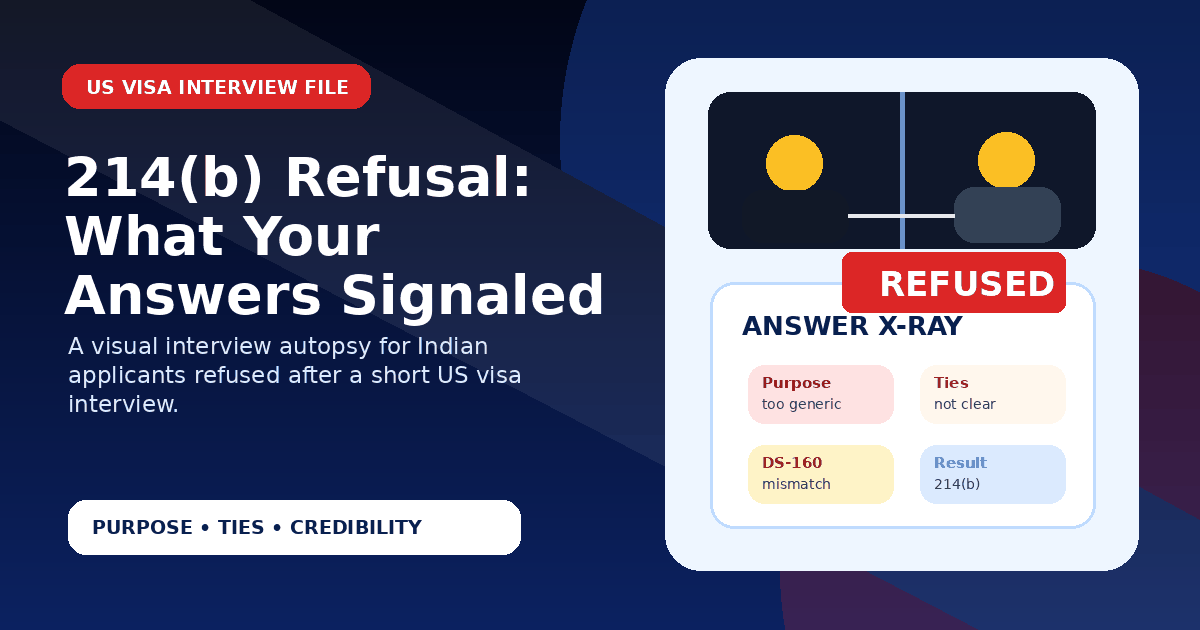
Quick answer: A US visa refusal under 214(b) generally means the consular officer was not satisfied that you qualified for the nonimmigrant visa category and/or that you overcame the presumption of immigrant intent with a clear purpose, credible answers and strong ties outside the United States.
Stop reading 214(b) as one reason. Read it as a pattern.
A US visa interview is different from a document-heavy application. The officer may only hear a few answers before making a decision — so every answer must be truthful, short, clear and consistent with your profile.
Answer X-Ray: what your words may have signalled
The officer is scanning for:
Purpose clarity, nonimmigrant intent, financial logic, home-country ties, DS-160 consistency and whether the trip makes sense for your profile.
One vague answer can trigger multiple doubts.
Better: specific city, duration, reason and return plan.
Better: job / business / family obligations explained naturally.
Better: clear self-funding or credible sponsor logic.
Better: form, purpose and interview all match.
Two-minute interview autopsy
Strong ties are not slogans. They are life anchors.
Red flags vs stronger preparation
Red flags
- Generic purpose
- DS-160 mismatch
- Over-rehearsed answers
- Unclear job / business
- Weak funding answer
- No changed circumstances after refusal
Stronger preparation
- 20-second purpose answer
- Consistent DS-160
- Natural, truthful responses
- Clear home-country anchors
- Funding source explained
- Reapply when the case is stronger
Reapply decision test
FAQs: US visa refused under 214(b)
No. A 214(b) refusal is not usually a ban — it means the officer was not satisfied for that application.
Yes, if you have additional information or significant changes, or your case can be presented more clearly.
The Department of State says there is no appeal process for a 214(b) refusal.
Reapply when the facts or presentation are stronger — not simply because a new appointment is available.
Documents help, but the interview answers and overall profile are very important.
Reapplying quickly without understanding what your first interview answers signalled.
Official reference: U.S. Department of State visa-denial guidance explains 214(b), nonimmigrant intent, ties, reapplication, and that there is no appeal process for 214(b) refusals. Official source.
Need help?
We'll handle your visa file end-to-end.
Documents, VFS slots, embassy filing — by a licensed consultant.
We answer within 5 minutes
Full Country Guide
USA Visa from India — fees, documents, processing time
Everything you need on one page: VFS centres, visa types, fee breakdown, doc checklist.

Written by
Paramjit SinghVisa Documentation & Case Support · B.Tech, Computer Science (2007)
Paramjit Singh focuses on the structure behind a strong visa file: the purpose, the supporting documents, the financial explanation and the return-ties logic. He keeps applications organised so the file never looks scattered, incomplete or contradictory.
Full profile