US B1/B2 Interview Day, Minute by Minute (2026)
Last reviewed: 10 September 2026 · Verified against current VFS Global India fees
The morning of your US visa interview, walked through: the consulate line, the phones-in-locker rule, and the 90 seconds at the window.

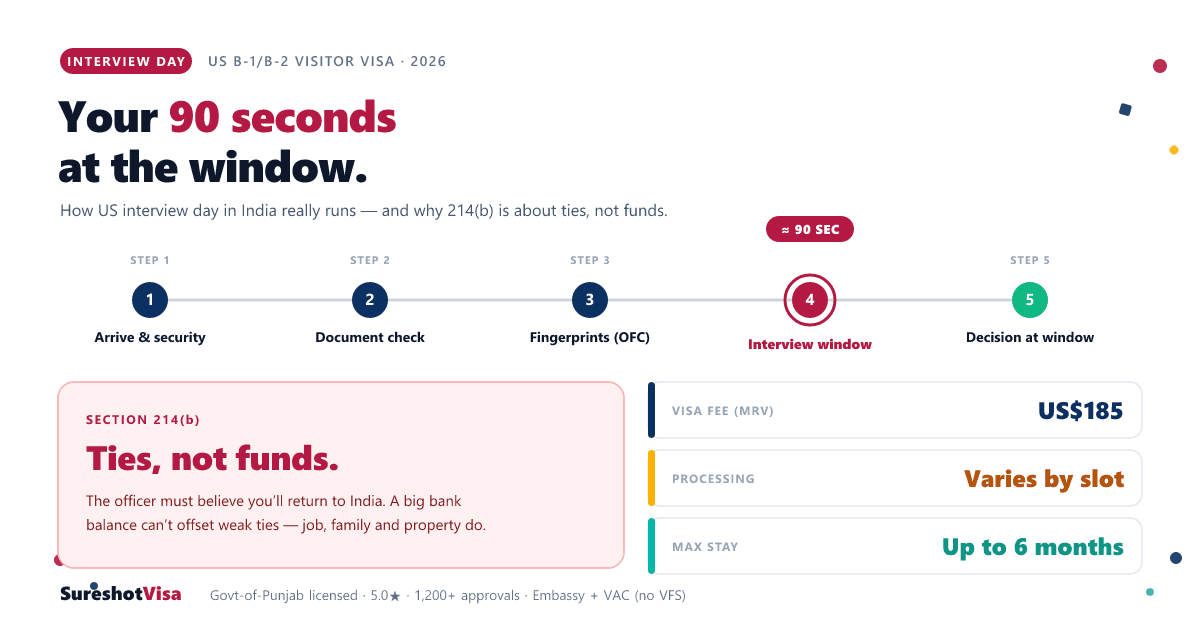
The morning of your US visa interview, minute by minute.
Unlike almost every other visa, this one is not decided on paper. It is decided in roughly ninety seconds at a window, by an officer who has already read your DS-160. Here is the whole morning — from the queue on the pavement to the words you hear at the glass.
You are early, and you have almost nothing with you
The B-2 visitor visa lets Indian passport holders travel to the US for tourism, family, or medical treatment — typically a 10-year multiple-entry stamp. But first, an interview at New Delhi, Mumbai, Chennai, Kolkata or Hyderabad.
The night before, you did the one packing job that matters: you left things out. No bags, no laptop, no phone, no water bottle — most consulates enforce this strictly, and there is often nowhere to store them. In your hand is a thin folder: passport, the DS-160 confirmation page with its barcode, the interview appointment confirmation, the $185 MRV fee receipt, and — because you are a careful person — originals of your ties and financial documents you may never be asked to show.
You paid that $185 (about ₹15,500) online weeks ago, filed the DS-160 at ceac.state.gov, and gave biometrics at a VFS centre at least two business days before today. All of that was the paperwork. Today is the part paperwork cannot do for you. The mechanics — DS-160, fee, appointments — are laid out in our USA tourist visa guide; this piece is about the room.
Two lines before the one that counts
Arrive about 15 minutes before your slot — not two hours; the queue outside is managed by appointment, not by who came first. Through the metal detector, into a large hall of numbered windows and a low, constant murmur. There are usually two touchpoints before your interview: a document check where your DS-160 and appointment are verified, and — if it wasn't done at the separate VAC visit — a fingerprint station.
Then you wait on a bench and watch. This is the most useful five minutes of your morning. You will see the pattern of the window: short exchanges, the officer looking at a screen and then at the face, a stamp or a slip of paper, "next". Applicants ahead of you are approved or refused in about the time it takes to order coffee. You are watching the format of your own decision.
Your DS-160 is already open in front of them. They are not discovering your case at the window — they are testing whether the person speaking matches the form that was filed. Which is exactly why every answer today has to agree with what you submitted. A contradiction between you and your own DS-160 is one of the fastest routes to a refusal.
The ninety seconds that are the entire visa
The interview averages two to three minutes. The part that decides it is shorter. There is a legal presumption you intend to immigrate, and your job in this exchange is to overcome it — this is Section 214(b), and it is the reason for by far the most B1/B2 refusals.
It sounds like this:
OfficerWhy are you going to the United States?
YouTo visit my brother in Seattle for three weeks.
OfficerWhat does he do there?
YouHe's a software engineer, on an H-1B.
OfficerAnd what do you do?
YouI run a textile business in Ludhiana — fourteen years.
OfficerWho's paying for the trip?
YouI am.
Officer[a pause, a look at the screen, a look at you] Your visa is approved. You'll get your passport in a few days.
Read it again and notice what did the work. Every answer was short, honest, and directly responsive. "I run a textile business in Ludhiana — fourteen years" is a ties statement disguised as small talk: it tells the officer there is a reason you come back. Nobody rambled. Nobody volunteered documents. The officer never asked for a bank statement — officers usually decide on your answers, not your paperwork — but you could have explained who funds the trip in one clean sentence if asked.
The questions Indians actually get
- Why are you going to the US? For how long?
- Who are you visiting — and what do they do there?
- What do you do for work?
- Who is paying for the trip?
- Do you have family in the US?
- Have you travelled abroad before?
None of these are trick questions. They are the raw material of the 214(b) judgement: purpose, ties, funding, intent. The failure mode is almost never the truth of your situation — it is a hesitant, vague, or inconsistent way of stating it. Most refusals happen in the first sixty seconds on a weak or contradictory answer. That is why we run a mock interview with these exact questions before you ever stand in that hall — the strategy is on our USA B1/B2 visa from India page.
Approved, 214(b), or 221(g)
The officer decides on the spot, and tells you immediately. There are three things you can walk away with.
Approved
The officer keeps your passport; the visa is stamped and delivered to your chosen VFS pickup or by courier within about 3–7 business days. US visas are a physical sticker, unlike the UK's or Australia's digital ones. Now you buy the flights — not before.
214(b) — refused
Not a ban. It means the officer wasn't convinced you'll return to India — you didn't overcome the immigrant-intent presumption. You can reapply, but only if your situation has genuinely changed (new job, marriage, assets, travel history). Same profile, same script, same result.
221(g) — administrative processing
Not a refusal — a pause. Your case needs further review or a document, and the decision comes later. It can add weeks to months. You'll be told what, if anything, is needed.
If you've been refused before, don't just rebook and rehearse harder. Reapply only with a significant change in your profile — a promotion, a marriage, a property purchase, new international travel. A same-profile reapplication tends to reach the same window and the same conclusion. We're candid about this before you spend another $185.
You can't script the officer. You can script yourself.
Everything that decides the ninety seconds is prepared long before them. A DS-160 filed carefully and consistently, because you can't edit it later and your answers must match it. A one-sentence, truthful purpose you can say without thinking. Ties you can name — the job, the business, the family who depend on you — layered so the "will you return" question answers itself. Funds you can explain in a breath. And the calm that comes from having rehearsed the real questions instead of imagining worse ones.
That preparation is the whole of our B1/B2 service — DS-160 done right and a mock interview with the exact questions, ₹16,999 including interview prep, itemised on the pricing page. Financial calm helps too; how to present funds you can explain in one sentence is covered in our US sponsor letter guide for those whose trip is funded by a relative. What we can't do is stand at the window for you, and what no one can do is guarantee the stamp. That decision belongs to the consular officer, alone.
Interview-day FAQs, answered plainly
What questions are asked in the US visa interview?
The common ones for Indians: why you're going, for how long, who you're visiting and what they do, what you do for work, who's paying, whether you have US family, and your travel history. Answers must be short, honest and consistent with your DS-160. We rehearse these exact questions in a mock before your date.
How long does the B1/B2 interview actually last?
Usually two to three minutes, and the decisive part is shorter. The officer has already read your DS-160 and decides on the spot, telling you the outcome immediately — approved, 214(b) refused, or 221(g) administrative processing.
What is a Section 214(b) refusal?
It means the officer wasn't satisfied you'll return to India — you didn't overcome the legal presumption of immigrant intent. It is the most common B1/B2 refusal and is not a ban; you can reapply, but realistically only if your circumstances have genuinely changed.
Do I need to show bank statements at the interview?
Officers usually decide on your answers, not documents. Still, carry originals of your financial and ties papers, and be able to say who funds the trip in one clear sentence. You may never be asked — but you should be ready if you are.
What can I carry into the US consulate?
As little as possible: passport, DS-160 confirmation, appointment confirmation, MRV fee receipt, and your supporting document originals. No bags, no phones, no laptops, no water bottles — most consulates enforce this strictly and offer no storage.
How early should I reach the consulate on interview day?
About 15 minutes before your appointment time — entry is managed by slot, not by queue position, so arriving hours early doesn't help. Dress smart and professional, and complete biometrics at the VAC at least two business days before the interview.
When do I get my passport back if approved?
The consulate keeps your passport and delivers the stamped visa to your chosen VFS pickup point or by courier, typically within 3–7 business days. The US issues a physical visa sticker, so the passport has to be surrendered and returned.
Can SureshotVisa guarantee my US visa?
No — the consular officer decides in the interview, and nobody can guarantee that. What we do is make your DS-160 and your interview answers consistent and your ties credible, and rehearse you against the real questions so you present your true case clearly.
Walk to that window already rehearsed.
SureshotVisa is a Government-of-Punjab licensed consultancy (Lic. No. 849/DC/PTA/PLA/LC-3/2024). For ₹499 we assess your profile — DS-160 readiness, ties, funding, refusal risk — and give you a written visa-possibility report with the honest odds, before you pay the $185 MRV fee. Credited in full if you file with us. We prepare you and your file; the consular officer alone decides the visa.
+91 97803 01303Prefer WhatsApp? The green button at the bottom of your screen reaches the same desk.
Notes on sources. Filed 04 July 2026. Figures reflect US Department of State and VFS Global India published information (B1/B2 MRV fee $185 ≈ ₹15,500; visa delivery 3–7 business days) as of the publication date. The INR cost follows the exchange rate on payment day. MRV fees are non-refundable regardless of interview outcome; verify current details on in.usembassy.gov and usvisascheduling.com before applying.
This article is for information only and does not guarantee a visa. Every application is assessed on its own merits, and the final decision rests solely with the US consular officer. Anyone promising a guaranteed US visa is promising something the law places entirely outside their control.
© 2026 Sureshot Visa · A brand of Pro Lifeset Overseas Pvt Ltd · Patiala, Punjab
Need help?
We'll handle your visa file end-to-end.
Documents, VFS slots, embassy filing — by a licensed consultant.
We answer within 5 minutes
Full Country Guide
USA Visa from India — fees, documents, processing time
Everything you need on one page: VFS centres, visa types, fee breakdown, doc checklist.
Written by
Paramjit SinghVisa Documentation & Case Support · B.Tech, Computer Science (2007)
Paramjit Singh focuses on the structure behind a strong visa file: the purpose, the supporting documents, the financial explanation and the return-ties logic. He keeps applications organised so the file never looks scattered, incomplete or contradictory.
Full profileRelated Guides
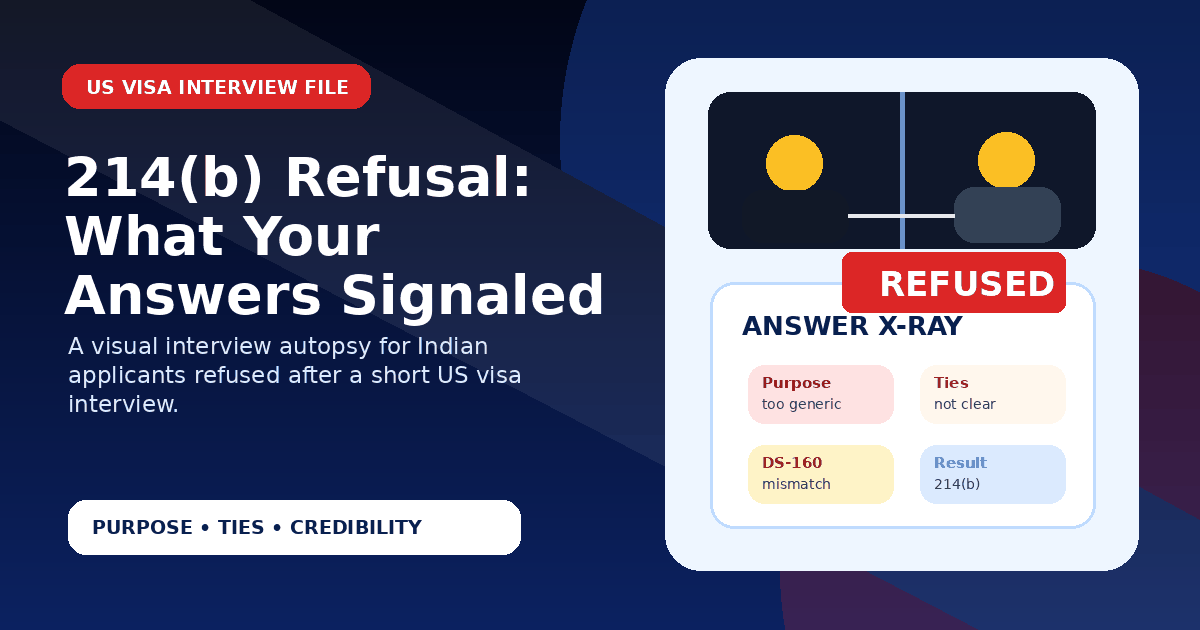
US Visa Refused Under 214(b): Interview Autopsy, Answer Signals & Reapply Strategy
US visa refused under 214(b)? A visual interview autopsy for Indian applicants: officer questions, weak answer signals, DS-160 traps, strong ties and reapply strategy.
Read guide