
How Long Does an Indian e-Visa Take? Timings 2026
How long an Indian e-Visa really takes in 2026 — realistic processing time, why some files run longer, when to apply, and the entry rules.

Last reviewed: 10 September 2026 · Verified against official Indian government sources
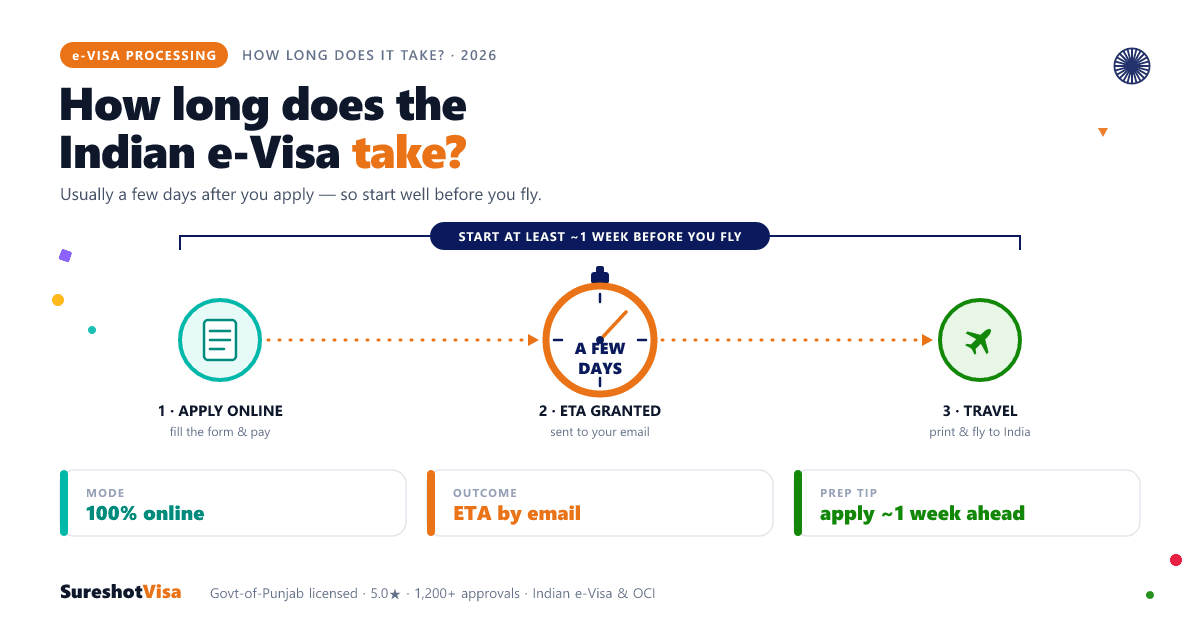
How long does an Indian e-Visa really take?
The honest answer has three parts: fast in the smooth case, not instant, and never guaranteed. Here is a realistic timeline, why some files run long, and the entry rules that kick in the moment your authorisation lands.
Usually days, sometimes longer, promised by no one
In the clean, common case an Indian e-Visa is decided within a few working days of a complete application. The trouble with quoting only that number is that it is a tendency, not a guarantee — and travellers who treat it as a guarantee are the ones who miss flights.
An e-Visa is not a rubber stamp that prints on payment. It is a real adjudication by the Government of India, run largely online and largely quickly, but subject to checks that can take a file off the fast track without warning. Most applications glide through; a minority are pulled for additional verification and sit longer. You cannot know in advance which yours will be, which is why every sensible timeline is built around the slow case, not the fast one.
So the useful way to think about the question is not "how fast can it go" but "how much runway should I leave so that a normal delay costs me nothing". The rest of this guide answers that.
From submit to boarding pass, in order
You complete the form on the official portal, upload your photo and passport page, and pay the government fee. The clock on processing starts once the file is in.
In most straightforward applications the Electronic Travel Authorisation arrives by email within a handful of working days. Print it and keep a copy on your phone.
Some applications are held for extra checks, or a query is raised. These take longer, and there is no fixed ceiling — this is exactly the case your buffer is for.
You present the printed authorisation and your passport at a designated port of entry, and the Bureau of Immigration officer makes the final admission decision.
Processing times shift with application volumes, the season, and the specifics of a file. A firm "it takes X days" would be a promise no one is in a position to keep. We would rather tell you to leave generous runway and be pleasantly early than quote a tidy figure that fails you in peak season.
Leave real runway — early is free, late is expensive
The single best thing you can do about processing time is start early. Applying well ahead of your flight turns a routine delay into a non-event; applying the night before turns a routine delay into a cancelled trip. There is no downside to being early that comes close to the downside of being late.
The official portal also sets its own window for how far in advance an e-Visa application can be lodged relative to your travel date — and that window can differ by visa type. Rather than quote a figure that might have changed, confirm the current application window and any minimum lead time on indianvisaonline.gov.in before you plan. When we handle a file, we work backwards from your departure date and file inside that window with a comfortable margin built in.
- Do not book non-refundable flights on the assumption of a fast approval. An approval is a decision, not a countdown you control.
- Watch the season. Busy travel periods mean more applications in the queue, and queues move slower.
- File a clean application. The fastest files are the boring ones — correct details, compliant photo, consistent answers. Errors are what invite the slow lane.
The usual reasons a file leaves the fast track
A mismatch or an error. A name that does not match the passport, a rejected photo, an inconsistent answer — anything that makes an officer look twice adds time. Most avoidable delays live here.
A query or request for more information. If the authorities want clarification, the file waits on your response, and every hour you take to reply is added to the wait.
Peak-season volume. When everyone applies at once — around holidays and wedding season — the whole queue lengthens, even for perfect files.
Background checks specific to a file. Some applications simply attract additional verification, and there is no way to predict or hurry that. It is not personal, and it is not something a fee can shortcut.
The entry rules that govern your authorisation
Approval is the middle of the story, not the end. How and when your e-Visa's clock runs depends on the type you hold:
- e-Tourist Visa. The 30-day tier is valid 30 days from your first arrival with double entry. The one-year and five-year tiers are multiple entry, and their validity runs from the date the authorisation is granted — so on those, part of the clock ticks before you even fly.
- e-Business Visa. Valid one year from grant, multiple entry, with each single stay capped at 180 days. It is for business activity, never employment.
- e-Medical & Medical Attendant Visa. Valid 60 days from first arrival with triple entry, and up to two attendants may accompany the patient.
Whichever you hold, three entry rules are constant: carry the printed authorisation and the passport you applied with; enter through a designated airport or seaport from the official list, not just any crossing; and treat the e-Visa as generally non-extendable and non-convertible once granted. Canadian travellers can see how these rules play out for their passport on our India visa guide for Canadian citizens, and the full picture sits on the Indian visa hub.
An approved authorisation is permission to travel to a port of entry — the final decision to admit you is made by the Bureau of Immigration officer on arrival. That holds for every traveller of every nationality. It is why we prepare files carefully and why we never promise entry: honestly, no one can.
Timing questions, answered honestly
How long does an Indian e-Visa take to process?
In the common, straightforward case it is decided within a few working days of a complete application, with the authorisation arriving by email. That is a tendency and not a guarantee — some files are held for additional verification and take longer — so plan around the slow case by applying well ahead of your travel date.
Can I get an Indian e-Visa the same day or overnight?
No responsible answer treats same-day approval as something you can count on. Even quick applications are real adjudications subject to checks, so you should never book non-refundable travel expecting an overnight turnaround. Leave generous runway instead.
How early can I apply for an Indian e-Visa before my trip?
The official portal sets an application window relative to your travel date, and it can differ by visa type, so confirm the current window and any minimum lead time on indianvisaonline.gov.in before planning. As a rule, apply as early as the window allows so a routine delay does not threaten your flight.
Why is my Indian e-Visa taking longer than expected?
The usual reasons are an error or mismatch in the application, a query awaiting your response, peak-season volume, or additional background verification specific to your file. A clean, consistent application avoids most avoidable delays, but some checks simply take the time they take and cannot be hurried.
Does paying more or using an agent make the e-Visa faster?
No. There is no official paid fast-track that changes the government's adjudication speed, and anyone promising to jump the queue for a fee should be treated with caution. What a good consultancy genuinely speeds up is your side — a correct, complete file filed early, which is the part most likely to keep you out of the slow lane.
When does my Indian e-Visa validity actually start?
It depends on the type: the 30-day e-Tourist Visa and the e-Medical Visa count from your first arrival, while the one-year and five-year e-Tourist tiers and the e-Business Visa run from the date the authorisation is granted. On the grant-date types, applying far in advance spends part of the validity before you travel.
What should I carry to enter India on an e-Visa?
The printed Electronic Travel Authorisation and the same passport you applied with, arriving at one of the designated airports or seaports on the official list. The immigration officer matches the two and makes the final admission decision on arrival.
Is my e-Visa approval or my entry into India ever guaranteed?
No. Approval is a decision made on the merits of your application by the Government of India, and admission is a separate decision made by the Bureau of Immigration officer at the border. No consultancy, ours included, can guarantee either — anyone who says otherwise is not being straight with you.
Cutting it fine — let us file it early and clean.
SureshotVisa is a licensed Indian visa consultancy. Message us on WhatsApp for a free assessment — we will check your dates, confirm the current application window and fee for your nationality, and, if you like, prepare and file the whole e-Visa so a routine delay never costs you a flight.
+91 97803 01303Prefer WhatsApp? The green button at the corner of your screen reaches the same desk.
Note. This guide is for information only and is correct to the best of our knowledge as of publication. Indian e-Visa processing times, application windows, validity rules and designated ports of entry are set by the Government of India and change without notice — verify the current details on the official portal, indianvisaonline.gov.in, before you apply or travel.
This article does not guarantee a visa or any processing time. Every application is decided on its own merits, and the final decisions on approval and entry rest with the Government of India and the Bureau of Immigration. No consultancy, ours included, can promise an approval, an entry, or a turnaround.
© 2026 Sureshot Visa · A brand of Pro Lifeset Overseas Pvt Ltd · Patiala, Punjab
Need help?
We'll handle your visa file end-to-end.
Documents, VFS slots, embassy filing — by a consultant at our licensed firm.
No obligation · A consultant at our licensed firm replies today
We answer within 5 minutes

Written by
Paramjit SinghVisa Documentation & Case Support · B.Tech, Computer Science (2007)
Paramjit Singh focuses on the structure behind a strong visa file: the purpose, the supporting documents, the financial explanation and the return-ties logic. He keeps applications organised so the file never looks scattered, incomplete or contradictory.
Full profileRelated Guides

No Objection Certificate (NOC) for a Visa — What It Must Say, and What Ruins It
Documents · Read guide
Does a UK Invitation Letter Need an Apostille? No — Here's What It Actually Needs
United Kingdom · Read guide
Switzerland Visitor Visa Cost from India 2026 — Every Rupee, Honestly
Switzerland · Read guide
Culturally Arranged Marriage Visa for New Zealand — The 2026 Guide for Indian Families
New Zealand · Read guide