
Indian e-Business Visa 2026: Rules & How to Apply
The Indian e-Business Visa for 2026 — what it permits, one-year multiple-entry validity, the 180-day per-stay cap, and how to apply.

Last reviewed: 10 September 2026 · Verified against official Indian government sources
The Indian e-Business Visa, explained without the fog.
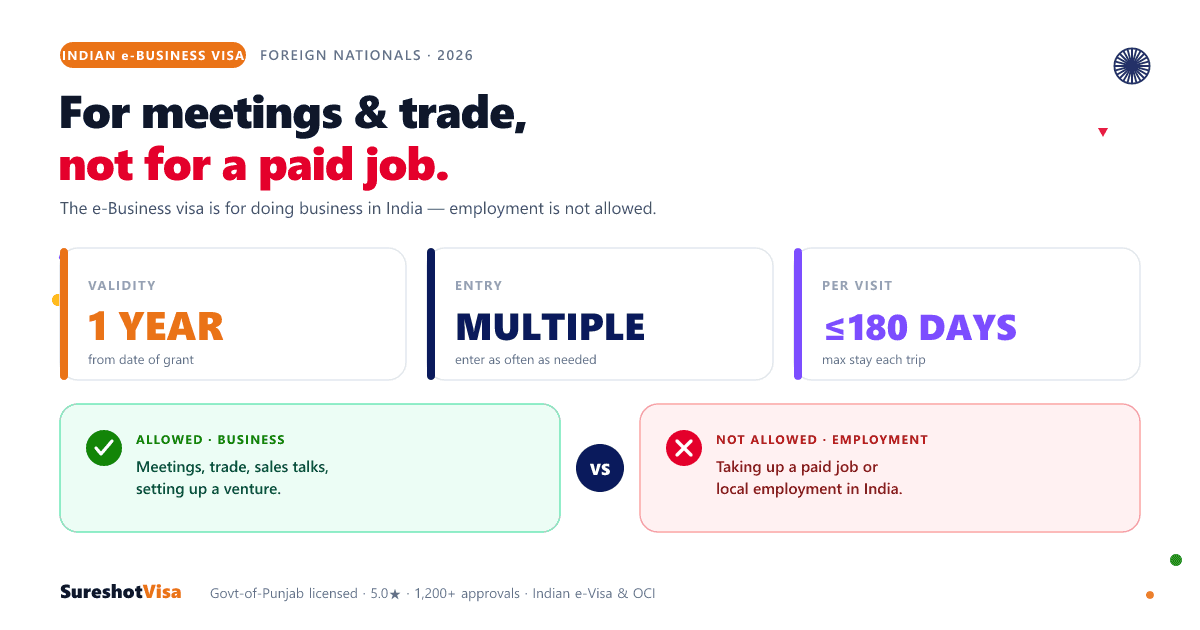
One year, multiple entry, 180 days per stay — and firmly not a work permit. If you travel to India for meetings, deals or setting up a venture, this is the brief on what the e-Business Visa is, what it is not, and how to apply.
A visa for doing business in India — not for being employed in it
The e-Business Visa lets you come to India to transact business: meet, negotiate, source, sell, exhibit, set things up. The one line that governs everything else is that it is not permission to hold a job here.
India runs its electronic visa scheme in a few purpose-based streams, and the business stream is the one you want when the reason for your trip is commercial rather than a holiday or medical treatment. It is applied for entirely online, and the approval arrives as an Electronic Travel Authorisation by email — no consulate visit for the visa itself, no sticker in the passport in advance.
Its shape is deliberately generous for a business traveller who returns often: it is valid a year, lets you enter as many times as you need within that year, and permits stays of up to 180 days at a stretch. That combination is what makes it the natural fit for someone running a supplier relationship, a partnership or a new venture across multiple visits.
Business activity versus employment — know which side you are on
This is the distinction that decides whether the e-Business Visa is even the right document for you. The rule of thumb: a business visa covers activity where you represent a foreign interest and are paid from abroad; an employment relationship with an Indian entity, drawing an Indian salary, is a different category entirely and needs an employment visa arranged through an Indian mission.
Typically fits the e-Business Visa
- Meetings, discussions and negotiations
- Attending trade fairs and exhibitions
- Sourcing, buying or selling on behalf of your overseas business
- Setting up or exploring a venture or partnership
- Short technical or commercial visits tied to a foreign company
Does not fit — needs another visa
- Taking up a job with an Indian employer
- Being paid a salary by an Indian company
- Long-term work or a posting requiring an employment visa
- Journalism or filming assignments
- Any activity the e-Visa scheme excludes for your nationality
If your situation sits near the boundary — a secondment, a mix of business and hands-on work, an unusual pay arrangement — that is precisely the grey area worth checking before you apply rather than after. Getting the category wrong is costly to unwind, and our free assessment exists to settle exactly this question.
The documents a business file usually turns on
Beyond the basics every e-Visa needs — a valid passport, a passport-style photo and a scan of the passport bio-data page — a business application leans on evidence of the commercial purpose. Expect to have ready:
- An invitation or letter from the Indian company or organisation you are dealing with, on their letterhead, describing the nature and purpose of the visit.
- Your own business card or proof of your role with the overseas company you represent.
- Details of the Indian entity — name, address and the relationship to your business.
- A clear statement of purpose that matches what you will actually do on the ground.
Confirm the exact current document list on the official portal before you apply — requirements are set by the Government of India and can be updated. As for the fee, it varies by nationality and visa type and changes over time, so we confirm the precise current figure for your passport in the assessment rather than quote a number that might be out of date. Singapore-based business travellers can see the country-specific view on our India visa guide for Singapore, and every category sits on the Indian visa hub.
The application route, kept simple
Apply only on the Government of India's official portal, indianvisaonline.gov.in. Lookalike sites charge a markup on the same free form, and a business traveller's time is worth more than that.
- Choose the e-Business Visa and its sub-purpose that matches your activity.
- Enter your details exactly as they appear in your passport — same spelling, same order. Mismatches are the top avoidable cause of delay.
- Upload the photo, passport page and business documents in the formats the portal specifies.
- Pay the government fee online and save the receipt and your application ID.
- Wait for the authorisation by email, then print it and keep a copy on your phone.
File early. The e-Business Visa is quick in the smooth case but not instant, and some applications are pulled for additional checks — leave comfortable runway before your first meeting so a routine delay never derails a deal.
Enter through a designated airport or seaport, carrying the printed authorisation and the passport you applied with. Approval is permission to travel to a port of entry — the final decision to admit you rests with the Bureau of Immigration officer on arrival, as it does for every traveller.
A few things business travellers get wrong
Treating the 180 days as a residency allowance. It is a per-stay ceiling, not an invitation to base yourself in India. Long, continuous presence that starts to look like living and working here is a category question, not a business-visa one.
Blurring business into work. Sitting in on meetings is business; taking an operational role and drawing local pay is employment. If the trip drifts from one into the other, the visa should too.
Assuming it is extendable. The e-Visa is generally non-extendable and non-convertible once granted, so plan the year and the purpose properly at the outset rather than expecting to stretch it later.
Leaving the application to the last minute. A missed approval and a missed flight are the same problem wearing different clothes. Apply well ahead.
The e-Business Visa questions we are asked most
What is the Indian e-Business Visa used for?
It is for business activity in India such as meetings, negotiations, attending trade fairs, sourcing or selling on behalf of an overseas business, and setting up a venture. It is applied for online and issued as an Electronic Travel Authorisation, and it is valid one year with multiple entries.
Can I work in India on an e-Business Visa?
No. The e-Business Visa expressly does not permit employment — you cannot take a job with an Indian company or draw an Indian salary on it. Employment requires a separate employment visa, generally arranged through an Indian mission rather than the e-Visa portal.
How long is the Indian e-Business Visa valid?
It is valid for one year from the date the authorisation is granted, with multiple entry across that year. Each individual stay is capped at 180 days, so it suits frequent business travellers rather than anyone planning to remain continuously.
How many times can I enter India on an e-Business Visa?
As many times as your business requires within the one-year validity, since it is a multiple-entry visa. Each visit is subject to the 180-day per-stay limit, and the visa's overall life is one year from grant.
What documents do I need for an Indian e-Business Visa?
Alongside a valid passport, a passport-style photo and a scan of the passport bio page, a business file usually needs an invitation or letter from the Indian company, proof of your role with your overseas business, and details of the Indian entity. Confirm the exact current list on the official portal, since requirements can be updated.
How much does the Indian e-Business Visa cost?
The government fee depends on your nationality and the visa type and is revised from time to time, so we do not quote a fixed figure that could be stale. We confirm the exact current fee for your passport in a free assessment, and you pay it directly to the government on the official portal.
Is the e-Business Visa the same as an OCI card?
No. The e-Business Visa is a one-year, purpose-specific business visa, whereas the OCI card is a lifelong, multiple-entry status for foreign nationals of Indian origin. OCI is not dual citizenship, and if you ever held an Indian passport you must surrender it and obtain a Surrender Certificate before OCI can be processed.
Is my e-Business Visa approval guaranteed if I pay the fee?
No. Paying the fee submits the application for adjudication; it does not buy an approval, and the final decision rests with the Government of India and, at the border, the Bureau of Immigration. Most complete, consistent business applications succeed, but no consultancy can honestly promise the outcome.
Travelling to India on business — let us handle the visa.
SureshotVisa is a licensed Indian visa consultancy. Message us on WhatsApp for a free assessment — we will confirm the e-Business Visa is the right category for your trip, the current fee for your nationality, and the documents your file needs, then prepare and file the whole application for you if you wish.
+91 97803 01303Prefer WhatsApp? The green button at the corner of your screen reaches the same desk.
Note. This guide is for information only and is correct to the best of our knowledge as of publication. Indian e-Business Visa rules, permitted activities, documents, fees and designated ports of entry are set by the Government of India and change without notice — verify the current details on the official portal, indianvisaonline.gov.in, before you apply or travel.
This article does not guarantee a visa. Every application is decided on its own merits, and the final decision rests with the Government of India and the Bureau of Immigration. No consultancy, ours included, can promise an approval or entry.
© 2026 Sureshot Visa · A brand of Pro Lifeset Overseas Pvt Ltd · Patiala, Punjab
Need help?
We'll handle your visa file end-to-end.
Documents, VFS slots, embassy filing — by a consultant at our licensed firm.
No obligation · A consultant at our licensed firm replies today
We answer within 5 minutes

Written by
Paramjit SinghVisa Documentation & Case Support · B.Tech, Computer Science (2007)
Paramjit Singh focuses on the structure behind a strong visa file: the purpose, the supporting documents, the financial explanation and the return-ties logic. He keeps applications organised so the file never looks scattered, incomplete or contradictory.
Full profileRelated Guides

No Objection Certificate (NOC) for a Visa — What It Must Say, and What Ruins It
Documents · Read guide
Does a UK Invitation Letter Need an Apostille? No — Here's What It Actually Needs
United Kingdom · Read guide
Switzerland Visitor Visa Cost from India 2026 — Every Rupee, Honestly
Switzerland · Read guide
Culturally Arranged Marriage Visa for New Zealand — The 2026 Guide for Indian Families
New Zealand · Read guide