
Indian e-Medical Visa: Treatment in India from Abroad
Coming to India for surgery or specialist care? The e-Medical Visa gives 60 days, triple entry, and lets up to two attendants travel with the patient. How it works in 2026.

Last reviewed: 10 September 2026 · Verified against official Indian government sources
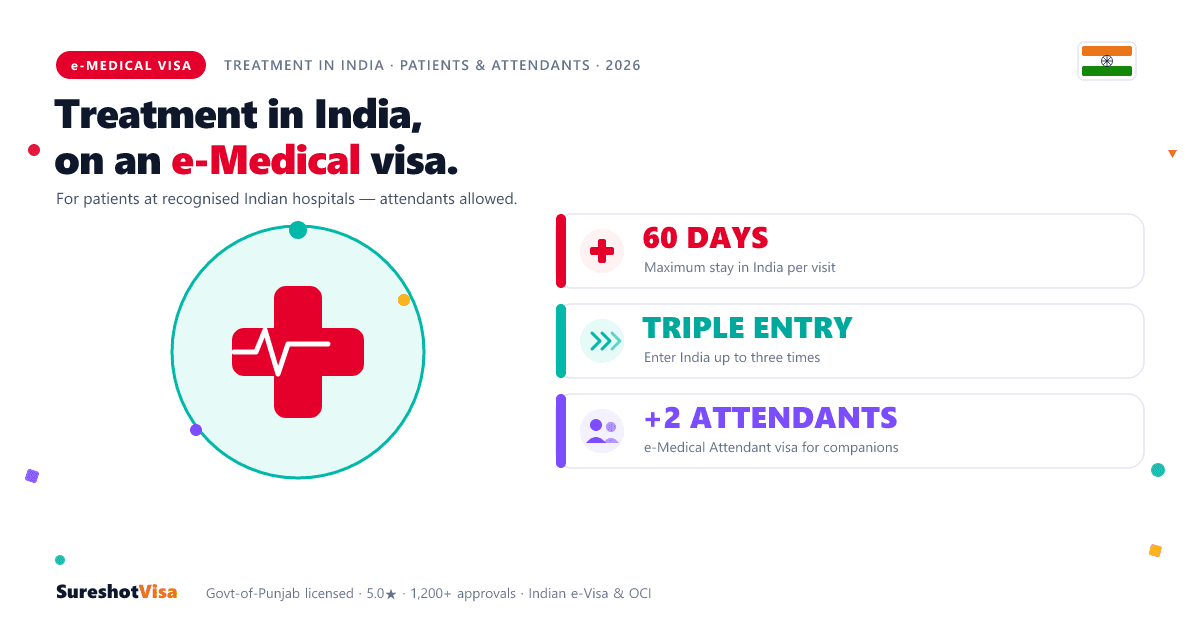
The Indian e-Medical Visa: treatment in India, from abroad.
India is one of the world's busiest destinations for medical travel — cardiac surgery, oncology, transplants, orthopaedics, fertility care and more, at hospitals that draw patients from across South Asia, the Gulf and Africa. The e-Medical Visa is how most of them arrive. Here is how it works, calmly and without the fee myths.
What the e-Medical Visa actually is
It is a purpose-built visa for one thing: receiving medical treatment at a hospital in India — not tourism, not business, not a general visit that happens to include a check-up.
The e-Medical Visa is part of India's electronic visa system, applied for online before travel. When granted, you receive an electronic authorisation to enter India for treatment. Its shape is designed around how medical care actually happens — the need to arrive, possibly leave and return for a follow-up cycle, and to bring family for support.
Read those three numbers together and the logic is clear. Sixty days from your first arrival covers a typical treatment-and-recovery window. Triple entry means you can leave India and come back within that window — useful when a treatment plan involves a return home between phases, or a hop to a neighbouring country. And the allowance for up to two attendants recognises that a patient rarely travels alone.
What it is not: it is not a work or study visa, not a tourist visa, and not a route to settle. It is treatment, for a defined period, at a recognised hospital. If your reason for coming is anything other than medical care, a different category — set out on our Indian visa hub — is the right one.
The Medical Attendant Visa — for the people who come with you
Almost nobody travels for surgery alone. India accounts for this with a companion category, the Medical Attendant Visa, so that family can be at the patient's side without improvising on a tourist visa.
Up to two attendants — typically a spouse, parent, adult child or other close family — can travel on Medical Attendant visas tied to the patient's treatment. Their visa tracks the patient's medical visa: same broad window, same purpose of accompanying and supporting the patient. It is applied for alongside, or in relation to, the patient's e-Medical Visa, and it exists specifically so companions are on the correct footing rather than the wrong visa.
The practical point for families: plan the patient's and the attendants' applications together, as one package, rather than treating them as separate errands. The attendant visas are anchored to the patient's treatment, so the hospital documentation that supports the patient's file is what supports the attendants' too. Getting this wrong — for instance, sending a companion in on a tourist visa — creates avoidable friction at exactly the moment a family least needs it.
What your file is built around
A medical visa file differs from a tourist one in a single decisive way: it must connect a real patient to a real hospital and a real treatment plan. The document set reflects that, and the hospital's own letter sits at the centre of it.
| Document | What it establishes |
|---|---|
| Letter from the hospital in India | That a recognised Indian hospital will treat you, and for what — the anchor of the file |
| Passport valid for the required period | Your identity and adequate validity for the stay |
| Recent photograph to specification | Identity, to the current e-Visa photo standard |
| Medical records / diagnosis | The condition and the reason treatment abroad is being sought |
| Proof of relationship (attendants) | That each attendant is genuinely connected to the patient |
| Return / onward travel details | Your intended entry and exit around the treatment window |
The hospital letter is the piece everything hinges on. It should come from the Indian hospital where you will actually be treated, and it ties your application to a genuine treatment plan. A vague or missing hospital letter is the single most common reason a medical visa file is weak. If you have not yet fixed on a hospital, that is step one — the visa follows the treatment, not the other way around.
Getting in, and what happens if treatment runs long
Entering India on an e-Visa
The e-Medical Visa, like all e-Visas, admits you through designated airports and seaports — not every border crossing. Carry a printout of your approved electronic authorisation together with the passport you applied on; immigration checks the two against each other on arrival. Enter through one of the designated points and keep the paperwork on your person, not in checked baggage.
When 60 days is not enough
Some treatments outlast the window. The 60-day, triple-entry structure covers most standard cases, but for prolonged treatment the position shifts from the e-Visa system to in-country processes handled through the Foreigners Regional Registration framework, and in some situations a regular Medical Visa obtained from an Indian mission is the more appropriate instrument from the outset. If your treatment is likely to be long or open-ended, flag it early — the right choice between the e-Medical Visa and a regular Medical Visa is best made before you travel, not after the clock runs down.
This is genuinely case-by-case, and it depends on your nationality, your diagnosis and your hospital's plan. It is also exactly the kind of judgement where getting it right up front saves a great deal of stress mid-treatment. Medical-travel volumes into India are high from neighbouring countries in particular; our page on the Indian visa from Sri Lanka reflects how common this route is, and the Indian visa from the UAE page covers another major medical-travel corridor.
The mistakes that cost patients time
Applying without a confirmed hospital
The hospital letter anchors the file. Trying to secure the visa before choosing where you will be treated inverts the process and produces a thin application. Fix the hospital first, get the letter, then apply.
Sending attendants on the wrong visa
A spouse or parent arriving on a tourist visa "to keep it simple" is not simpler — it puts a companion on the wrong footing for a medical stay. Use the Medical Attendant Visa, up to two, planned alongside the patient's application.
Entering at the wrong point, or without the printout
e-Visas admit only through designated airports and seaports, and only with the approved authorisation in hand. Arriving at a non-designated crossing, or without the printed ETA, turns a granted visa into a problem at the counter. Check your arrival point and print the approval.
None of these is complicated once you know it, and that is really the value of planning a medical trip properly: the visa should be the least of a patient's worries. Sort the hospital, the letter, the attendants and the entry point in advance, and the family can focus on the treatment. When you are ready, the Indian visa hub is the starting point, and we are happy to run the whole file for you.
e-Medical Visa questions, answered
How long can I stay in India on an e-Medical Visa?
The e-Medical Visa allows a stay of up to 60 days from your first arrival in India, with triple entry so you can leave and re-enter within that window. It is designed to cover a standard treatment-and-recovery cycle. If your treatment is likely to run longer, that is best flagged before you travel so the right visa is chosen from the start.
Can my family come with me for treatment in India?
Yes. Up to two attendants — usually close family such as a spouse, parent or adult child — can travel on Medical Attendant visas tied to the patient's treatment. Their visas track the patient's medical visa and exist specifically so companions are on the correct footing. Plan the patient's and attendants' applications together as one package.
Do I need a hospital letter for the e-Medical Visa?
Yes — it is the document the whole file is built around. A letter from the Indian hospital where you will be treated connects your application to a genuine treatment plan, and a vague or missing letter is the most common reason a medical visa file is weak. Confirm your hospital and obtain the letter before applying.
How much does an Indian e-Medical Visa cost?
The fee varies by nationality and changes without notice, so we do not quote a figure that might mislead you. We confirm the exact, current fee for your nationality as part of a free assessment, before you pay anything. Be cautious of anyone quoting a single flat price for all nationalities.
Which airports can I use to enter India on an e-Medical Visa?
e-Visas, including the e-Medical Visa, admit travellers only through designated airports and seaports rather than every border point. Carry a printout of your approved electronic authorisation along with the passport you applied on, and enter through one of the designated points. Keep the paperwork on your person, not in checked baggage.
What happens if my treatment takes longer than 60 days?
For treatment that outlasts the window, the position moves from the e-Visa system to in-country processes handled through the Foreigners Regional Registration framework, and in some cases a regular Medical Visa from an Indian mission is more appropriate from the outset. This is case-by-case and depends on your nationality, diagnosis and hospital plan. If a long stay is likely, decide the right route before you travel.
Can I use an e-Medical Visa for a routine check-up or wellness trip?
The e-Medical Visa is intended for actual medical treatment at a recognised hospital, anchored by that hospital's letter. A general wellness trip or a visit that merely includes a check-up is usually better matched to a different category. If you are unsure which visa fits your purpose, the Indian visa hub sets out the options and we can point you to the right one.
Is the e-Medical Visa a route to stay in India permanently?
No. It is a time-limited visa for treatment, not a path to settle, work or study. When the treatment window ends, the visa ends. Anyone planning a longer-term connection to India — for example a person of Indian origin — should look at separate routes such as OCI, which are entirely different from the medical visa.
Coming to India for treatment? Let us handle the visa side.
SureshotVisa is a licensed Indian visa consultancy. Send us the hospital, the treatment and how many attendants are travelling, and we will confirm the right visa, the exact current fee for your nationality, and the documents your hospital letter must carry — then prepare and file the patient's and attendants' applications together. We do the paperwork; the Government of India makes the decision.
+91 97803 01303Prefer WhatsApp? The green button at the bottom of your screen reaches the same desk.
Notes. Published 05 July 2026 and correct to the best of our knowledge on that date. e-Medical Visa rules, eligible nationalities, designated ports of entry and fees are set by the Government of India, vary by nationality, and change without notice. Confirm current requirements on the official portal at indianvisaonline.gov.in before booking treatment or travel.
This article is general information, not medical or legal advice, and does not guarantee any visa outcome. Every application is decided on its own merits, and the final decision rests with the Government of India and its Bureau of Immigration. We prepare and file; we do not approve.
© 2026 Sureshot Visa · A brand of Pro Lifeset Overseas Pvt Ltd · Patiala, Punjab
Need help?
We'll handle your visa file end-to-end.
Documents, VFS slots, embassy filing — by a consultant at our licensed firm.
No obligation · A consultant at our licensed firm replies today
We answer within 5 minutes

Written by
Paramjit SinghVisa Documentation & Case Support · B.Tech, Computer Science (2007)
Paramjit Singh focuses on the structure behind a strong visa file: the purpose, the supporting documents, the financial explanation and the return-ties logic. He keeps applications organised so the file never looks scattered, incomplete or contradictory.
Full profileRelated Guides

No Objection Certificate (NOC) for a Visa — What It Must Say, and What Ruins It
Documents · Read guide
Does a UK Invitation Letter Need an Apostille? No — Here's What It Actually Needs
United Kingdom · Read guide
Switzerland Visitor Visa Cost from India 2026 — Every Rupee, Honestly
Switzerland · Read guide
Culturally Arranged Marriage Visa for New Zealand — The 2026 Guide for Indian Families
New Zealand · Read guide