
Indian e-Tourist Visa: 30-Day vs 1-Year vs 5-Year
India's e-Tourist Visa comes in three durations — 30-day, one-year and five-year. A plain guide to which tier actually fits how you travel.

Last reviewed: 10 September 2026 · Verified against official Indian government sources
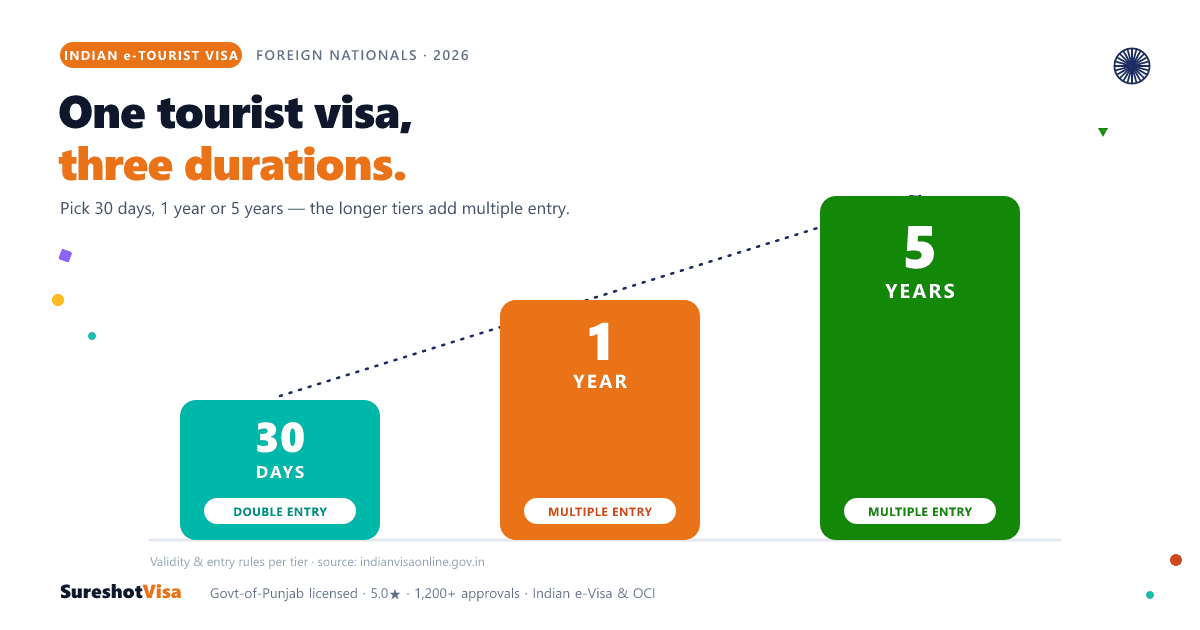
Thirty days, one year, or five — which tier is really yours?
India offers the same e-Tourist Visa in three different lengths. Most people pick by instinct and either over-buy or run short. This is the plain, unhurried way to match the tier to the way you actually travel.
One visa, three lifespans. That is the whole decision.
The e-Tourist Visa does not change what you can do in India — it changes for how long, and how many times, you can come and go. Pick the tier that matches your next two or three years of travel, not just the trip in front of you.
All three tiers cover the same purposes: tourism, visiting family and friends, a short recreational course, or a yoga or wellness stay. What separates them is duration and entries. Get those two dimensions right and you never think about your visa again until it lapses; get them wrong and you either pay for years you will not use, or find yourself reapplying the week before a trip you thought you were covered for.
Here is the honest framing we give clients: the 30-day is a ticket, the one-year is a season pass, and the five-year is a membership. The rest of this guide helps you decide which of the three you are.
What each tier gives you, in its own words
30-day e-Tourist Visa
- Validity
- 30 days from your first arrival in India
- Entries
- Double entry
- Clock starts
- On the day you first land
Best for: a single holiday, a wedding, one focused trip — perhaps with a short hop to a neighbouring country and back, which the double entry allows.
One-year e-Tourist Visa
- Validity
- One year
- Entries
- Multiple entry
- Clock starts
- On the date the authorisation is granted
Best for: travellers making two or three trips across a year — the visit-the-parents-twice, or the winter-and-monsoon explorer.
Five-year e-Tourist Visa
- Validity
- Five years
- Entries
- Multiple entry
- Clock starts
- On the date the authorisation is granted
Best for: frequent, long-horizon visitors — family abroad who come every year, or anyone who simply does not want to think about a visa for half a decade.
Notice where the clock starts. The 30-day tier counts from the day you land. The one-year and five-year tiers count from the day the authorisation is granted — so if you apply months before you fly, part of that validity is spent before your trip even begins. Plan your application timing with that in mind.
Multiple entry is not the same as unlimited stay
The one-year and five-year tiers let you enter India many times over their life. That does not mean you can settle in on one long, rolling stay. On the longer tiers there is a cap on how many days you may remain per visit, and — importantly — that cap varies by nationality.
Because it is nationality-dependent, we do not print a single number here that might be wrong for your passport. It is one of the first things we confirm in a free assessment: the exact per-visit stay limit that applies to you, so you can plan a long trip without a nasty surprise at an exit gate. British travellers can see the country-specific picture on our India visa guide for UK citizens, and every nationality is covered from the Indian visa hub.
Four questions that usually settle it
How many trips in the next twelve months. One trip and done points to the 30-day. Two or three points to the one-year. A steady pattern of yearly visits points to the five-year.
How firm are your dates. If you know exactly when you are travelling and it is soon, a short tier keyed to arrival can be cleanest. If your travel is loose and likely to repeat, a longer tier bought once saves you re-applying each time.
Do you need to leave and re-enter. A quick side-trip to Nepal, Sri Lanka or the Maldives and back needs at least the double entry the 30-day gives — or the multiple entry of the longer tiers if you will do it more than once.
How much friction do you want to avoid. Some travellers happily reapply for each trip; others would pay a little more once to never touch the portal again for five years. Neither is wrong — but knowing which one you are is the whole answer.
The longer tiers usually cost more than the 30-day, and the fee varies by nationality and changes over time — so we do not quote figures that could be stale. In your assessment we lay out the current fee for each tier for your passport side by side, so you can weigh a slightly higher one-time cost against the convenience of not reapplying. That is a genuine trade-off, not a sales line.
The rules that do not change with the tier
- Same purposes. Tourism, family visits, short recreational courses and wellness stays — never employment, journalism or long-term study, which need other visa types.
- Apply on the official portal only. Every tier is applied for at indianvisaonline.gov.in; the approval arrives by email as an Electronic Travel Authorisation.
- Carry the printed authorisation and your passport. Enter through a designated airport or seaport, and let the immigration officer stamp you in on arrival.
- The e-Visa is generally fixed. It is non-extendable and non-convertible to another category once granted, so choose the right tier and purpose up front.
The tier questions, answered plainly
What is the difference between the 30-day, 1-year and 5-year e-Tourist Visa?
They cover the same tourist purposes but differ in lifespan and entries. The 30-day is valid 30 days from your first arrival with double entry; the one-year and five-year tiers are multiple entry, with their validity running from the date the authorisation is granted rather than from arrival.
When does the validity of the 1-year and 5-year Indian e-Tourist Visa start?
From the date the Electronic Travel Authorisation is granted, not from the day you first land in India. That means applying far in advance quietly spends part of the validity before your trip, so it is worth timing the application sensibly relative to your travel plans.
Can I enter India multiple times on the e-Tourist Visa?
Yes on the one-year and five-year tiers, which are multiple entry. The 30-day tier is double entry, which allows one exit and re-entry — useful for a short hop to a neighbouring country — but not repeated comings and goings over a long period.
How long can I stay in India per visit on the 5-year e-Tourist Visa?
There is a cap on how long you may remain per visit on the longer tiers, and it varies by nationality, so we confirm the exact figure for your passport rather than print a number that might not apply to you. Multiple entry lets you come and go, but it does not mean an unlimited continuous stay.
Which e-Tourist Visa tier is best value?
It depends on how often you will travel: one trip favours the 30-day, occasional trips favour the one-year, and frequent yearly visits favour the five-year, which spares you reapplying. Because fees vary by nationality and change over time, we lay out the current cost of each tier for your passport in a free assessment so you can compare like for like.
Can I extend or change my Indian e-Tourist Visa after it is granted?
The e-Visa is generally non-extendable and non-convertible to another category once issued, so the right approach is to choose the tier and purpose that match your real plans before applying. If your needs are likely to grow, a longer tier chosen up front is usually cleaner than trying to alter one later.
Can I work or study long-term on any e-Tourist Visa tier?
No — none of the three tiers permits employment, paid work, journalism or long-term study, whatever their length. Those purposes require different visa categories, such as an employment or student visa, generally arranged through an Indian mission rather than the e-Visa portal.
Does a longer tier make my application more likely to be approved?
No. Each application is adjudicated on its own merits regardless of the tier you request, and the final decision rests with the Government of India. Choosing five years instead of 30 days does not improve your odds; a complete, consistent, honest application is what matters.
Not sure which tier is yours — we will tell you straight.
SureshotVisa is a licensed Indian visa consultancy. Message us on WhatsApp for a free assessment — we will recommend the tier that fits your travel, confirm the current fee for your nationality, and, if you like, prepare and file the whole e-Tourist Visa for you. No pressure to pick the pricier option.
+91 97803 01303Prefer WhatsApp? The green button at the corner of your screen reaches the same desk.
Note. This guide is for information only and is correct to the best of our knowledge as of publication. Indian e-Visa tiers, per-visit stay limits, fees and rules are set by the Government of India and change without notice — verify the current details on the official portal, indianvisaonline.gov.in, before you apply.
This article does not guarantee a visa. Every application is decided on its own merits, and the final decision rests with the Government of India and the Bureau of Immigration. No consultancy, ours included, can promise an approval.
© 2026 Sureshot Visa · A brand of Pro Lifeset Overseas Pvt Ltd · Patiala, Punjab
Need help?
We'll handle your visa file end-to-end.
Documents, VFS slots, embassy filing — by a consultant at our licensed firm.
No obligation · A consultant at our licensed firm replies today
We answer within 5 minutes

Written by
Paramjit SinghVisa Documentation & Case Support · B.Tech, Computer Science (2007)
Paramjit Singh focuses on the structure behind a strong visa file: the purpose, the supporting documents, the financial explanation and the return-ties logic. He keeps applications organised so the file never looks scattered, incomplete or contradictory.
Full profileRelated Guides

No Objection Certificate (NOC) for a Visa — What It Must Say, and What Ruins It
Documents · Read guide
Does a UK Invitation Letter Need an Apostille? No — Here's What It Actually Needs
United Kingdom · Read guide
Switzerland Visitor Visa Cost from India 2026 — Every Rupee, Honestly
Switzerland · Read guide
Culturally Arranged Marriage Visa for New Zealand — The 2026 Guide for Indian Families
New Zealand · Read guide