
OCI for the Foreign Spouse of an Indian Citizen
Married to an Indian citizen or OCI holder? A foreign spouse can qualify for an OCI card — but only when specific conditions, including a two-year marriage test, are met.

Last reviewed: 10 September 2026 · Verified against official Indian government sources
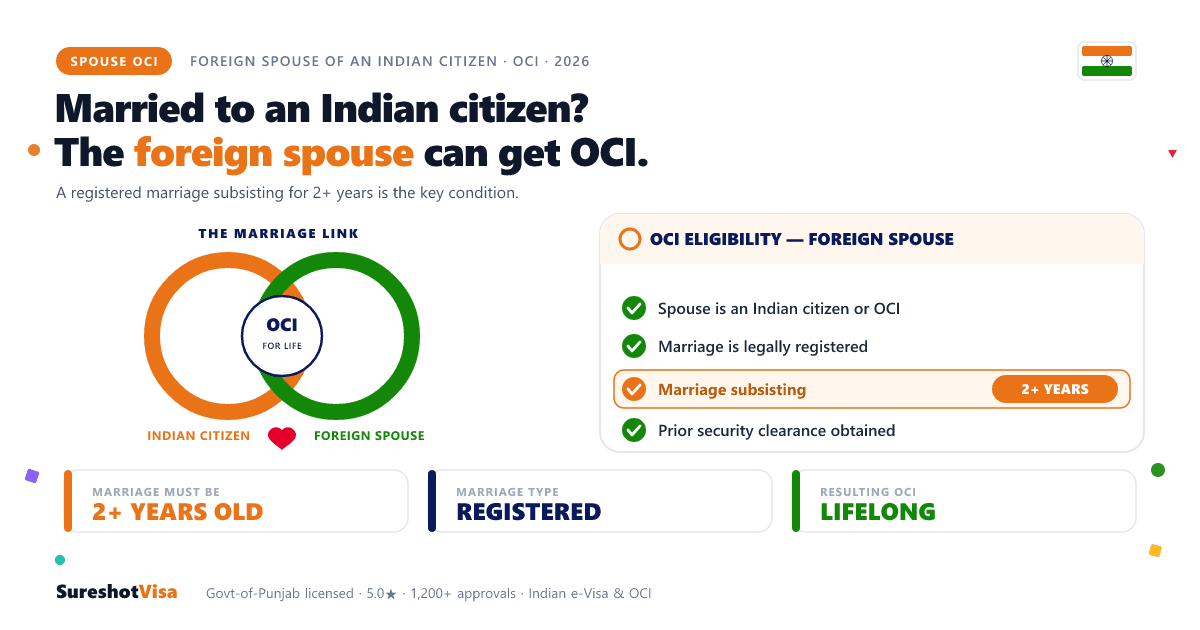
OCI for the foreign spouse of an Indian citizen: who actually qualifies.
Marriage to an Indian citizen does not hand you an OCI card the way a wedding hands you a ring. It opens a door — one with a specific set of conditions on the other side. Here is exactly what a foreign husband or wife must satisfy, and what the card gives you once granted.
A right in your own name, not a plus-one
The foreign spouse of an Indian citizen — or of an OCI holder — can be granted an OCI card in their own right. Not as an add-on to their partner's status, but as their own registration, on their own conditions.
This distinction matters because it shapes everything that follows. Your OCI is not derived from your spouse's card the way a dependent visa hangs off a primary one. You apply as yourself, you are assessed as yourself, and — once granted — you hold the card as yourself, for life, regardless of what happens to your spouse's own status later.
The trade-off is that a spouse application is scrutinised more closely than an ordinary origin-based one. Because the qualifying link is a marriage rather than a bloodline, the government looks hard at whether that marriage is genuine and enduring. The conditions below exist precisely to test that, and they are where most of the real work — and the occasional disappointment — sits.
The conditions you must clear
Every one of these has to hold. They are cumulative, not a menu.
- Your spouse is either an Indian citizen or an existing OCI cardholder at the time of your application.
- The marriage is legally registered — a religious or customary ceremony alone is not enough; there must be a registration recognised as valid.
- The marriage has subsisted continuously for at least two years immediately preceding the date you apply. This is the condition people most often trip over.
- You clear the background and security checks that the spouse category involves; a prior clearance step commonly applies before the card is granted.
- You fall outside the excluded categories — notably, a person who is, or whose parents or grandparents were, a citizen of certain neighbouring countries is not eligible; this is confirmed case by case.
One further point on the word "subsisting": the marriage must be intact at the time of application, not merely to have existed for two years at some point in the past. A marriage that has broken down, even if it once cleared two years, does not satisfy the condition.
The documents a spouse file turns on
A spouse application lives or dies on two things being airtight: proof of the marriage, and proof of the Indian spouse's status. Everything else supports those two pillars. The precise list is set by the processing authority and can vary, so treat this as the core rather than the last word.
| Document | What it establishes |
|---|---|
| Registered marriage certificate | The legal, registered marriage and its date — the anchor of the whole file |
| Spouse's Indian passport or OCI card | That your partner is an Indian citizen or OCI holder |
| Your foreign passport | Your identity and current nationality |
| Proof the marriage subsists | Evidence the marriage is current and continuous over the qualifying period |
| Photographs and signatures | To the current specification of the processing authority |
| Residential and supporting proof | Address and any further evidence the authority requests for the spouse category |
The marriage certificate carries more weight than any other page. Make sure its registration date is clearly earlier than two years before you apply, that the names on it reconcile with both passports, and that it is a properly registered certificate — not merely a ceremony record. If your names differ across documents because of the marriage itself, keep the linking paperwork in the same file so nobody has to ask.
What the card does — and where it stops
A spouse who is granted OCI holds exactly the same card, with the same lifelong benefits, as any other OCI holder. The route in is different; the card is not.
What it gives you
- Lifelong, multiple-entry travel to India with no separate visa
- No police reporting, however long you stay
- Broad rights to live, work and study in India
- A status held in your own name, for life
What it does not give you
- Indian citizenship — India allows only one
- The right to vote or hold public office
- The right to buy agricultural land
- Any automatic status for your own relatives
In short, the spouse OCI delivers the same near-resident access as any OCI, short of the political and land rights reserved for citizens. It is worth internalising that it is not a step toward Indian citizenship — the two are separate systems, and holding OCI does not put you on a citizenship track. For a fuller comparison of OCI against the ordinary visa route, our Indian visa and OCI hub lays the two side by side.
Where spouse applications go wrong
Applying before the two years are up
The most common and most avoidable misstep. Count from the registered marriage date, not the wedding, the engagement or the move-in. If you are short, the disciplined move is to travel to India in the meantime on an ordinary visa and apply for OCI once the clock is clear.
Relying on an unregistered marriage
A ceremony is not a registration. If your marriage was solemnised abroad or under a custom, confirm it is registered in a form the authorities accept, and that you hold the certificate to prove it, before you build a file around it.
Forgetting the interim travel need
While a spouse OCI is being prepared or processed, you still need a way into India for visits. That is what the ordinary visa system is for — an entry or tourist visa on your foreign passport through the official portal covers the gap. Our country pages, such as the Indian visa from the UK and the Indian visa from Australia, walk through that interim route for common nationalities.
None of this should discourage a genuinely married couple — the spouse OCI route is well-trodden and, filed at the right time with a clean marriage record, entirely routine. The failures we see are almost always about timing and about the quality of the marriage documentation, not about the merits of the marriage itself. Get those two right and the rest is process.
Spouse OCI questions, answered
Does marrying an Indian citizen automatically give me an OCI card?
No. Marriage makes you potentially eligible, but the card is granted only after you meet the conditions and apply in your own right. Chief among those conditions is that the registered marriage has subsisted continuously for at least two years before you apply, and that you clear the background checks the spouse category involves.
How long must we be married before I can apply for spouse OCI?
The marriage must be legally registered and must have subsisted continuously for at least two years immediately before the date of application. The two years run from the registration of the marriage, not from when you started your relationship or lived together. Applying before the period is complete wastes the fee and the file.
Can I apply if my spouse is an OCI holder rather than an Indian citizen?
Yes. A foreign spouse of an existing OCI cardholder can be eligible on the same footing as the spouse of an Indian citizen, provided the same conditions are met — a registered marriage subsisting for the qualifying period and successful background checks. The application is still made in your own right, not derived from your spouse's card.
Is a spouse OCI a route to Indian citizenship?
No. OCI is not citizenship and does not put you on a citizenship track — India permits only one citizenship. A spouse OCI gives you lifelong, visa-free access to India with broad rights to live, work and study, but not the right to vote, hold public office or buy agricultural land. Those remain reserved for citizens.
What happens to my OCI if the marriage later ends?
Because the card is held in your own name once granted, the general position is that it is not something that simply lapses on a private change of circumstances, but a spouse OCI can be subject to review or cancellation in defined situations, and the rules can change. We recommend confirming the current position for your circumstances rather than assuming — this is exactly the kind of point a free assessment settles.
My marriage was a religious ceremony abroad — does that count?
Only if it is legally registered in a form the authorities recognise. A religious or customary ceremony on its own is not sufficient; there must be a valid registration and a certificate to evidence it. If you are unsure whether your marriage is registered to that standard, resolve that first, because the whole application rests on it.
Can I visit India while my spouse OCI is being processed?
Yes, on your foreign passport with an appropriate Indian visa — an entry or tourist visa applied for through the official portal. OCI processing takes time, so the ordinary visa covers your travel in the interim. Do not delay a needed trip waiting for the card; the two run in parallel.
Do our children get OCI through the same application?
No. Each person's eligibility is assessed separately, and children are considered under their own criteria rather than being folded into a spouse application. If your children are of Indian origin through the Indian-citizen parent, they may qualify on that basis, but it is a distinct application with its own documents.
Not sure your marriage clears the two-year test? We will check.
SureshotVisa is a licensed Indian visa and OCI consultancy. Send us your marriage-registration date and your spouse's status, and we will confirm whether you are eligible now, exactly which marriage documents your file needs, and whether an interim visa makes sense while OCI is prepared. We do the paperwork and file it; the Government of India makes the decision.
+91 97803 01303Prefer WhatsApp? The green button at the bottom of your screen reaches the same desk.
Notes. Published 05 July 2026 and correct to the best of our knowledge on that date. Eligibility conditions, documents and fees for spouse OCI are set by the Government of India, vary by case and nationality, and change without notice — including the marriage-duration requirement referenced here. Confirm the current rules on the official portal at indianvisaonline.gov.in before acting.
This article is general information, not legal advice, and does not guarantee any OCI outcome. Every application is decided on its own merits, and the final decision rests with the Government of India and its Bureau of Immigration. We prepare and file; we do not approve.
© 2026 Sureshot Visa · A brand of Pro Lifeset Overseas Pvt Ltd · Patiala, Punjab
Need help?
We'll handle your visa file end-to-end.
Documents, VFS slots, embassy filing — by a consultant at our licensed firm.
No obligation · A consultant at our licensed firm replies today
We answer within 5 minutes

Written by
Rohit GirDocumentation & Financial Profile Support · M.Com (2022)
Rohit Gir supports the team with document review, financial-profile organisation and applicant communication. He helps ensure that income proof, bank statements, business documents, salary records and supporting evidence are presented clearly and consistently.
Full profileRelated Guides

No Objection Certificate (NOC) for a Visa — What It Must Say, and What Ruins It
Documents · Read guide
Does a UK Invitation Letter Need an Apostille? No — Here's What It Actually Needs
United Kingdom · Read guide
Switzerland Visitor Visa Cost from India 2026 — Every Rupee, Honestly
Switzerland · Read guide
Culturally Arranged Marriage Visa for New Zealand — The 2026 Guide for Indian Families
New Zealand · Read guide