Why Canada Refused 74% of Indian Students in 2025 — and How to Get In Anyway
Last reviewed: 10 September 2026 · Verified against current VFS Global India fees
An investigation into Canada's record visa refusals for Indians: why the door narrowed, what your refusal letter is really hiding, and the exact way to come back stronger.


Canada said no to almost everyone. Here's how to be the exception.
In 2025, nearly three out of four Indian students were refused. The refusal letter never told them why. We did the digging.
Simran did everything right. She had an offer letter from a college in Toronto. Her father had arranged the money. Her flight was half-booked in her head. Then one morning a short email arrived — four cold lines from the visa office. "We are not satisfied that you will leave Canada at the end of your stay." Refused.
She read it ten times. She had never planned to stay forever. So why did they think she would? The letter didn't say. And that is the cruellest part of a Canada refusal: it tells you that you failed, but never tells you why.
Simran is not alone. Not even close.
In just two years, the refusal rate more than doubled. For visitor visas, more than half of Indians are now refused too. The door to Canada did not slam shut — but it narrowed to a thin gap. And most people are walking straight into the frame, the wrong way.
Part OneHow the easy dream got hard
For years, Canada was the dream that felt within reach. Decent cost, friendly people, a clear path from study to PR. Word spread fast through Punjab and Gujarat — uncle to nephew, neighbour to neighbour. Soon, too many were applying. Some "colleges" were barely colleges. Some "students" never meant to study.
So in 2024, Canada pulled the brakes. Hard. Five changes turned the easy dream into an obstacle course:
It put a limit on seats
Canada now caps how many study permits it gives each year. Fewer approvals overall — even strong files now lose simply because the room is smaller.
It doubled the money you must show
The living-cost proof jumped to about CAD 20,635 — over ₹13 lakh — on top of your tuition. Old, comfortable bank balances suddenly look too small.
It closed the fast lane
The quick Student Direct Stream (SDS) is gone. Everyone now goes through the slower, stricter normal route, where officers look much harder.
It started phoning your college
Your acceptance letter is now checked directly with the institution. A weak, fake, or "agent-arranged" offer gets caught in days.
It started asking: "does this make sense?"
A random diploma after a master's degree? A course with no link to your past? To an officer, that doesn't look like study — it looks like a back door. And it gets refused.
Part TwoYour refusal letter is lying to you
Here is the trap. The letter you receive is short and full of vague tick-boxes. It is designed to be legally safe, not honest. Most people read it, guess what went wrong, fix the wrong thing, and get refused again. Let's translate a typical one:
After careful review, I am not satisfied that you will leave Canada at the end of your authorized stay. I am refusing your application based on:
— Your personal assets and financial status. 1
— The purpose of your visit. 2
— Your family ties in Canada and your country of residence. 3
Notice something? Three completely different problems — money, plan, ties — and the letter lumped them together in cold, identical language. So which one actually sank your file? You cannot fix it until you know. And there is exactly one way to find out.
The officer wrote down the real reason
Almost no refused student knows this: the visa officer kept private notes on your case — the actual, plain-language reason you were refused. And by law, you are allowed to request and read them.
They're called your GCMS notes (older name: CAIPS notes). They turn the vague letter into a clear sentence like "applicant's funds deposited 19 days before submission, source not established." That one line is everything. It tells you precisely what to fix.
Reapplying without reading your notes is like swallowing medicine without knowing the disease. Get the notes first. Always.
Part ThreeThe comeback
A refusal is not a verdict. It's a redirection. Once you know the real reason, the path back is surprisingly clear — four honest steps, in order:
Get the truth
Order your GCMS notes and read the officer's real reason. Don't skip this — it's the whole game.
Fix the exact wound
Money problem? Build a clean money trail. Weak plan? Rewrite your study purpose. Treat the real issue — not everything in a panic.
Strengthen the weak spots
Add clear proof of funds, a study plan that makes sense, and strong ties to India that show why you'll return.
Walk back in stronger
Reapply with a file that answers the officer's exact worry head-on. This is how second tries get approved.
And sometimes the honest answer is different: if Canada is a poor fit for your profile, Australia, the UK, or a European study route may suit you better. A good consultant tells you that truth — instead of selling you another Canada attempt that's likely to fail again.
Part FourWhat happened to Simran
Simran ordered her notes. The real reason was almost embarrassingly small: one large deposit had landed in her account three weeks before she applied, with no paper trail. To the officer, borrowed money. To Simran, her own savings she'd simply moved at the wrong time.
The fix took an afternoon — a clear money trail, the right documents, a tighter study plan. Three months later she reapplied. This time, the email was one line shorter and a whole life longer: approved.
The door to Canada is narrow now. But narrow is not closed. You just have to walk in knowing exactly what the officer is looking at — and that starts with reading the file they wrote about you.
Refused? Let's read your file together.
We'll help you order your GCMS notes, find the real reason, and rebuild a stronger application before you reapply.
Questions people ask after a refusal
Can I reapply right after a refusal?
Yes, immediately. But fix the real reason first — reapplying with the same file usually gets refused again.
What exactly are GCMS / CAIPS notes?
The visa officer's private notes on your case. They reveal the real reason for refusal — the thing the short letter never tells you.
How long do the notes take?
Usually about 25 to 30 days after you order them.
Does a refusal stay on my record?
Yes. You must declare past refusals in future applications, for Canada and other countries. That's exactly why fixing the real reason matters.
Need help?
We'll handle your visa file end-to-end.
Documents, VFS slots, embassy filing — by a licensed consultant.
We answer within 5 minutes
Full Country Guide
Canada Visa from India — fees, documents, processing time
Everything you need on one page: VFS centres, visa types, fee breakdown, doc checklist.

Written by
Narinder ChahalFounder, SureshotVisa · B.Tech, Computer Science (2008)
Narinder Chahal founded SureshotVisa with a simple belief: a visa file should be clear, honest and backed by strong documents. After moving to Canada in 2014, he has helped Indian and international applicants understand visa filing, refusal concerns, document gaps and immigration-related issues.
Full profileRelated Guides

Canada Tourist Visa Show Money from India: Requirements
Learn how much show money you need for a Canada tourist visa from India, whose name it should be in, and how long funds must remain in your account.
Read guide
Can You Take Your Dog to Canada from India? The 2026 Pet Guide
Yes — your dog can come to Canada, and the paperwork is simpler than you fear. The one document CFIA cares about, the airline choice that trips people up, and the timeline to start now.
Read guide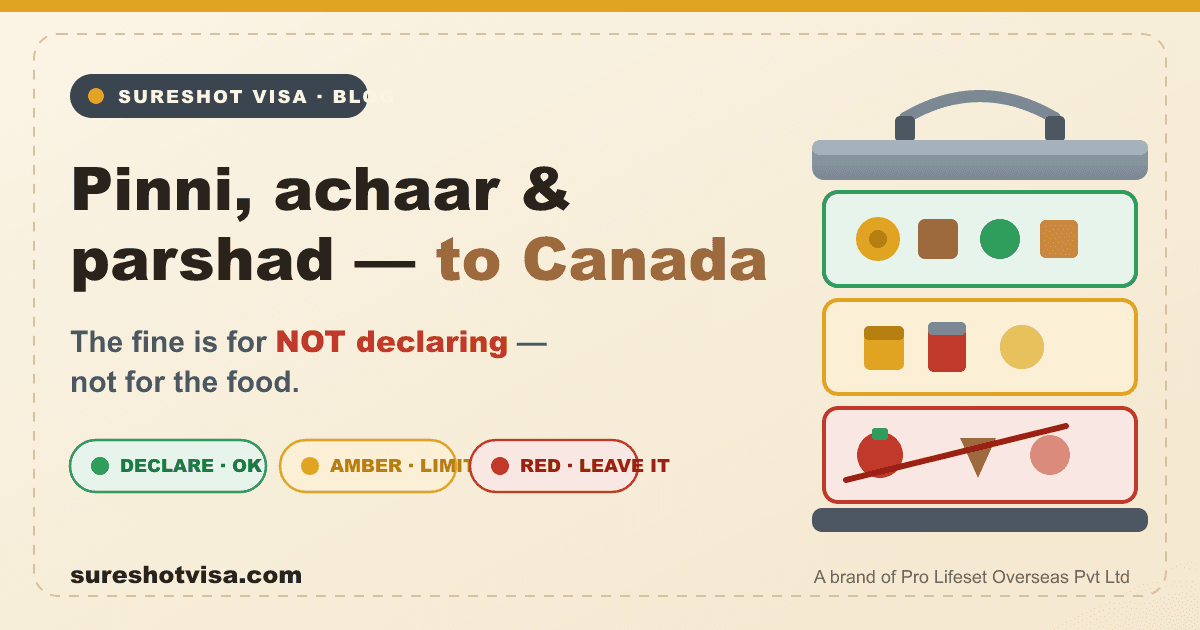
Pinni, Achaar & Parshad to Canada: What You Can Actually Pack (2026)
Yes, you can carry many Indian foods to Canada — but the fine is for NOT declaring, not for the food. The green / amber / red guide to packing your maa-ke-haath sweets without a CA$1,300 surprise.
Read guide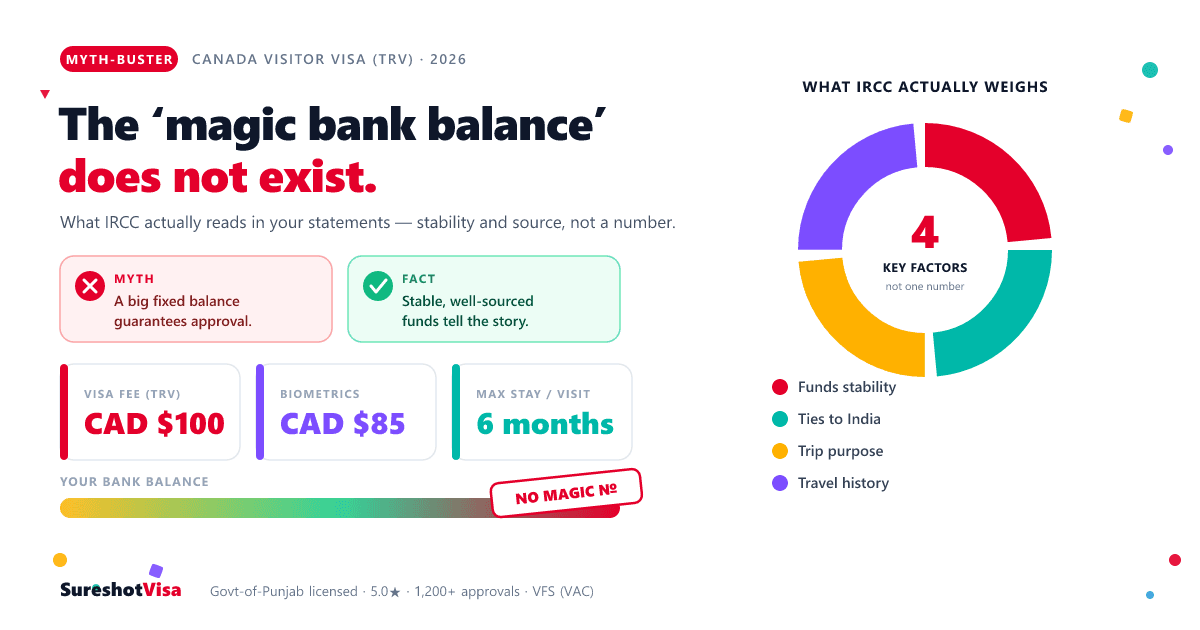
Canada Visitor Visa Bank Balance Myths, Busted (2026)
There is no magic bank balance number for a Canada visitor visa. Six myths against what IRCC officers actually read in your six-month statements.
Read guide