
OCI vs Indian Visa: Which Do NRIs Actually Need?
An OCI card and an Indian visa solve different problems. A plain-English decision guide for NRIs and people of Indian origin on which one you actually need in 2026.

Last reviewed: 10 September 2026 · Verified against official Indian government sources
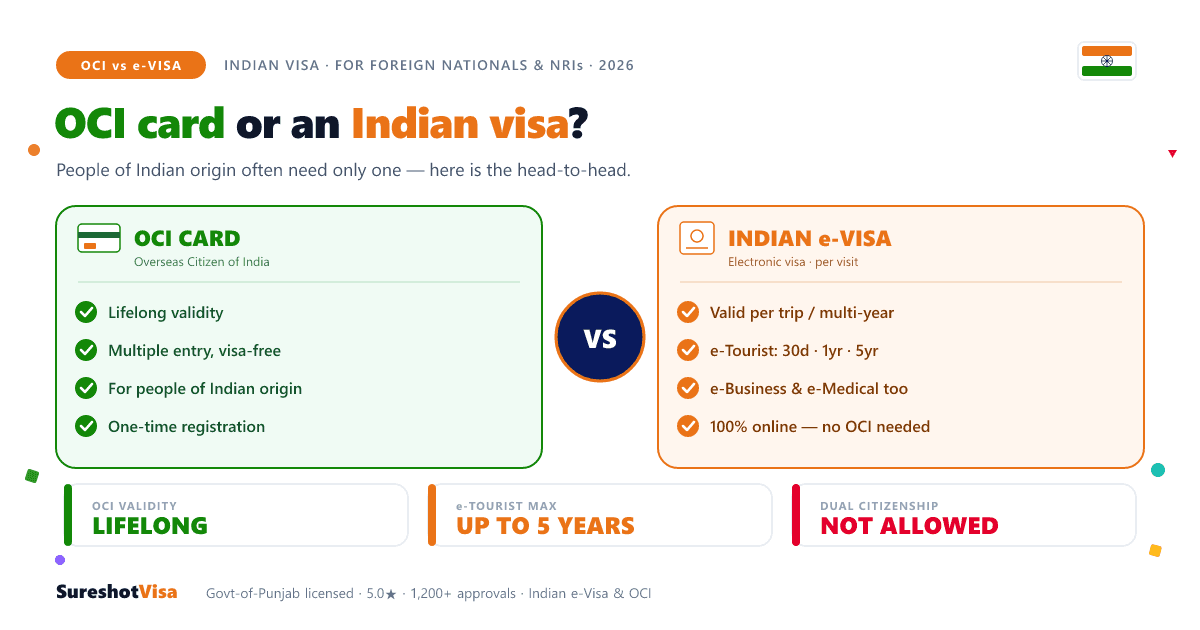
OCI or an Indian visa? They solve different problems.
Half the confused emails we get from abroad come from mixing these two up. One is a lifelong status tied to your heritage; the other is time-limited permission to enter. Here is how to tell, in five minutes, which one your situation actually calls for.
A card you keep for life, versus a stamp that runs out
If you remember nothing else: an Indian visa is permission to visit; an OCI card is recognition of who you are.
An Indian visa — whether the electronic ETA you apply for online or the sticker your nearest mission places in your passport — is a time-boxed authorisation. It says the Government of India will let you enter for a stated purpose, for a stated window, and no longer. When it expires, it is gone, and the next trip needs a fresh one.
An OCI card — Overseas Citizen of India — is a different animal entirely. It is a lifelong registration granted to foreign nationals of Indian origin (and, in defined cases, their foreign spouses). It carries a multiple-entry, lifelong right to travel to India, with no separate visa and no police reporting no matter how long you stay. It is not, however, citizenship. India does not permit dual citizenship, and the OCI card is careful to say so on its own terms.
So the honest first question is not "which is better" — it is "which are you even eligible for?" Most people abroad qualify for exactly one of the two paths without a choice to make. The rest of this guide sorts you into the right lane.
The two, on one table
The visa column below lumps the electronic e-Visa families together; there are separate posts on each. What matters here is how the two categories differ in kind.
| Indian visa | OCI card | |
|---|---|---|
| What it is | Permission to enter for a purpose and period | Lifelong registration for people of Indian origin |
| Who it is for | Any eligible foreign national | Foreign nationals of Indian origin & qualifying spouses |
| How long it lasts | 30 days, 1 year or 5 years by tier; then expires | For life (re-issue only at defined passport milestones) |
| Entries | Single, double or multiple, by category | Multiple, unlimited, for life |
| Long stays | Capped per the visa tier | Stay indefinitely, no police reporting |
| Can you work / study? | Only under the matching visa category | Broad access; some sectors still restricted |
| Voting, farmland, public office | No | No — this is where it stops short of citizenship |
Read the bottom two rows together and the design becomes obvious. OCI gives you almost everything a resident enjoys except the political and land rights reserved for citizens. A visa gives you a defined slice of access for a defined time. They are not competitors; they are answers to different questions.
Which lane are you in?
Work down these in order and stop at the first one that fits.
If neither you nor your parents, grandparents or great-grandparents were Indian, OCI is off the table — it is a heritage status. You need a visa, full stop. A tourist e-Visa for a holiday or family visit, a business e-Visa for meetings, a medical e-Visa for treatment, or a sticker visa for work or long study. Start at our Indian visa hub and pick the category that matches your reason for coming.
Born in India, or descended from someone who was, but you only visit every few years for weddings and holidays? A 5-year tourist e-Visa may cover you comfortably without the paperwork of OCI. Many NRIs of convenience live happily on e-Visas. OCI becomes worth the effort when the visits get frequent, the stays get long, or a parent needs care.
Property here, ageing parents, a business, children you want rooted in the country, or simply a plan to spend months at a stretch — this is what OCI was built for. Apply once, hold it for life, and never fill in a visa form for India again. If you were ever an Indian citizen yourself, note the catch in the next section before you start.
The wrong turns we untangle every week
Treating OCI as a faster visa
People sometimes ask us to "just get the OCI quickly" for a trip next month. It does not work that way. OCI is a registration process with document verification and background checks; it is measured in weeks, sometimes longer, and depends on your case. For an imminent trip, the e-Visa is the tool — apply on the official portal, carry the approved ETA, and pursue OCI separately for the long game.
Assuming the OCI card is a passport
It is not travel documentation. You still travel on your foreign passport; the OCI is what removes the visa requirement on arrival. Carry both, and keep the passport number on your OCI current — a mismatch at immigration is an avoidable headache we see too often.
Forgetting that a visa still has a job after OCI
Even OCI holders occasionally need the visa system — for example, journalists and researchers in certain fields need specific permissions regardless of OCI. And family members who are not of Indian origin, travelling with you, will each need their own visa. OCI covers the individual it is issued to, not the whole household.
The clean way to think about it: decide your eligibility first, your frequency second, and your timeline third. Eligibility tells you whether OCI is even possible; frequency tells you whether it is worth it; timeline tells you whether you need a visa in the meantime while OCI is processed. Nearly every real case resolves cleanly once those three are on the table. For country-specific detail — documents, mission jurisdiction, processing quirks — our page for the Indian visa from the USA is a good worked example, and the Indian visa from the UK page mirrors it for British applicants.
What NRIs ask us most
Is an OCI card the same as dual citizenship?
No. India does not allow dual citizenship, and the OCI card is explicit that it is not citizenship. It gives you a lifelong, multiple-entry right to live, work and study in India without a visa, but you cannot vote, hold a constitutional or public office, or buy agricultural land. Think of it as permanent access, not a second nationality.
Can I get OCI if I still hold an Indian passport?
No. Because India permits only one citizenship, you must surrender your Indian passport and obtain a Surrender Certificate before an OCI application can be processed. If you acquired foreign citizenship, your Indian citizenship has already ceased by law, and surrendering the passport is the formal step that lets OCI proceed.
Do I need a visa if I already have an OCI card?
No — that is the point of OCI. The card gives you visa-free entry to India for life, with unlimited entries and no police reporting on long stays. You travel on your foreign passport and present the OCI card, but you do not apply for a separate visa each time.
I only visit India occasionally — is a 5-year e-Visa enough?
Often, yes. For infrequent tourism or family visits, a multiple-entry tourist e-Visa can be simpler than the OCI registration process. OCI earns its keep when your visits become frequent or long, when you own property, or when you want indefinite stays without the reporting a visa can involve. We can weigh the two for your travel pattern in a free assessment.
How long does OCI take compared to an e-Visa?
They are not in the same league on speed. An e-Visa is an online application processed relatively quickly, suited to an upcoming trip. OCI is a registration with document verification and background checks, measured in weeks and sometimes longer depending on your case. For a trip soon, use the visa; pursue OCI in parallel for the long term.
Does my foreign spouse get OCI automatically through me?
Not automatically. A foreign spouse of an Indian citizen or of an OCI holder can be eligible in their own right, but only when specific conditions are met — chiefly that the marriage is registered and has subsisted for a qualifying continuous period before applying. It is a separate application with its own documents, which we cover in a dedicated guide.
Can my whole family travel on my OCI card?
No. OCI covers only the individual named on the card. Family members who are not of Indian origin — including a spouse who has not obtained their own OCI — each need their own Indian visa to travel with you. Plan each traveller separately rather than assuming the card extends across the household.
If I am not of Indian origin at all, what are my options?
OCI is only for people of Indian origin and qualifying spouses, so it will not apply to you. You use the visa system: a tourist e-Visa for holidays or visiting friends, a business e-Visa for work-related travel, a medical e-Visa for treatment, or a regular sticker visa for employment or long study. The right category depends entirely on why you are coming.
Not sure which lane is yours? We will tell you straight.
SureshotVisa is a licensed Indian visa and OCI consultancy. Tell us your citizenship, your Indian-origin details and how you use India, and we will confirm whether you need a visa, an OCI card, or a visa now and OCI later — then prepare and file it for you. We do the paperwork; the Government of India makes the decision.
+91 97803 01303Prefer WhatsApp? The green button at the bottom of your screen reaches the same desk.
Notes. Published 05 July 2026 and correct to the best of our knowledge on that date. Eligibility rules, categories and fees for OCI and Indian visas vary by nationality and change without notice; confirm current requirements on the official Government of India portal at indianvisaonline.gov.in before acting.
This article is general information, not legal advice, and does not guarantee any visa or OCI outcome. Every application is decided on its own merits, and the final decision rests with the Government of India and its Bureau of Immigration. We prepare and file; we do not approve.
© 2026 Sureshot Visa · A brand of Pro Lifeset Overseas Pvt Ltd · Patiala, Punjab
Need help?
We'll handle your visa file end-to-end.
Documents, VFS slots, embassy filing — by a consultant at our licensed firm.
No obligation · A consultant at our licensed firm replies today
We answer within 5 minutes

Written by
Paramjit SinghVisa Documentation & Case Support · B.Tech, Computer Science (2007)
Paramjit Singh focuses on the structure behind a strong visa file: the purpose, the supporting documents, the financial explanation and the return-ties logic. He keeps applications organised so the file never looks scattered, incomplete or contradictory.
Full profileRelated Guides

No Objection Certificate (NOC) for a Visa — What It Must Say, and What Ruins It
Documents · Read guide
Does a UK Invitation Letter Need an Apostille? No — Here's What It Actually Needs
United Kingdom · Read guide
Switzerland Visitor Visa Cost from India 2026 — Every Rupee, Honestly
Switzerland · Read guide
Culturally Arranged Marriage Visa for New Zealand — The 2026 Guide for Indian Families
New Zealand · Read guide