
Surrendering Your Indian Passport After Foreign Citizenship
Acquired a foreign passport? Your Indian citizenship has already ended by law — and you must surrender your Indian passport to get a Surrender Certificate. The steps, in order.

Last reviewed: 10 September 2026 · Verified against official Indian government sources
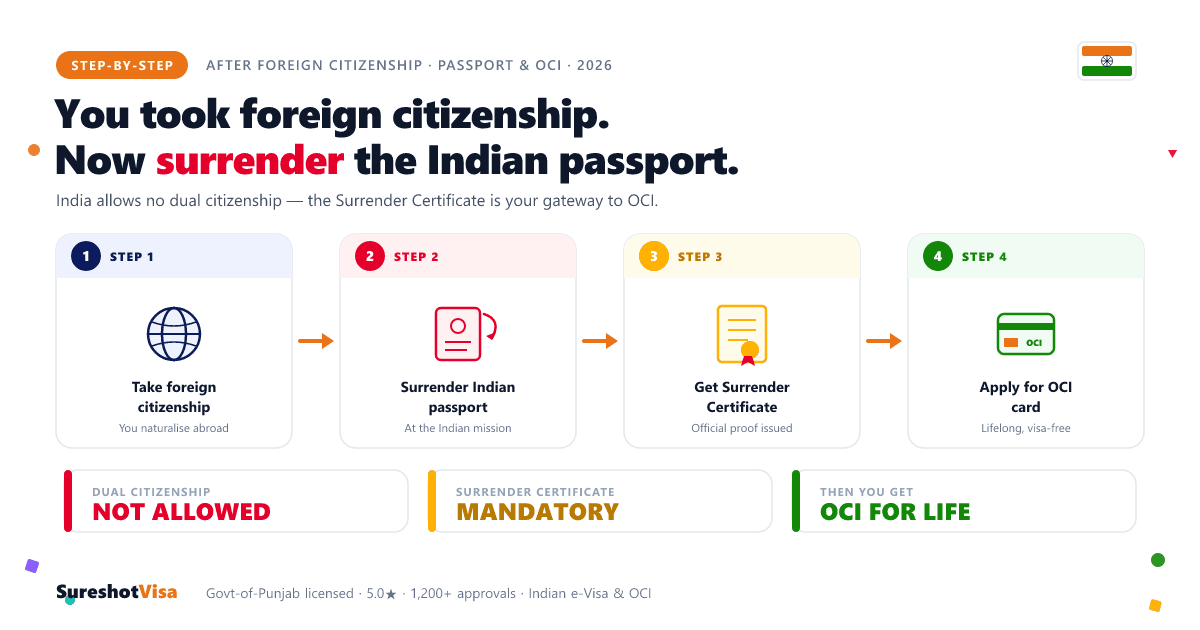
Surrendering your Indian passport after foreign citizenship, step by step
The day you took a foreign passport, your Indian citizenship ended by operation of law — not by your choice, and not on a form. What remains is a formality you cannot skip: surrendering the Indian passport and obtaining a Surrender Certificate. Here is exactly what that involves.
Why this is compulsory, not optional
India does not permit dual citizenship. The moment you naturalised abroad, you stopped being an Indian citizen — the surrender is the paperwork that catches up with a status that has already changed.
This trips people up, so it is worth stating plainly. Nobody at an Indian mission "cancels" your citizenship when you naturalise; the law does it automatically. But your Indian passport is a document that certifies a citizenship you no longer hold, and continuing to hold — or worse, travel on — that passport after acquiring foreign nationality is an irregularity the authorities take seriously.
There are two very practical reasons to complete the surrender promptly rather than "some day". First, the Surrender Certificate is a hard prerequisite for OCI. If you plan to hold an Overseas Citizen of India card — and most people in this position eventually do — the OCI application cannot be processed until the surrender is done and the certificate issued. Second, delay can attract penalties. Missions may levy charges for late surrender, and for any travel undertaken on the Indian passport after your naturalisation date. We do not quote figures here because they vary by mission and change; we confirm the current position for your case in the free assessment.
The takeaway: treat the surrender as the first item on the list the week your foreign passport arrives, not a chore for later.
What you are actually applying for
The process produces two things, and it helps to know both before you start:
- Your cancelled Indian passport, returned. The mission physically cancels the booklet (typically by punching or stamping it) and hands or couriers it back to you. You keep it — it is proof of your former citizenship and is sometimes asked for later.
- The Surrender Certificate. A separate document confirming you have formally surrendered Indian citizenship. This is the piece OCI, and various other formalities, will ask to see.
People sometimes call this a "renunciation certificate" — for the purpose of surrendering the passport, treat the terms as referring to the same outcome. What matters is that you end up holding the certificate and the cancelled booklet. Keep scans of both, indexed somewhere you will find them in five years, because the OCI file and any future re-issue will want them.
The document set
The exact list is set by the Indian mission with jurisdiction over where you live, and small variations exist between missions. The core set below is what almost every file needs. Gather it before you open the online form — a half-assembled application is the single most common reason a surrender stalls.
| Ref | Item | Notes |
|---|---|---|
| D-1 | Original Indian passport | The booklet to be surrendered and cancelled; must be the current or most recent one |
| D-2 | Foreign passport | Proof of your new citizenship; the bio page is copied |
| D-3 | Naturalisation / citizenship certificate | The document showing the date you acquired foreign citizenship |
| D-4 | Completed surrender application | Filled on the official portal, printed and signed |
| D-5 | Passport-size photographs | To the mission's current photo specification |
| D-6 | Proof of current address | Establishes which mission's jurisdiction you fall under |
| D-7 | Any earlier Indian passports held | If you have held more than one; missions often ask for the history |
Two document notes save the most grief. First, names must reconcile across the Indian and foreign passports — if you changed your surname on naturalisation or marriage, be ready to bridge the gap with the marriage or deed-poll document. Second, the citizenship date on D-3 is load-bearing; it fixes the moment your Indian citizenship ceased and drives any late-surrender assessment, so make sure the certificate is legible and the date is unambiguous.
The steps, in order
Surrender is handled by the Indian embassy, high commission or consulate — or its outsourced service provider — that covers your place of residence. Your address (D-6) decides which one. Applying to the wrong jurisdiction is a common early misfire.
The form is filled through the official Government of India passport/visa portal, then printed and signed. Enter the citizenship-acquisition date carefully and check every field against your documents before submitting.
Attach the printed form, the original Indian passport, the foreign passport and naturalisation certificate copies, photographs and address proof. Fees vary by mission and by how long after naturalisation you are applying; the current amount is confirmed at this stage, not guessed at earlier.
How you lodge the file depends on your mission; some require the original passport by secure courier, others in person. Follow that mission's channel exactly, and keep the tracking or receipt reference.
The mission cancels the booklet and issues the certificate. Processing time varies by mission and workload. Once both are in hand, scan them, store them safely, and you are cleared to move on to OCI if that is your plan.
The avoidable delays
The name mismatch left unexplained
A surname changed on naturalisation, with no marriage certificate or name-change deed to bridge it, is the classic hold. Include the linking document from the start rather than waiting to be asked.
The wrong or expired Indian passport
Surrender the current or most recent Indian passport. If you have held several, missions frequently want sight of the earlier ones too (D-7). Assume the history will be asked for and assemble it up front.
Underestimating the timeline before OCI
Because OCI depends on the certificate, any delay in the surrender delays the OCI, which in turn delays your first visa-free trip. If a trip to India is on the horizon, a good interim step is applying for an ordinary e-Visa on your foreign passport through the official portal while the surrender and OCI work through. Our country pages — for instance the Indian visa from Canada and the Indian visa from the USA — cover that interim visa route in detail.
None of these steps is individually hard. The difficulty is that they must be done in the right order, with a document set that reconciles internally, through the correct mission. Get those three right and a surrender is routine. Get any one wrong and it becomes a months-long correspondence. When you are ready to move on to the card itself, the Indian visa and OCI hub covers what comes next.
Surrender questions, answered
Do I really have to surrender my Indian passport, or can I just let it expire?
You must surrender it. Because India does not allow dual citizenship, your Indian citizenship ended by law when you naturalised, and the passport certifies a status you no longer hold. Letting it lapse does not close the matter, and the Surrender Certificate you receive is a document you will need later — for OCI in particular.
What is a Surrender Certificate and why does OCI need it?
It is the official document confirming you have formally surrendered your Indian citizenship after acquiring a foreign one. OCI is only for foreign nationals, so the government must first see proof that you are no longer an Indian citizen. Without the Surrender Certificate, an OCI application cannot be processed.
Where do I apply to surrender my Indian passport?
Through the Indian mission — embassy, high commission or consulate — or its outsourced service provider, that has jurisdiction over where you live. Your residential address determines which office that is. The application itself is completed on the official Government of India portal and then submitted to that mission through its stated channel.
Is there a penalty if I surrender late?
There can be. Missions may charge for a delayed surrender and for any travel done on the Indian passport after your naturalisation date. The amounts vary by mission and change over time, so we do not quote figures here; we confirm the current position for your specific dates and location in a free assessment before you file.
Can I travel to India while my surrender is being processed?
Yes, but on your foreign passport with an appropriate Indian visa — not on the Indian passport you are surrendering. Once you hold foreign citizenship, you should never enter India on the old Indian booklet. An ordinary e-Visa on your foreign passport is the usual interim route while the surrender and any OCI application are in progress.
How long does the surrender take to process?
It varies by mission and current workload, so we avoid promising a fixed number. What you can control is the delay caused by an incomplete file: submitting a fully reconciled document set through the correct jurisdiction is the single biggest lever on turnaround. Build in comfortable time before any planned trip or OCI application.
I have held more than one Indian passport over the years — which do I surrender?
You surrender the current or most recent Indian passport, but be ready to show the earlier ones too. Missions frequently ask for the passport history to confirm continuity, so gather every Indian booklet you have held before you submit rather than producing them one at a time on request.
My name changed after marriage or naturalisation — does that complicate the surrender?
It can, if the change is left unexplained. Include the document that bridges the old and new names — a marriage certificate or a name-change deed — from the outset so the mission can reconcile your Indian and foreign passports. An unbridged name mismatch is one of the most common reasons a surrender file is held up.
Let us run the surrender — and set up your OCI right behind it
SureshotVisa is a licensed Indian visa and OCI consultancy. Send us your naturalisation date and where you live, and we will confirm the exact document set, the right mission, the current fees for your case, and the correct order to file the surrender and OCI. We prepare and lodge the paperwork; the Government of India makes the decision.
+91 97803 01303Prefer WhatsApp? The green button at the bottom of your screen reaches the same desk.
Notes. Published 05 July 2026 and correct to the best of our knowledge on that date. Document requirements, procedures and fees for surrendering an Indian passport are set by the relevant Indian mission and vary by jurisdiction and applicant; they change without notice. Confirm the current requirements on the official Government of India portal at indianvisaonline.gov.in and with your mission before acting.
This article is general information, not legal advice, and does not guarantee any outcome. Every application is decided on its own merits, and the final decision rests with the Government of India and its Bureau of Immigration. We prepare and file; we do not approve.
© 2026 Sureshot Visa · A brand of Pro Lifeset Overseas Pvt Ltd · Patiala, Punjab
Need help?
We'll handle your visa file end-to-end.
Documents, VFS slots, embassy filing — by a consultant at our licensed firm.
No obligation · A consultant at our licensed firm replies today
We answer within 5 minutes

Written by
Rohit GirDocumentation & Financial Profile Support · M.Com (2022)
Rohit Gir supports the team with document review, financial-profile organisation and applicant communication. He helps ensure that income proof, bank statements, business documents, salary records and supporting evidence are presented clearly and consistently.
Full profileRelated Guides

No Objection Certificate (NOC) for a Visa — What It Must Say, and What Ruins It
Documents · Read guide
Does a UK Invitation Letter Need an Apostille? No — Here's What It Actually Needs
United Kingdom · Read guide
Switzerland Visitor Visa Cost from India 2026 — Every Rupee, Honestly
Switzerland · Read guide
Culturally Arranged Marriage Visa for New Zealand — The 2026 Guide for Indian Families
New Zealand · Read guide