
Indian e-Visa for US Citizens 2026: How to Apply
A US passport qualifies for India's fully online e-Visa — which visa you need, the documents, how to apply, and the airport rules, for 2026.

Last reviewed: 10 September 2026 · Verified against official Indian government sources
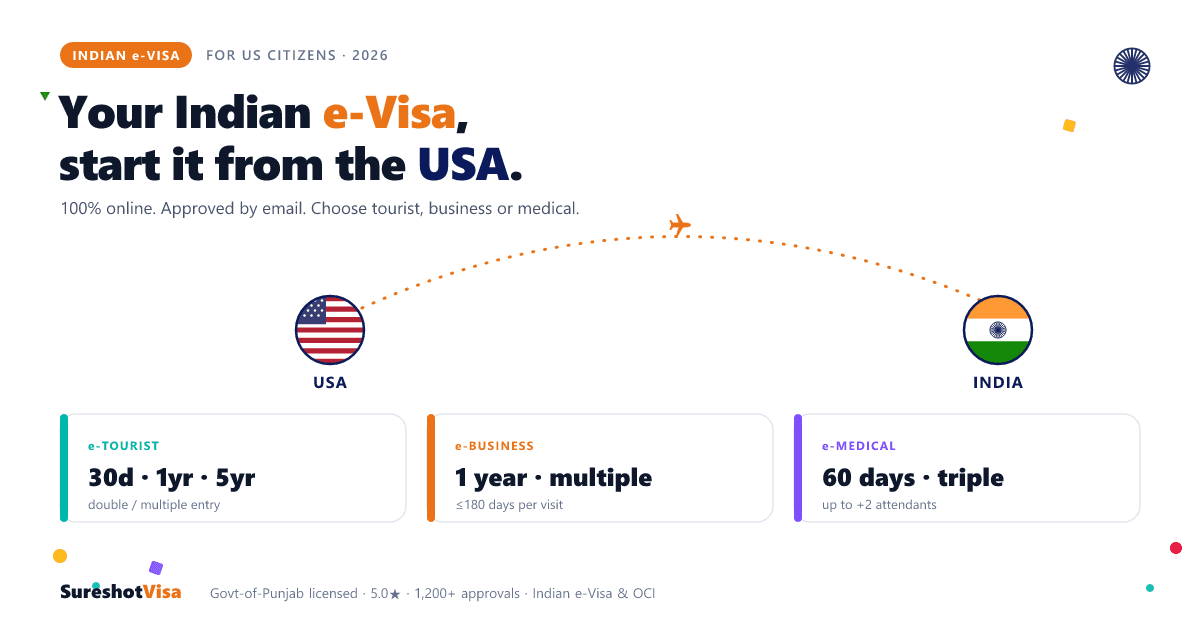
The Indian e-Visa for US citizens, applied the calm way.
Your American passport qualifies for India's fully online e-Visa. No embassy queue, no courier, no sticker — an approval that lands in your inbox. Here is the whole route, in order, with the traps flagged before you reach them.
Most Americans need the e-Visa. A few need something else.
Before you touch a form, name the trip. India issues a different visa for sightseeing than for a board meeting or a job, and picking the wrong one is the most expensive mistake on this page — it usually means starting over.
US citizens are eligible for India's electronic visa scheme, so for the common reasons Americans visit, you will almost certainly want an e-Visa. It splits by purpose:
- e-Tourist Visa — for tourism, seeing family and friends, a short recreational course, or a yoga or wellness retreat. This is the one most American travellers reach for, and it comes in three durations we will get to below.
- e-Business Visa — for meetings, negotiations, setting up a venture, trade fairs and the like. It is valid a year with multiple entries, and no single stay may exceed 180 days. It is emphatically not a work permit — you cannot take up employment on it.
- e-Medical & Medical Attendant Visa — for treatment at an Indian hospital, valid 60 days from your first arrival with triple entry, and up to two attendants may travel on the companion visa.
Where the e-Visa does not fit — you are moving to India to take a job, enrol in a long degree, or work as a journalist — you need a regular sticker visa from an Indian mission or consulate in the US, not the online route. And if you are a foreign national of Indian origin, the smarter long-game document is often the OCI card, which we cover at the end.
Not sure which bucket you fall in? That is exactly what our free assessment settles. Our India visa guide for US citizens lays the options side by side, and the Indian visa hub covers every category.
Assemble these five things first, then apply in one sitting
Have the following ready before you begin — the form takes about twenty focused minutes, and it times out if you wander off mid-way.
- Your US passport — with comfortable validity beyond your travel dates and blank pages for stamping. Confirm the current minimum validity and blank-page requirement on the official portal before you rely on it; these rules are set by India, not by us.
- A digital passport-style photograph — square, recent, plain light background, your full face in view.
- A clear scan or photo of your passport's bio-data page — the one with your photo and details.
- A US-issued payment card — the government fee is paid online at the end. Fees vary by nationality and change over time, so we confirm the exact current figure for a US passport in your assessment rather than quote one that may be stale.
- Your India details — a reference address or hotel, and for a business trip, your inviting company's letter and address.
Enter your name precisely as it appears in the machine-readable zone of your passport — same spelling, same order, no nicknames. A "Bill" where the passport says "William" is the single most common reason a clean US application gets snagged.
Seven steps on the official portal, start to inbox
Apply only on the Government of India's official site — indianvisaonline.gov.in. Lookalike sites charge a markup for the same free form and sometimes for nothing at all.
Go to indianvisaonline.gov.in and choose the e-Visa application. Check that the address is exactly right.
Tourist, business or medical — and within tourist, the 30-day, one-year or five-year duration. Choose deliberately.
Copy everything from the passport itself, character for character. Slow here saves grief later.
Meet the size and format the portal asks for. A rejected photo is the top cause of an avoidable back-and-forth.
Travel history, prior visas, occupation. Consistency with your documents matters more than any single answer.
With your US card. Save the receipt and your application ID — you will want both.
Approval arrives as an Electronic Travel Authorisation in your inbox. Print a copy and keep a phone image as backup.
That is the mechanical part. The judgement part — whether your type, dates and answers hang together as one consistent file — is where applications quietly succeed or fail, and it is what we do for clients daily.
Three tourist tiers, and which one fits your travel habit
If you land on the e-Tourist Visa, you choose one of three durations. They differ by how long the authorisation lives and how many times you can enter.
On the one-year and five-year tiers there is a cap on how long you may stay per visit, and that cap varies by nationality. Rather than print a figure that might not match your passport, we confirm the exact per-visit limit for a US citizen in your assessment — one of the details worth getting right before you book weeks of travel.
What the e-Visa lets you do — and the airport rules
An approved e-Visa is an Electronic Travel Authorisation, not a stamp in advance. A few rules govern how you actually use it:
- Carry the printed ETA and the passport you applied with. The immigration officer matches one against the other, and stamps the entry on arrival.
- Enter through a designated port. e-Visa holders are admitted at specified international airports and seaports — not at every crossing. Check that your arrival city is on the current designated list before ticketing.
- Treat the e-Visa as fixed. It is generally non-extendable and non-convertible to another category once granted, so match the type and duration to the real trip up front.
An approved ETA is permission to travel to a port of entry; the final decision to admit you rests with the Bureau of Immigration officer at the border. That holds for every nationality — nobody can guarantee entry, and be wary of anyone who claims they can.
Three things that trip up American applicants
Leaving it to the last week. The e-Visa is fast in the smooth case but not instant, and some files are pulled for extra checks. Apply well ahead so a routine delay does not become a cancelled trip.
Choosing tourist when the trip is business. Meetings, contract talks and site visits are business activity, not tourism. The purpose you declare should match what you will actually do in India.
Assuming approval is automatic. The vast majority of straightforward US applications go through cleanly, but the e-Visa is a real adjudication, not a formality — a coherent, consistent file is what keeps it straightforward.
A word on OCI, the lifelong alternative
If you are a US citizen of Indian origin — or the spouse of one, subject to conditions — you may not want a repeat-purchase visa at all. The Overseas Citizen of India (OCI) card gives lifelong, multiple-entry, visa-free access to India, with no police reporting on long stays. It is a far better fit for anyone who visits often or keeps family ties there.
Two honest caveats. OCI is not dual citizenship — India does not permit that — so it does not let you vote, hold constitutional office, or buy agricultural land. And if you ever held an Indian passport, you must surrender it and obtain a Surrender Certificate before OCI can be processed. We handle both the surrender and the OCI application as one file when that is your situation.
The e-Visa questions we field most from American clients
Can US citizens get an Indian visa online?
Yes. US passport holders are eligible for India's e-Visa scheme, so tourist, business and medical trips can be applied for entirely online at the official portal, with the approval arriving by email. Only purposes outside the e-Visa scheme — such as employment, long-term study or journalism — require a regular sticker visa from an Indian mission.
How much does the Indian e-Visa cost for a US passport?
The government fee depends on your nationality and the visa type and duration, and it is revised from time to time, so we do not quote a fixed figure that could be out of date. We confirm the exact current fee for a US citizen in your free assessment, and you pay it directly to the government on the official portal.
How long is the Indian e-Tourist Visa valid for US citizens?
It depends which of the three tiers you choose: 30 days from first arrival with double entry, one year with multiple entry, or five years with multiple entry. On the one-year and five-year tiers the validity runs from the date the authorisation is granted, and a per-visit stay cap applies that varies by nationality.
Do I need a visa for a business trip to India on a US passport?
Yes — for meetings, negotiations or setting up a venture you need an e-Business Visa, which is valid one year with multiple entries and caps each single stay at 180 days. It does not permit employment; taking up a job in India requires a regular employment visa arranged through an Indian mission.
Where do I actually apply for the Indian e-Visa?
Only on the Government of India's official portal at indianvisaonline.gov.in. Many lookalike sites rank in search results and charge a markup for the same free form, so confirm the web address before entering any details or paying.
Which airports can I use to enter India on an e-Visa?
e-Visa holders are admitted through a specified list of designated international airports and seaports, not every crossing. Check that your arrival city is on the current designated list before you book, and carry your printed authorisation and passport for the immigration officer.
What is the difference between an OCI card and an Indian visa?
A visa is a time-limited permission for a specific trip and purpose, while the OCI card gives foreign nationals of Indian origin lifelong, multiple-entry, visa-free access with no police reporting. OCI is not dual citizenship, and if you ever held an Indian passport you must surrender it and obtain a Surrender Certificate before OCI can be processed.
Is my Indian e-Visa approval guaranteed once I pay?
No. Paying the fee submits your application for adjudication; it does not buy an approval, and the final decision rests with the Government of India and, at the border, the Bureau of Immigration. Most complete, consistent US applications are approved, but no honest consultancy can promise the outcome.
Let us prepare and file your Indian e-Visa for you.
SureshotVisa is a licensed Indian visa consultancy. Message us on WhatsApp for a free assessment — we will confirm the right visa type for your trip, the current fee for a US passport, and the exact documents you need, at no charge. If you would like us to handle it, we prepare and file the whole application end to end.
+91 97803 01303Prefer WhatsApp? The green button at the corner of your screen reaches the same desk.
Note. This guide is for information only and is correct to the best of our knowledge as of publication. Indian visa rules, fees, eligibility and designated ports of entry are set by the Government of India and change without notice — always verify the current requirements on the official portal, indianvisaonline.gov.in, before you apply or travel.
This article does not guarantee a visa. Every application is decided on its own merits, and the final decision rests with the Government of India and the Bureau of Immigration. No consultancy, ours included, can promise an approval or entry.
© 2026 Sureshot Visa · A brand of Pro Lifeset Overseas Pvt Ltd · Patiala, Punjab
Need help?
We'll handle your visa file end-to-end.
Documents, VFS slots, embassy filing — by a consultant at our licensed firm.
No obligation · A consultant at our licensed firm replies today
We answer within 5 minutes

Written by
Paramjit SinghVisa Documentation & Case Support · B.Tech, Computer Science (2007)
Paramjit Singh focuses on the structure behind a strong visa file: the purpose, the supporting documents, the financial explanation and the return-ties logic. He keeps applications organised so the file never looks scattered, incomplete or contradictory.
Full profileRelated Guides

No Objection Certificate (NOC) for a Visa — What It Must Say, and What Ruins It
Documents · Read guide
Does a UK Invitation Letter Need an Apostille? No — Here's What It Actually Needs
United Kingdom · Read guide
Switzerland Visitor Visa Cost from India 2026 — Every Rupee, Honestly
Switzerland · Read guide
Culturally Arranged Marriage Visa for New Zealand — The 2026 Guide for Indian Families
New Zealand · Read guide