Germany Tourist Visa 2026: The Process, Engineered
Last reviewed: 10 September 2026 · Verified against current VFS Global India fees
The Germany Schengen tourist visa process from India as a blueprint — VIDEX, jurisdiction gates, exact specs, the EUR 91 fee, and the Mumbai decision line.

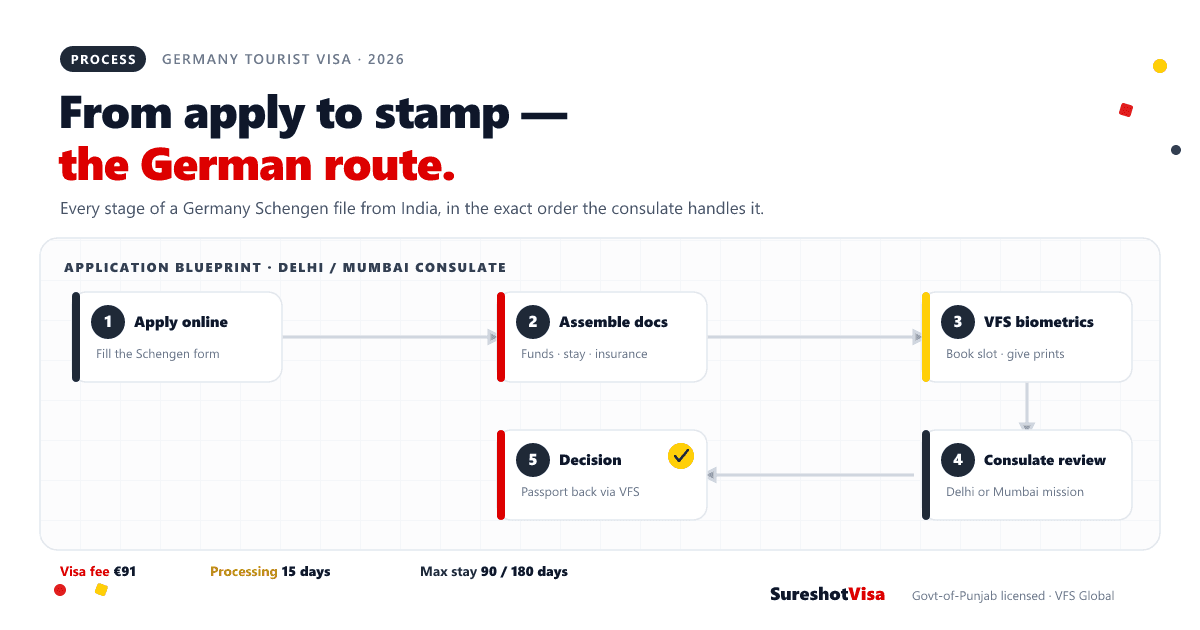
The German visa process is a machine. Here is its blueprint.
Germany does not do vague. Every tolerance in this process is published: the fee to the euro, the window to the day, the photo to the millimetre. Applicants who read the spec pass. Applicants who improvise jam the machine.
Operating principle: the system rejects out-of-spec inputs
Most Schengen refusals we see for Germany are not judgment calls. They are specification failures — an input that missed a published tolerance and stopped the line.
That is actually good news. A machine with published tolerances can be passed deliberately. The German tourist process from India has five checkpoints and one non-negotiable operating window, all documented in the official checklists behind our Germany tourist visa guide. Walk them in sequence and the file that reaches the decision desk in Mumbai is one the machine is built to approve — though the decision itself always remains the consulate's alone.
Checkpoint zero: the operating window and the jurisdiction gate
Before any document exists, two parameters must be set correctly.
The window. Applications are accepted not earlier than 6 months before travel and not later than 15 working days before it. Outside that band, the system returns your input unprocessed. The engineering sweet spot is 3–4 weeks out — early enough to absorb extended processing, late enough that your reservations haven't expired.
The gate. You must apply at the VFS centre covering your place of habitual residence. The New Delhi jurisdiction alone covers Haryana, Himachal Pradesh, Jammu & Kashmir, Punjab, Rajasthan, Sikkim, Uttar Pradesh and Uttarakhand, plus Chandigarh, NCT of Delhi, Andaman & Nicobar and Lakshadweep. Applying at the wrong VAC is not a delay — it is a refusal at the counter, before your file is even read.
The five checkpoints, in production order
VIDEX — the form that generates its own barcodes
The application is filled online at videx.diplo.de. Print all pages including the barcodes and sign. Paper-only forms are not accepted; a VIDEX printout missing its barcode pages counts as an incomplete form.
Two signed declarations ride along with it: the Declaration of True and Complete Information (§54 AufenthG) and the Declaration on Travel and Health Insurance. Both are mandatory for every applicant.
Passport, photo and paper — measured, not eyeballed
- Passport: issued within the last 10 years, valid 3+ months beyond return, at least 2 blank pages, no observations on the data page. Name-observation passports are not accepted.
- Photos: two biometric prints, 35×45 mm, white background, face filling 70–80% of the frame, taken within 6 months.
- Language: every document in German or English. Anything else needs a certified translation — a missing translation is processed as "document not submitted".
- Insurance: minimum €30,000, valid across all Schengen states, covering the entire stay — and accepted only from approved Indian insurers. A compliant-looking policy from a non-approved provider fails the checkpoint even if the cover is higher. Our Schengen insurance guide shows what the certificate must say.
The financial file must carry the declared trip
Germany reads your money the way an engineer reads a stress test: the declared load (your itinerary cost) must sit comfortably inside the rated capacity (your funds).
- Employed: 3 months of pay slips, employment contract, leave-sanction letter, 3 months of bank statements, ITR for 2 years or Form 16.
- Self-employed: GST registration, 2 years of ITR, 3 months of business bank statements.
- Retired: 3 months of pension statements plus income proof.
- Sponsored: sponsor letter, sponsor's passport copy and stamped 3-month statements, plus relationship proof.
Add the travel evidence: a flight reservation — never a purchased ticket — hotel confirmations for every night, and a covering letter whose numbers match both. Consistency is the whole test.
VFS: biometrics, fees, and the receipt
Book the appointment at your jurisdiction's VAC — Germany files are accepted at VFS centres including New Delhi, Mumbai, Bengaluru, Chennai, Kolkata, Hyderabad, Ahmedabad, Pune, Chandigarh, Jalandhar, Jaipur, Goa, Cochin and Puducherry. Fingerprints are captured in person unless you gave them for a Schengen visa within the last 59 months.
| Item | Amount |
|---|---|
| Visa fee — adult€91, effective 29 January 2026; INR varies with the daily exchange rate (≈ ₹8,300) | €91 |
| Visa fee — child 6–1250% concession (≈ ₹4,100) | €45 |
| Visa fee — child under 6 | FREE |
| VFS service chargeFixed, per applicant, incl. 9% CGST + 9% SGST | ₹2,022 |
| Courier return (optional) | ₹718 |
| SMS updates (optional) | ₹153 |
| Premium lounge (optional) | ₹3,230 |
Payment modes: cash, Visa, Mastercard, Amex, RuPay, UPI or demand draft. Every rupee is non-refundable regardless of outcome. Model your own family's total on the Germany visa cost calculator.
Every file routes to Mumbai — build that into the schedule
Whichever Indian VAC accepts your file, it is forwarded to the German Consulate General, Mumbai — the single decision point for all Schengen applications from India. Budget up to 2 working days of transit, then 15 working days of standard processing from the day the file reaches Mumbai, longer in peak season or if further documents are requested.
Failure-mode analysis: how this machine actually stops
Wrong jurisdiction. Residence address doesn't match the VAC's coverage area — refused at the counter, fees spent, nothing examined.
Non-approved insurer. Cover above €30,000 means nothing if the provider isn't on the approved Indian insurers list.
Main-destination mismatch. Germany declared as main destination while more nights are booked in another Schengen country. Count your nights before the consulate does.
Missing barcode pages. A VIDEX printout without all pages, or unsigned declarations, is an incomplete form — and incomplete documentation alone is a published ground for refusal. The visa section is not obliged to ask for what's missing.
Funds that don't match the story. A bank balance out of proportion to the declared trip cost, or sudden unexplained deposits, fails the load test at CP-03.
Specification queries
How long does a Germany tourist visa take from India in 2026?
Standard processing is 15 working days from the day your file reaches the German Consulate General in Mumbai, plus up to 2 working days for VFS to transport it there. Peak season — summer and Christmas — can stretch this further. Apply 3–4 weeks before travel, and never later than 15 working days before.
What is the Germany visa fee for Indians in 2026?
The visa fee is €91 for adults, effective 29 January 2026, payable in rupees at the application-day exchange rate (roughly ₹8,300). Children aged 6–12 pay €45 and children under 6 pay nothing. Every applicant also pays the fixed VFS service charge of ₹2,022 including GST, and all fees are non-refundable whatever the outcome.
Why does my Germany visa application go to Mumbai?
All Schengen applications accepted for Germany at any Indian VAC are forwarded to the German Consulate General, Mumbai, which takes every decision. You still must submit at the VFS centre covering your residence — a Punjab applicant files through the New Delhi jurisdiction, and the file then travels to Mumbai. Add up to 2 working days for that transit when planning.
Can I use any travel insurance for a Germany visa?
No. German missions accept travel medical insurance only from approved Indian travel-insurance companies, with minimum €30,000 cover valid across all Schengen states for your entire stay. A policy from a non-approved provider is rejected even if its coverage is higher. Check the current approved list at india.diplo.de before buying.
What is the VIDEX form and can I fill it on paper?
VIDEX is Germany's online Schengen application form at videx.diplo.de, and it is the only accepted format — paper-only forms are refused. Fill it online, print every page including the barcodes, and sign. You must also sign the Declaration of True and Complete Information and the Declaration on Travel and Health Insurance.
Can I apply for a Germany visa at any VFS centre in India?
No — you must apply at the centre covering your place of habitual residence. The New Delhi jurisdiction, for example, covers Punjab, Haryana, Himachal Pradesh, J&K, Rajasthan, Sikkim, UP and Uttarakhand plus several union territories. Applying at the wrong VAC gets the application refused at the counter itself.
Do I need to buy flight tickets before applying for a Germany visa?
No — submit a flight reservation, not a purchased ticket. The official guidance is explicit that a booked ticket does not lead to priority processing, so buying early gains nothing and risks the full fare on a refusal. Purchase real tickets only after the visa is issued.
Can I visit other Schengen countries on a Germany tourist visa?
Yes — a Schengen visa issued by Germany is valid across all 29 Schengen countries for up to 90 days in any 180-day period. Germany must be your main destination, meaning the country with the most booked nights. If another country dominates your itinerary, apply through that country instead.
Have your file inspected before the machine does it.
SureshotVisa is a Government-of-Punjab licensed consultancy (Lic. No. 849/DC/PTA/PLA/LC-3/2024). For ₹499 we run your profile against every checkpoint above and give you a written visa-possibility report — honest odds, the exact document list for your employment type, and the failure modes your file is currently exposed to. Credited in full if you file with us. We engineer the file; the final decision rests solely with the German consulate — no one can guarantee an approval, and no one honest will try.
+91 97803 01303Prefer WhatsApp? The green button at the bottom of your screen reaches the same desk.
Revision notes. Filed 04 July 2026. Figures are from the published VFS Global Germany (India) schedule and German mission checklists — visa fee €91 effective 29 January 2026 (INR varies with the daily exchange rate), VFS service charge ₹2,022 incl. GST — and are correct as of the publication date. Fees and procedures change without notice; verify the live figures on the official VFS Global Germany page before paying.
This guide is for information only and does not guarantee a visa. Every application is assessed on its own merits, and the decision is the sole prerogative of the German Consulate General, Mumbai — VFS Global has no role in approvals or refusals.
© 2026 Sureshot Visa · A brand of Pro Lifeset Overseas Pvt Ltd · Patiala, Punjab
Need help?
We'll handle your visa file end-to-end.
Documents, VFS slots, embassy filing — by a licensed consultant.
We answer within 5 minutes
Full Country Guide
Germany Visa from India — fees, documents, processing time
Everything you need on one page: VFS centres, visa types, fee breakdown, doc checklist.

Written by
Sherbir Singh GrewalDirector, Pro Lifeset Overseas Pvt Ltd · B.Tech, Information Technology (2007)
Sherbir Singh Grewal supports applicants across visa-file preparation, document organisation and case coordination. His approach is practical: understand the applicant's real situation first, then build the documents around a consistent, believable story.
Full profileRelated Guides
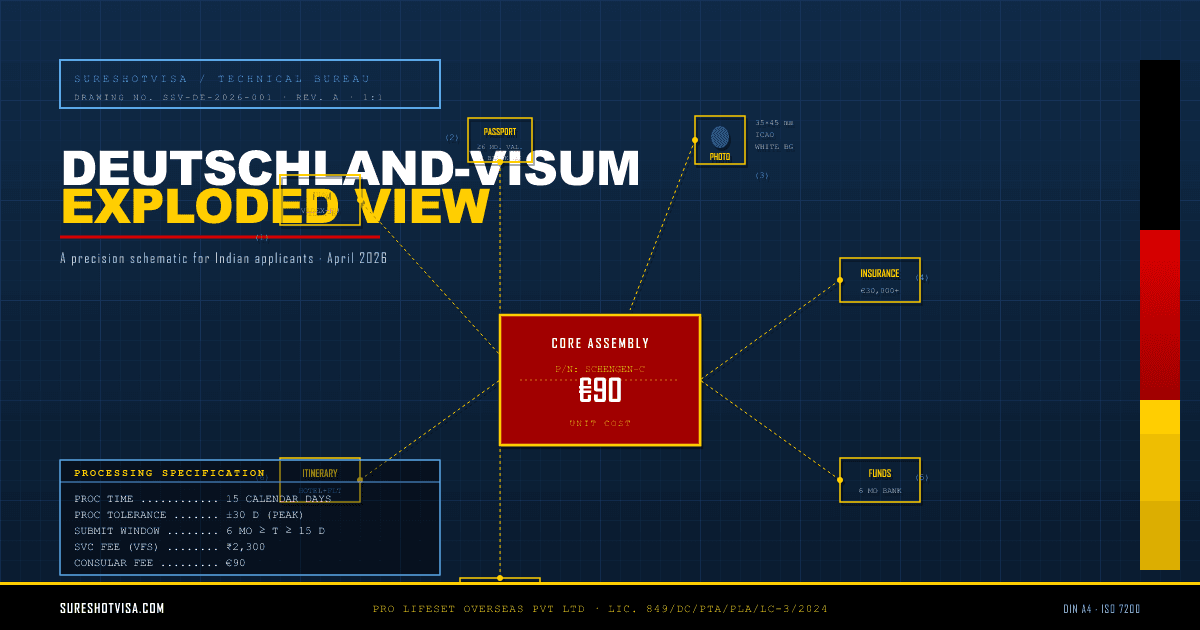
The German Visa, Engineered. A Precision Blueprint.
Germany rewards exactness, not eloquence. An engineering-manual breakdown of the German Schengen visa from India — specs, tolerances, fault tree, and the seven components every file must contain. April 2026.
Read guide