Skip to content
Invitation LetterAny countryVisitor / family / business

Invitation Letter for Visa Sample, Format & Template (2026)

An invitation letter is written by the person you are going to see — a relative, a friend, or a company — confirming who you are to them, why you are coming, where you will stay and for exactly how long. It is the document that answers the one question a refusal form asks most often: what is the purpose of this journey, and is it believable?

Reviewed by Rohit Gir, SureshotVisa — a government-licensed consultancy (Licence 849/DC/PTA/PLA/LC-3/2024). Verify us.

Not sure about something on this page?

Ask a licensed consultant on WhatsApp — whether your employer's wording is acceptable, which format your country wants, what to do when a standard line does not apply to you. No obligation, and you will get a straight answer today. Want the document itself read and checked against the rest of your file? That is the paid check further down.

No obligation · A licensed consultant replies

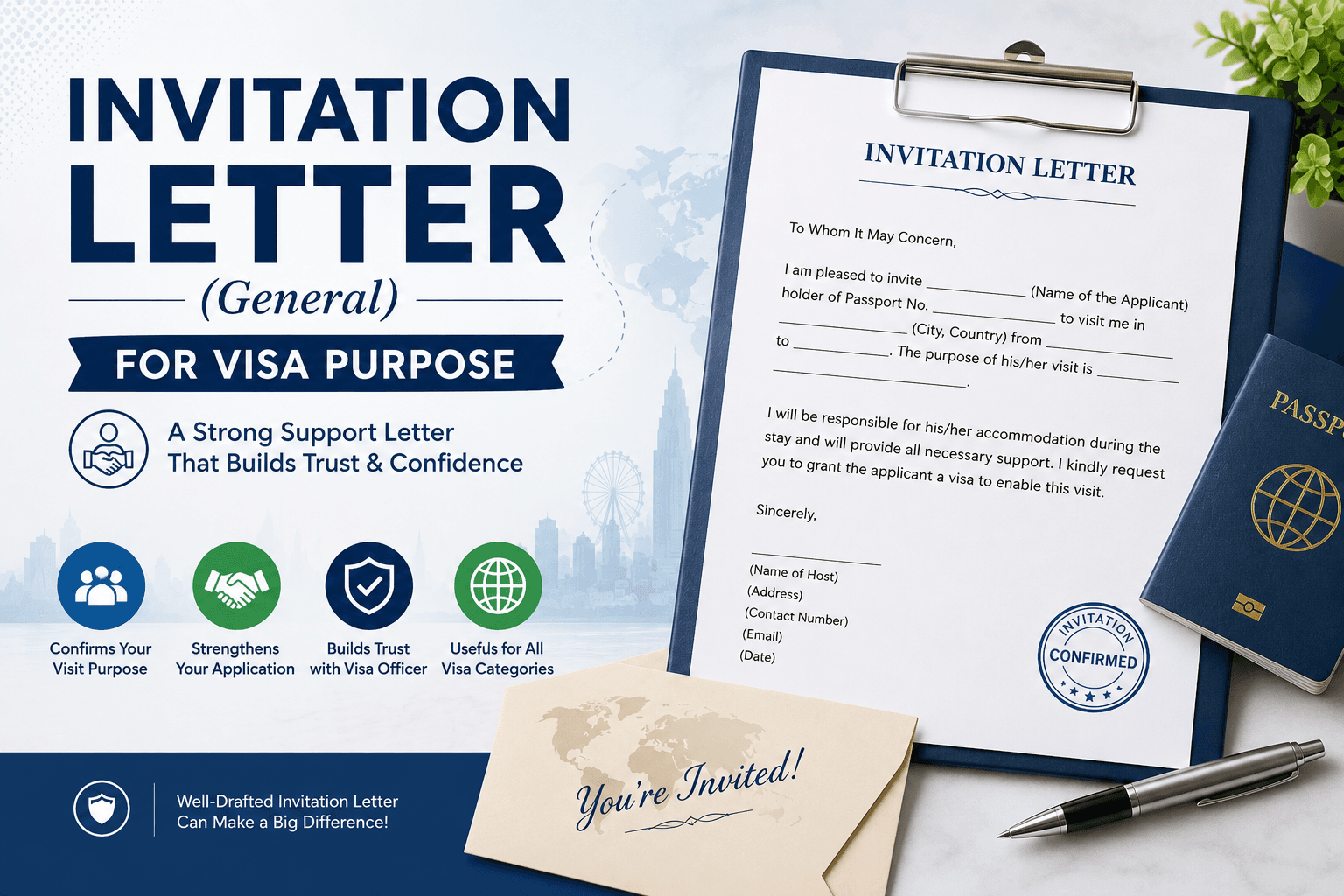
An invitation letter for a visa application on a clipboard beside a passport and an envelope, showing the standard invitation letter format

At a Glance

Document
Invitation Letter
For
Any country
Visa Type
Visitor / family / business
Mistakes
5 to avoid

Why This Document Matters

Most refusals of visitor applications turn on purpose, not money. An invitation letter is the only document in the file where a real person in the destination country states the purpose in their own words and attaches their own identity to it. Done properly it converts your trip from a claim into something the officer can verify with a phone call.

Need the whole visa file done, not just this invitation letter?

We prepare and file visitor, tourist and study visas for 60+ countries from anywhere in India: documents, VFS slot, embassy filing, with published fees and one licensed office in Patiala. This invitation letter is one of the pieces we check before anything is submitted.

Format & Requirements

One page, written and signed by the host, dated within a month of your submission. Plain paper is fine for a private host; a company invitation goes on letterhead. It must name the host, their address and their status in that country; name you exactly as your passport does, with your passport number; state your relationship and how it began; give exact arrival and departure dates; and say clearly where you will stay and who is paying for what. The host's contact details must be real and answerable.

Sample / Template

Customize before submitting

Get this invitation letter filled in with your details — ₹499

You answer the questions, we generate the finished document as a PDF, ready to print and sign. Credited in full if you go ahead with filing.

Build mine

The sample below stays on this page to read. What you are paying for is the finished document with your own details in it — and a person who has read refused files checking it.

sample-invitation-letter-for-visa.pdf
[Host's full address] [Date] To the Visa Officer, [Embassy / Consulate / Visa Section] Subject: Invitation for [Applicant Full Name], passport no. [XXXXXXX] Dear Sir or Madam, I, [Host Full Name], [nationality / immigration status — e.g. British citizen / permanent resident], residing at [full address], am writing to invite [Applicant Full Name], holder of passport no. [XXXXXXX], to visit me. [Applicant] is my [exact relationship — brother, cousin, university friend since 2014]. [One or two sentences on how you know each other and when you last met, if you have.] The purpose of the visit is [specific purpose — attending my wedding on 14 March, a family visit, meeting my newborn son]. [Applicant] intends to arrive on [Arrival Date] and depart on [Departure Date], a stay of [X] days. During the visit [Applicant] will stay with me at the address above, at no cost to them. [If sponsoring: I will also be responsible for their living expenses during the stay. / If not: [Applicant] will meet their own travel and living expenses, as shown in their own bank statements.] I confirm that [Applicant] will return to India on the stated date, and that I will inform the authorities of any change to these arrangements. I enclose a copy of my [passport / residence permit] and proof of my address. Should you require anything further, please contact me on [phone] or [email]. Yours faithfully, [Signature] [Host Full Name] [Phone] · [Email]

The same letter, written the way that gets refused

This is not an exaggeration. It is the shape of letter most applicants actually bring us: polite, short, and answering none of the questions the officer has.

Too weak to help you
To Whom It May Concern, I am inviting my friend Mr. Rajesh Kumar to visit me. He will stay at my home for two weeks. Please grant him the visa. Thanking you, Amit

What the officer sees missing

  • No host address and no status — the officer cannot tell whether the writer is lawfully in that country at all.
  • No passport number for either person, so the letter cannot be tied to the application it arrived with.
  • “my friend” with nothing about how or when they met. Unevidenced friendship is the weakest relationship claim there is.
  • “two weeks” with no dates. The stay must match the flight booking and the dates on the form, to the day.
  • Says nothing about who is paying, so the officer cannot tell whether to expect the host's finances or yours.
  • “Please grant him the visa” — the host cannot request a decision, and asking for one reads as pressure rather than evidence.
  • Signed with a first name only, no contact details. Nothing here can be checked.

None of these are hard to fix. They are simply things nobody tells you before you hand the letter in.

A question about this invitation letter? Ask a licensed consultant on WhatsApp

Leave your number and we'll WhatsApp you back. No long forms, no obligation.

✓ The ₹499 report is fully refundable · our refund promise

Do's and Don'ts

Do

  • Have the HOST write and sign it, not you
  • Name the applicant exactly as the passport does
  • Give exact arrival and departure dates
  • Attach the host's status and address proof
  • State plainly who is paying for what

Don't

  • Don't send a letter with no host documents attached
  • Don't say 'sponsor' unless the host really is paying
  • Don't use vague dates like 'for two weeks in summer'
  • Don't get it notarised or apostilled — it is not required
  • Don't let the letter contradict your own bank statements

Common Mistakes That Cause Rejections

1

Applicant writes the letter themselves and the host only signs

2

No copy of the host's passport or residence permit

3

Relationship stated as 'friend' with nothing showing how they know each other

4

Dates on the letter do not match the flight booking or the application form

5

Letter promises sponsorship the host cannot evidence

Stop guessing. Get your invitation letter reviewed by experts.

We've prepared thousands of visa files. One mistake in your document can cost you a rejection.

Frequently Asked Questions

What exactly must an invitation letter contain?+

Seven things. The host's full name, address and immigration status in that country — a letter from someone whose own right to be there is unclear carries little weight. Your name exactly as it appears on your passport, and your passport number, so the letter can be tied to your application. Your relationship, and crucially how it began — “my cousin” is fine, “my friend” needs a sentence explaining how you know each other. The exact arrival and departure dates, not a season or a duration. Where you will sleep. And who is paying for what, stated plainly. Everything else in the letter is politeness.

Does an invitation letter need to be notarised or apostilled?+

No. This is easily the most common misunderstanding about this document, and it is worth being clear: an invitation letter is a private letter from one person to a visa section, not a legal instrument. UKVI, the Schengen missions and IRCC do not ask for it to be notarised, apostilled or attested, and paying for any of that adds nothing to your application. What they do want is evidence behind the letter — a copy of the host's passport or residence permit, proof of their address, and, where the host is paying, proof they can. Spend the money on getting those right instead. If a consultant tells you an invitation letter must be apostilled, ask them to show you where that is written.

Is inviting someone the same as sponsoring them?+

No, and confusing the two causes real problems. Inviting means “come and stay with me” — it establishes purpose and accommodation, and you still demonstrate your own funds from your own bank statements. Sponsoring means “I will pay for this trip”, which is a financial undertaking, and the moment a letter says it the host has to evidence it with payslips, bank statements and sometimes a formal undertaking form. The mistake to avoid is a host who writes “I will sponsor him” as a friendly gesture and then attaches nothing. That is worse than not offering, because the officer now has a promise with no proof behind it, sitting next to your own funds that you have suddenly implied are not needed.

What documents must the host send along with the letter?+

A letter alone proves nothing, because anybody can type one. At minimum the host attaches a copy of their passport or residence permit — whatever establishes their right to be in that country — and proof of the address they have invited you to, such as a utility bill, council tax bill or tenancy agreement. If they are hosting you in their home, evidence they actually live there matters more than most applicants realise. If they have offered to pay, add recent payslips and bank statements. If they own the property, the deed or mortgage statement settles the accommodation question outright.

The name on my passport is slightly different from the letter. Is that a problem?+

Yes, and it is one of the quickest ways to slow a file down. Officers cross-check the name on your passport against the name in the letter, and the dates in the letter against the dates on your application form and your bookings. A missing middle name, an initial where the passport has a full name, or a spelling that follows local usage rather than the passport is enough to make an officer read everything else more carefully. Have the host copy the name character by character from your passport bio page. If your passport shows no surname, or a single-name entry, tell the host how to write it rather than letting them guess.

Can I write the letter myself and have my host sign it?+

In practice this is what usually happens, and drafting it for a host who is busy or writes little English is reasonable. But the letter has to sound like them and has to be true, because they are the one who will answer the phone if the mission calls. Two things give away a letter written by the applicant: details the host would not plausibly know or care about, and language identical to a template that thousands of other applicants have used. Write it plainly, in ordinary sentences, and let the host change anything that does not sound like them. A slightly clumsy letter in the host's own voice is stronger than a polished one that reads as manufactured.

My host is a friend, not family. Does that weaken it?+

Only if the friendship is asserted rather than shown. Missions see a great many applications where the “friend” turns out to be a recent contact, so an unevidenced friendship is treated cautiously. The fix is not to overstate the relationship but to evidence it: say when and how you met — a university course, a former employer, a family connection — and where you can, attach something ordinary that supports it, such as photographs from a previous meeting, or a record of a visit one of you has already made. A friend who can show a five-year history is a stronger host than a cousin who cannot show any contact at all.

Does the invitation letter need to be in English?+

It needs to be in a language the visa section works in, which for Indian applicants usually means English. If the host writes in another language, submit the original together with a translation. For most visitor applications a straightforward translation is accepted; some missions ask for a certified one, so check the requirements for the specific country before paying for certification. What you should not do is submit only the translation, or only the original — the pair together is what lets an officer read it and see it was genuinely written by your host.

How recent should the letter be?+

Dated within about a month of your submission, and never dated after your appointment. An invitation written six months ago describes a plan that may have changed, and if it predates your flight booking then its dates were chosen without reference to your actual trip — which is exactly how mismatches creep in. Settle the travel dates first, then ask the host to write the letter. If your plans move, ask for a fresh letter rather than sending one with a correction on it.

Do I still need bank statements if I have an invitation letter?+

Yes, unless the host is genuinely sponsoring you and has evidenced it. An invitation letter answers purpose and accommodation. It does not answer means, and those are separate boxes on a refusal form. The strongest visitor files show both: a letter that makes the trip specific and believable, and your own funds showing you could make the trip regardless. Applicants who treat an invitation as a substitute for financial evidence tend to be answering one question well and another not at all.

Can a company invite me for a business visit?+

Yes, and a business invitation follows the same logic with different evidence. It goes on the company's letterhead, is signed by someone with authority there, and states the business purpose specifically — meetings with named parties, a trade fair with its name and dates, training on a stated system. It should say who is paying for travel and accommodation, and it helps enormously if it refers to an existing relationship between the two companies, such as a purchase order, contract or prior correspondence. A business invitation with no evidence of any prior dealing reads exactly like a personal invitation with no evidence of any prior friendship.

Can SureshotVisa check my invitation letter before I submit it?+

Yes, and it costs nothing. Send it on WhatsApp and a licensed consultant will read it against the seven points above, check the names and dates against the rest of your file, and tell you whether the host has attached the right supporting documents — which is where most invitation letters actually fall short. If the letter is already sound we will say so. No consultant can guarantee a visa; the officer always decides. What a properly built invitation does is remove one of the reasons they might say no.

Send us the letter before you submit it.

A licensed consultant will check it against every point above — what is missing, whether the dates agree with the rest of your file, and whether the contact details would survive a verification call. If it is already fine, we will tell you that.

Related Document Guides

Or skip the writing

Have it written for you in about a minute — ₹499.

An invitation letter drafted for your host abroad to review and sign, covering the relationship, the stay and who is paying — the three things officers check. Answer a few questions, pay ₹499, and it arrives by email straight away.

Instant

No waiting, no appointment

Nobody calls you

No chat, no sales follow-up

Just ₹499

One document, one price

Write my invitation letter

Written instantly from your answers — no consultant reviews it first, and nothing you do not tell us is ever invented. It comes as a draft for your host in the destination country to review and sign. Want a licensed consultant to check it against the rest of your file? That is the One-Document Check.

Ready when you are

The template is free. The checking is what you are missing.

Everything above costs you nothing, and you are welcome to it. What a template cannot do is read itself against the rest of your file — and that is where applications actually fail: a date that does not match the ticket, a salary that does not match the bank statement, a signatory the company cannot verify on a call. You are about to spend an embassy fee, a visa-centre fee and a trip on this application. Having a licensed consultant read the paperwork first costs a fraction of any one of them.

Filing it yourself? That is genuinely fine — most straightforward cases do not need anyone. If it comes back refused, bring us the letter. Reading the actual refusal ground is how a case gets recovered, and it is the work we do most. How refusal recovery works