Skip to content
Self-Employed FileAny countryVisitor / business

Visa Documents for Self-Employed & Business Owners in India — Full List

Every visa checklist is written for a salaried applicant: payslips, an employer's letter, leave approval. If you run your own business none of those exist, and the usual response is to submit the file with three gaps in it and hope. That is the wrong instinct. A business owner has more to come back to than an employee does — the task is to evidence it in the form an officer already knows how to read.

Reviewed by Rohit Gir, SureshotVisa — a government-licensed consultancy (Licence 849/DC/PTA/PLA/LC-3/2024). Verify us.

Not sure about something on this page?

Ask a licensed consultant on WhatsApp — whether your employer's wording is acceptable, which format your country wants, what to do when a standard line does not apply to you. No obligation, and you will get a straight answer today. Want the document itself read and checked against the rest of your file? That is the paid check further down.

No obligation · A licensed consultant replies

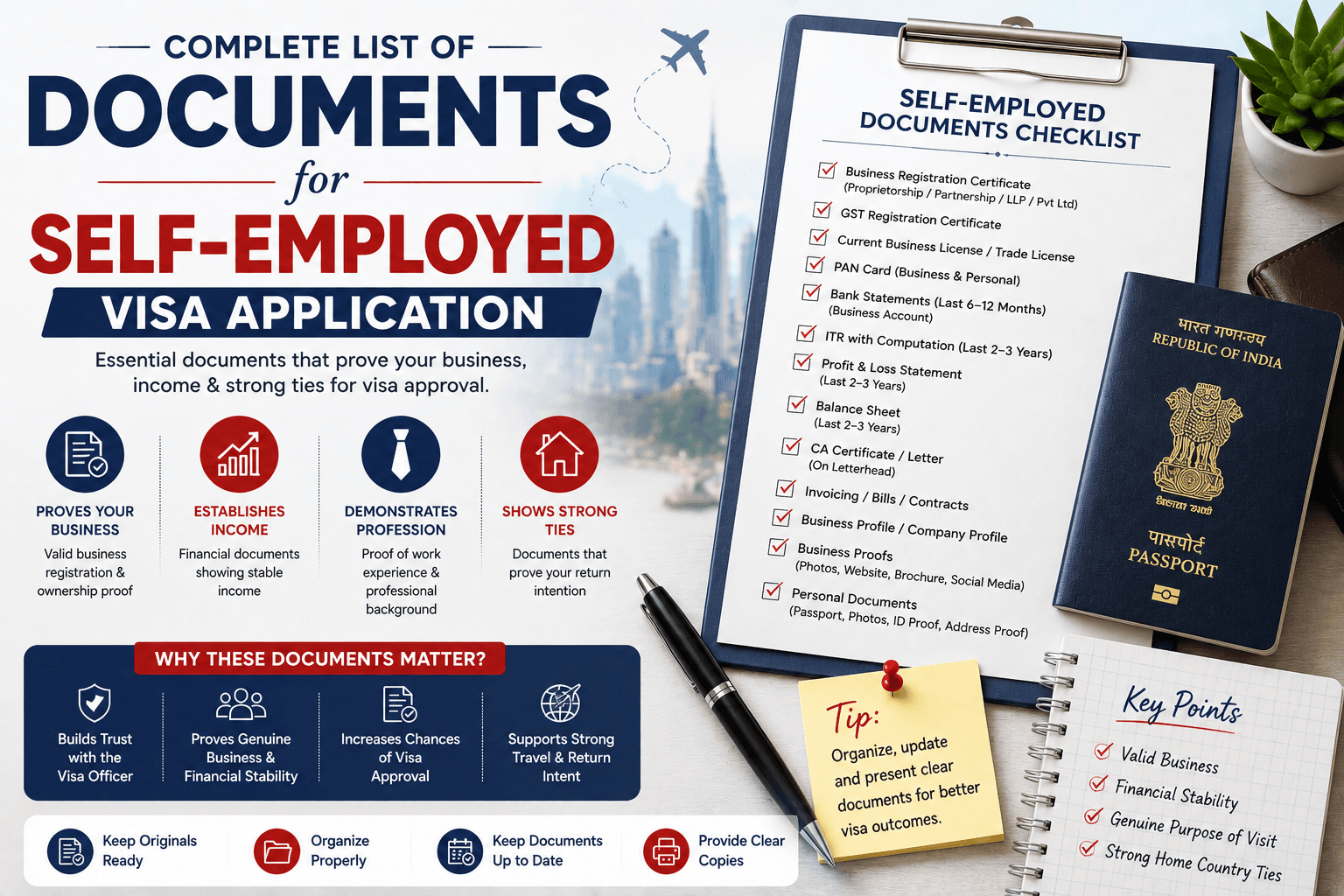
A business owner's visa document set — GST certificate, income tax returns and current account statements — arranged beside a passport

At a Glance

Document
Self-Employed File
For
Any country
Visa Type
Visitor / business
Mistakes
5 to avoid

Why This Document Matters

An officer assessing a visitor is asking two things: can you fund this trip, and will you come back. A salaried applicant answers both with one document. You answer them with four or five, and the file is stronger for it once assembled — because a job can be resigned from, while a registered business with staff, premises and a filing history cannot be walked away from as easily. Applicants who present themselves as an employee without an employer lose that advantage entirely.

Need the whole visa file done, not just this self-employed file?

We prepare and file visitor, tourist and study visas for 60+ countries from anywhere in India: documents, VFS slot, embassy filing, with published fees and one licensed office in Patiala. This self-employed file is one of the pieces we check before anything is submitted.

Format & Requirements

Registration first — GST certificate, Udyam registration, shop and establishment licence, or the certificate of incorporation and MOA for a company. Then income: business ITRs with computation for two to three years, and GST returns for the last four quarters. Then movement of money: six months of current-account statements, and personal statements alongside them. Then a letter you sign in your capacity as proprietor or director, stating your role, the business's activity, and the dates you will be away with confirmation the business continues. Where there are staff, a note of headcount helps.

Sample / Template

Customize before submitting

Get your self-employed file checked by a licensed consultant — ₹999

Document Review — send us your own document and a licensed consultant tells you what an officer would question, and what to change. Credited in full if you go ahead with filing.

Get it checked

The sample below stays on this page to read. What you are paying for is the finished document with your own details in it — and a person who has read refused files checking it.

sample-self-employed-visa-documents.pdf
[Business letterhead] Date: [Date] To Whom It May Concern, This is to confirm that I, [Full Name], am the [Proprietor / Director / Partner] of [Business Name], [GSTIN / CIN / Udyam registration no.], operating from [full business address] since [Year]. [Business Name] is engaged in [nature of business — e.g. wholesale trading of agricultural machinery] and currently employs [X] people. The business's turnover for the financial year [YYYY-YY] was Rs. [Amount], as reflected in the enclosed income tax return and GST filings. I intend to travel to [Country] from [Departure Date] to [Return Date] for [purpose]. During my absence the business will continue to operate under [name and designation of the person in charge], and I will resume my responsibilities on [Return Date]. I confirm that I am funding this trip from my own resources, as shown in the enclosed bank statements. Enclosed: 1. GST registration certificate / certificate of incorporation 2. Business income tax returns with computation, [years] 3. GST returns, last four quarters 4. Current account statements, last six months 5. Personal bank statements, last six months [Signature] [Full Name] [Designation] · [Business Name] [Phone] · [Email]

The same letter, written the way that gets refused

This is not an exaggeration. It is the shape of letter most applicants actually bring us: polite, short, and answering none of the questions the officer has.

Too weak to help you
To Whom It May Concern, I am doing my own business since many years. I have no salary slip because I am self employed. My income is good. Kindly grant me the visa. [Name]

What the officer sees missing

  • Explains an absence instead of filling it. The officer does not need to know why there is no payslip — they need what goes in its place.
  • “since many years” with no start date, and no registration document to date the business against.
  • No business name, no GSTIN, no incorporation number. Nothing here establishes that any business exists.
  • “income is good” with no figure, no ITR and no turnover — an assertion where a return was expected.
  • No mention of a current account, so there is no way to see money actually moving through the business.
  • Nothing about who runs the business during the trip, which is the question an owner's file has to answer and an employee's does not.
  • “Kindly grant me the visa” — applicants cannot request a decision, and it reads as pleading rather than evidence.

None of these are hard to fix. They are simply things nobody tells you before you hand the letter in.

A question about this self-employed file? Ask a licensed consultant on WhatsApp

Leave your number and we'll WhatsApp you back. No long forms, no obligation.

✓ The ₹499 report is fully refundable · our refund promise

Do's and Don'ts

Do

  • Lead with registration — it proves the business exists
  • Send business AND personal statements together
  • Name who runs the business while you are away
  • Match the turnover you state to the ITR you enclose
  • Sign in your capacity as proprietor or director

Don't

  • Don't write yourself an employer NOC — you are the employer
  • Don't submit only personal statements with no business account
  • Don't state a turnover the returns do not show
  • Don't leave the business's continuity during your absence unaddressed
  • Don't apologise for having no payslip — substitute, don't explain

Common Mistakes That Cause Rejections

1

A self-signed NOC granting the applicant permission to travel

2

Personal account only, with no current account or GST filings

3

Turnover claimed in the letter does not match the enclosed ITR

4

No registration document, so nothing establishes the business exists

5

Nothing said about who runs the business during the trip

Stop guessing. Get your self-employed file reviewed by experts.

We've prepared thousands of visa files. One mistake in your document can cost you a rejection.

Frequently Asked Questions

I have no payslip and no employer. What do I send instead?+

Four things, in this order. Registration, which proves the business exists — GST certificate, Udyam registration, shop and establishment licence, or incorporation certificate and MOA for a company. Income, which proves it earns — business ITRs with computation for two to three years, plus GST returns for the last four quarters. Movement, which proves the earnings are real — six months of current-account statements alongside your personal ones. And a letter you sign as proprietor or director covering your role, the business activity, and what happens while you are away. That set answers everything a payslip and an employer's letter would have, and rather more.

Can I write myself an NOC?+

No, and it is the commonest mistake on these files. An NOC is one person granting another permission to be absent; when you are the proprietor there is nobody above you, so a letter permitting yourself to travel proves nothing and looks like paperwork produced for the officer's benefit. What you write instead is a proprietor's or director's letter — a statement of fact about the business, your role in it, the dates you will be away, and who is running things in the meantime. Same page, different logic: you are describing a business, not granting yourself leave.

My business is not registered. Can I still apply?+

You can, and many people do, but you have to accept that the burden shifts to your bank and your returns. Without registration there is no single document that establishes the business, so the file has to build the picture from personal ITRs showing business income, bank statements showing consistent receipts from identifiable customers, and whatever contracts, invoices or rent agreements exist for premises. It is a weaker starting point than a registered business, not a hopeless one. If registration is straightforward in your case — Udyam takes very little — it is worth doing well before you apply rather than in the week you submit.

Should I send business or personal bank statements?+

Both, and the reason is that they answer different questions. The current account shows the business is trading — money coming in from customers, going out to suppliers, in a rhythm that matches the turnover you have claimed. The personal account shows what reaches you and what you have available for this trip. An officer who sees only a personal account cannot tell a business owner from someone with an unexplained income; one who sees only the business account cannot see your personal capacity to travel. Six months of each is the normal ask.

My turnover is large but my personal balance is small. Is that a problem?+

It is a question rather than a problem, and it is worth answering in the letter before it is asked. Business owners commonly leave money in the business and draw modestly, which is sensible and entirely normal — but it produces a file where the ITR looks strong and the personal account looks thin. Say so plainly: state that you draw as required and that the funds for this trip are available from the business account, and enclose both statements. What causes trouble is the same picture left unexplained, because the officer's default reading of a thin personal balance is a thin applicant.

How many years of ITR should I send?+

Two at minimum, three if you have them. One year shows income; three show a business rather than a good year. If your returns move around, that is normal for trading businesses and it is better to send the full picture with a sentence explaining the variation than to send only your best year and invite the question of what the others looked like. Send the computation pages alongside the acknowledgements — the acknowledgement alone confirms a return was filed, while the computation shows what it actually said.

Who should mind the business while I am away, and does it matter?+

It matters more than most applicants expect, because it is the return-intent question in a form specific to owners. An employee's return is evidenced by a job waiting; yours is evidenced by a business waiting. Name the person in charge and their designation, and if there are staff, say how many. A business with employees, premises and continuing obligations is one of the strongest ties to India an applicant can show — but only if the file says so. A letter that never mentions who runs things while you travel leaves the officer to assume nobody does.

Is a business visitor visa different from a tourist visa for me?+

Yes, and it turns on the purpose of the specific trip rather than on your occupation. If you are going to meet suppliers, attend a trade fair, negotiate a contract or inspect goods, that is a business visit and the file should include the invitation or the event registration alongside your business documents. If you are going on holiday, it is a visitor application that happens to be made by a business owner. Applying under the wrong purpose is a genuine problem — the documents will not match what the route expects — so decide which trip you are actually taking before you start.

I file under presumptive taxation. Does that weaken my file?+

No, provided the file is consistent. Presumptive schemes are a legitimate and common way for small businesses to file, and returns under them are perfectly acceptable evidence. What creates difficulty is the mismatch that sometimes follows: a presumptive return declaring a modest figure sitting beside bank statements showing much larger receipts. If that is your situation, be ready to show the relationship between the two — bank credits that include customer payments later passed on, for example. Consistency between the return and the account matters more than the size of either.

Do I need to show my premises?+

Not always, but it helps and it is easy. A rent agreement, a property document, a utility bill in the business's name, or photographs of a shop or unit with signage all serve the same purpose: they move the business from a name on a certificate to a place that exists. This is particularly worth doing where the business is registered at a residential address, which is common and entirely legitimate but tells an officer nothing on its own.

Should I mention that I have travelled before?+

If you have, yes — prominently. Previous travel that was complied with is among the strongest evidence a visitor file can carry, and it is often buried. Include the visa pages and entry and exit stamps from earlier trips, particularly to the country you are applying to or to comparable destinations. For a business owner this does double work: it shows compliance, and it shows that the business survived your previous absence, which answers the continuity question with a fact rather than a promise.

Can SureshotVisa build the file for a business owner?+

Yes, and it is one of the cases where the difference is largest, because the standard checklist genuinely does not fit and most applicants end up presenting themselves as an employee without an employer. Send us your registration, returns and statements on WhatsApp and a licensed consultant will tell you what is missing, whether the turnover and the accounts tell the same story, and how the proprietor's letter should be worded for your specific structure. It is and there is no obligation. No consultant can guarantee a visa; the officer always decides.

Send us the letter before you submit it.

A licensed consultant will check it against every point above — what is missing, whether the dates agree with the rest of your file, and whether the contact details would survive a verification call. If it is already fine, we will tell you that.

Related Document Guides

Ready when you are

The template is free. The checking is what you are missing.

Everything above costs you nothing, and you are welcome to it. What a template cannot do is read itself against the rest of your file — and that is where applications actually fail: a date that does not match the ticket, a salary that does not match the bank statement, a signatory the company cannot verify on a call. You are about to spend an embassy fee, a visa-centre fee and a trip on this application. Having a licensed consultant read the paperwork first costs a fraction of any one of them.

Filing it yourself? That is genuinely fine — most straightforward cases do not need anyone. If it comes back refused, bring us the letter. Reading the actual refusal ground is how a case gets recovered, and it is the work we do most. How refusal recovery works