Will Mehndi Fail Your Visa Biometrics? The Fingerprint Truth (2026)
Last reviewed: 10 September 2026 · Verified against current VFS Global India fees
Fresh dark mehndi on your fingertips can make a visa biometric scanner fail — not because it is banned, but because the scanner cannot read the ridges. What actually happens, and how brides time it right.

Biometrics · Mehndi & fingerprints · Wedding season 2026
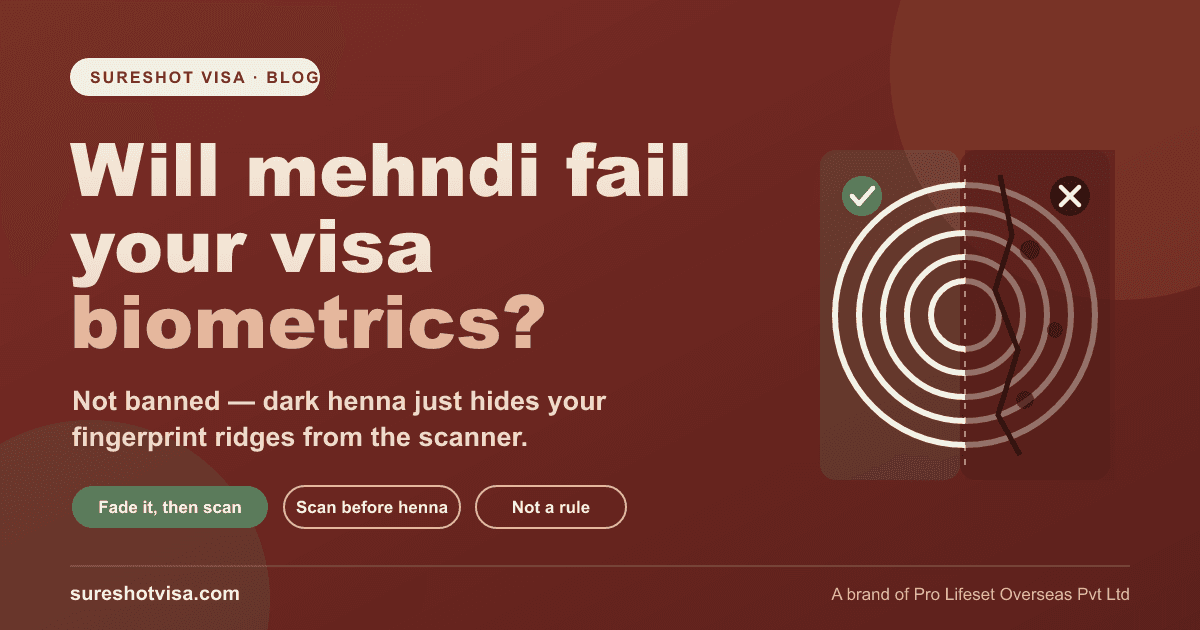
Will mehndi fail your visa biometrics? The fingerprint truth.
It happens quietly every wedding season in Punjab — a bride reaches the VFS counter, presses her fingers to the glass, and the scanner just… won't read them. Here is why fresh mehndi does that, and exactly how to time it so it never costs you an appointment.
Short answer: dark henna isn't banned — it hides your fingertip ridges from the scanner. Fade it, or scan before you apply it.Biometrics is a scan, not a decision
The counter does not judge your visa. It only records your fingers and your face — and passes them on.
At the visa application centre — VFS Global, BLS, or whichever centre your country uses — "biometrics" means two things and only two: a digital scan of all ten fingerprints and a digital photograph of your face. The staff at that window do not assess your documents, weigh your bank balance, or decide anything. They capture your prints and send them onward. The embassy or immigration authority makes the actual decision later, on your whole file. So a fingerprint that scans cleanly changes nothing about your chances — it simply lets the appointment finish on time.
Why it matters for a bride is purely mechanical. A fingerprint scanner reads the tiny raised ridges on your fingertip — the loops and whorls that make your print unique — as a pattern of light and shadow. Anything that darkens, coats, or flattens that ridge surface gives the machine less to read.
The scanner's-eye view
The same finger, two conditions — this is all the machine ever sees.
A clean fingertip reads in a fraction of a second. A coated or cracked one makes the machine guess — and it would rather ask again.
It's a scan-quality problem, not a rule
Nowhere in any country's visa rules does it say "no mehndi". There is no henna ban, no line on any checklist about bridal hands, no officer who rejects a file for a decorated palm. What actually happens is simpler and far more forgivable: fresh, dark henna sits on top of the ridges as a dense stain, and on its darkest days — the first two or three after application — it can fill the valleys between the ridges enough that the scanner reads a smudge instead of a pattern. The result is a failed read: the machine asks for the finger again, and again, and occasionally the operator books a fresh appointment for once the colour has faded.
Here is the reassuring part — mehndi is far from the only thing that does this. Centre operators see the exact same failed reads all day long, from causes that have nothing to do with weddings:
Deep cuts & fresh injuries
A recent cut or blister on a fingertip breaks the ridge line the scanner is trying to trace.
Cracked, very dry skin
A Punjab-winter classic — dry, flaking ridges scatter the light and confuse the read.
Worn-down ridges
Years of manual or farm labour can smooth the ridges almost flat. Common with elders.
Thick oil or cream
A greasy fingertip pressed to the glass blurs into one shiny patch instead of ridges.
If your father's fingers "don't scan" at the centre, it is almost always decades of hard work on the land, not henna — and it is not a visa problem for him either. Every one of these is a scan-quality issue, and the counter handles them all, every single day.
Two safe windows, one to avoid
Henna fades — and that single fact is the whole solution. Once the stain goes light and faint, the ridges show through and the scan is usually fine. So you have two comfortable strategies, and one to steer clear of. Dark henna tends to hold for roughly a week or two before fading, so give yourself room.
The cleanest plan — book the appointment for any day before the henna goes on, and your hands are irrelevant afterwards.
Once the colour is pale, the ridges read normally. Wait for faint, not perfectly gone.
The one combination to avoid — darkest stain, hardest read, most likely to need retries or a rebooking.
The do / don't for biometric day
None of this is a rule you must follow — it is simply how to give the scanner the easiest possible read, so the appointment is over in a minute.
✓ Do
- Give biometrics before the henna goes on, if the dates let you.
- Moisturise cracked, dry hands the night before so ridges aren't flaking.
- Arrive with clean, dry hands — a quick wash beforehand helps.
- If henna is on, let it fade to faint first, and stay relaxed at the counter.
✗ Don't
- Don't turn up with fresh, dark henna on the fingertips.
- Don't schedule the mehndi party the morning of a biometric appointment.
- Don't slather on thick oil or cream right before the scan.
- Don't cancel or panic if a finger fails — that is the operator's job to fix.
Give them once, reuse them for years
One more piece of good news for anyone planning several trips: once your biometrics are captured, they are reused for a set validity window, so you don't redo them for every visa inside that period. The exact window depends on the country — here is the rough shape of it.
| Country | Who gives them (by age) | Reused for |
|---|---|---|
| Canada | Generally applicants in their teens through adulthood; very young children and elderly applicants may follow different rules. | Commonly 10 years |
| Schengen | Typically from around age 12 upward; younger children usually give only a photo. | Around 59 months (~5 years) |
| Most others | Teens upward is the usual pattern; the exact age varies by country. | A set window applies — check the current rule. |
Age rules and reuse windows differ by country and change without notice. Treat the figures above as a guide, and confirm the current period for your specific country on its official visa page (or ask us) before you count on skipping a fresh biometric.
What actually happens at the counter
Suppose you didn't plan it, and you're standing at the centre with beautiful, dark, two-day-old bridal mehndi. Don't panic, and don't cancel. The operator will simply retry — pressing your finger a little differently, wiping the fingertip, sometimes offering a dab of hand cream to even out the surface, occasionally changing the order of fingers. Wedding season is their busiest season; a bride's decorated hands are not a surprise to anyone at that desk.
In the large majority of cases the scan goes through after a few tries. In the rare case it truly won't, they simply rebook you for a few days out — an inconvenience, never a refusal, and with no effect whatsoever on the visa decision itself. The one thing a failed scan can cost you is a lost appointment slot in a busy season, which is exactly the kind of small, avoidable detail worth planning around.
If you'd rather not gamble the slot at all, the fix is only timing — and we sort out timing, documents and the full checklist before you book anything. Our free document guides walk through what each country's file needs.
Mehndi & biometrics FAQs, answered straight
Can mehndi get my visa rejected?
No. Mehndi is not a visa factor at all — it appears in no country's rules. At worst, very fresh dark henna can make the fingerprint scanner struggle to read your ridges, which is a scan-quality issue handled at the counter. It has no bearing on whether your visa is approved.
Is henna banned at biometrics?
No. There is no ban on henna, mehndi or decorated hands. The centre only needs a readable scan of your fingertips, and dark henna simply makes that harder for a few days until it fades.
How long before biometrics should I wait after mehndi?
Wait until the colour is light and faint rather than dark — for most people that is roughly one to two weeks after application, though it varies. If your appointment falls right after the wedding, the safer plan is to give biometrics before the henna goes on.
My father's fingerprints won't scan because of farm work — is that a problem?
Not a visa problem. Ridges worn smooth by manual or farm labour are one of the most common scan difficulties operators see. They retry with different techniques, and it does not affect his application.
Do I have to give biometrics for every single visa?
Usually not. Once captured, biometrics are reused for a validity window — commonly quoted as ten years for Canada and around 59 months for Schengen — so trips inside that period don't need a fresh scan. Confirm the current window for your country before you count on it.
Should I remove or scrub off my mehndi to pass the scan?
There is no need to scrub it off, and no rule requires bare or perfect hands. If a scan struggles, the operator manages it. The only thing worth doing is timing the appointment so your fingertips aren't at their darkest.
We'll time your biometrics and check the whole file.
SureshotVisa is a Government-of-Punjab licensed consultancy (Lic. No. 849/DC/PTA/PLA/LC-3/2024). For ₹499 we review your complete profile — purpose, funds, ties, documents, photos and the appointment plan — and give you a written visa-possibility report with an honest Yes / Maybe / No and the exact fixes, before you spend any embassy fees.
+91 97803 01303Refundable, and credited in full to any service.
Prefer WhatsApp? The green button at the bottom of your screen reaches the same desk.
Notes on sources. Filed 08 July 2026. Biometric collection is carried out by the official visa application centres (such as VFS Global and BLS International) on behalf of the deciding authorities; reuse windows reflect published guidance from IRCC (Canada, commonly ten years) and the European Commission's Schengen visa rules (around 59 months) as of the publication date. Age applicability and validity periods differ by country and change without notice — verify the current rule on the relevant official visa page before you rely on it.
This article is for information only and does not guarantee a visa. Every application is assessed on its own merits, and decisions rest solely with the relevant authority.
© 2026 Sureshot Visa · A brand of Pro Lifeset Overseas Pvt Ltd · Patiala, Punjab
Need help?
We'll handle your visa file end-to-end.
Documents, VFS slots, embassy filing — by a licensed consultant.
We answer within 5 minutes

Written by
Rohit GirDocumentation & Financial Profile Support · M.Com (2022)
Rohit Gir supports the team with document review, financial-profile organisation and applicant communication. He helps ensure that income proof, bank statements, business documents, salary records and supporting evidence are presented clearly and consistently.
Full profileRelated Guides

No Objection Certificate (NOC) for a Visa — What It Must Say, and What Ruins It
One page from your employer quietly answers the officer's biggest question: will this person come back? Most NOCs answer the opposite. The four facts it must contain, the layout, and the five things that break it.
Read guide
Does a UK Invitation Letter Need an Apostille? No — Here's What It Actually Needs
There is no UKVI requirement to apostille or notarise a visitor invitation letter, and chasing one costs weeks you may not have. What the letter must contain, when legalisation genuinely applies, and why the letter is not what decides your case.
Read guide
Switzerland Visitor Visa Cost from India 2026 — Every Rupee, Honestly
The €90 fee is the small part. Here is the real all-in cost of a Switzerland Schengen visa from India — and the far larger number that only has to sit in your account, not leave it.
Read guide
Culturally Arranged Marriage Visa for New Zealand — The 2026 Guide for Indian Families
New Zealand has a visa built for arranged marriages, and most families never hear about it. The three-month rule that cuts both ways, the evidence that actually decides your case, and why letters from your own family are not enough.
Read guide