Visa Documents for Self-Employed Indians: Proof of Income
Last reviewed: 10 September 2026 · Verified against current VFS Global India fees
Learn what visa documents self-employed Indians need to prove income and business ties. Complete guide to ITR, bank statements, and business proof requirements.


If you run your own business or work as a freelancer, visa officers cannot simply pull your salary slips to judge your finances — you have to build the story yourself. This guide shows self-employed Indians exactly how to prove income and business ties so your file reads as stable, genuine, and rooted in India.
The self-employed file wins on consistency, not a single big number.
Why self-employed applicants get scrutinised more
A salaried applicant has a simple story: fixed employer, fixed salary, fixed leave. A visa officer reads one appointment letter and three salary slips and understands the whole picture in two minutes.
For a business owner or freelancer, that easy narrative does not exist. Your income may swing month to month. You may take money out as drawings, not salary. Your "employer" is you. This is not a red flag by itself — millions of self-employed Indians get visas every year — but it does mean you must do more work to remove doubt.
The officer is trying to answer two questions: Can this person afford the trip? and Will this person return to India? Everything you submit should quietly answer one or both.
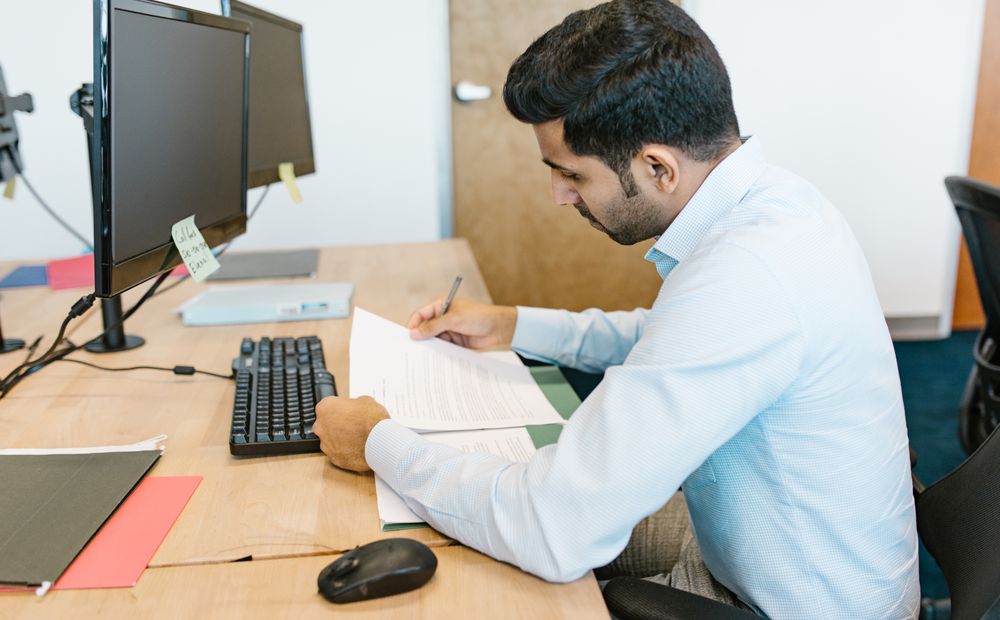
The core document set for self-employed Indians
Different countries word their checklists differently, but the underlying requirements are remarkably similar. Here is what a strong self-employed file almost always contains.
1. Proof that your business legally exists
- Certificate of Incorporation (for Pvt Ltd / LLP) or Partnership Deed for partnership firms.
- GST Registration Certificate — one of the strongest "this is real" documents you can show.
- Udyam / MSME Registration if you have it — cheap to obtain and adds legitimacy.
- Shop & Establishment licence or trade licence from your municipal body.
- For professionals: Council registration (e.g. Bar Council, Medical Council, ICAI membership for CAs).
2. Proof of income
- Income Tax Returns (ITR-V + computation) for the last 2-3 assessment years. This is the single most important income document.
- Personal bank statements for 6 months, stamped by the bank.
- Business current-account statements for 6 months.
- Audited financials — Balance Sheet and Profit & Loss — if your turnover requires audit, signed by a Chartered Accountant with UDIN.
- CA-certified income letter summarising your net income year on year.
3. Proof of ties to India
- Property papers, jamabandi, or registry documents.
- Ongoing client contracts or purchase orders showing work waiting for you back home.
- Employee salary registers or PF/ESI records showing you run a staffed operation.
- Family responsibilities — dependents, children's school records.
Rule of thumb: a salaried person proves ties with a leave letter. A business owner proves ties by showing the business cannot run itself without them.
How much money should be in the account?
There is no official minimum balance for most tourist and business visas. What matters is that your bank activity matches your declared income and comfortably covers the trip.
| Trip type | Rough funds to show comfortably | Notes |
|---|---|---|
| Schengen, 10 days | ₹1.5–2.5 lakh liquid | Roughly €100/day guideline plus flights & hotel |
| UK, 2 weeks | ₹2.5–4 lakh liquid | UK weighs 6-month pattern heavily |
| USA B1/B2 | No fixed figure | Interview-based; funds support the story |
| Dubai, 5 days | ₹1–1.5 lakh liquid | Sponsor/hotel booking often enough |
These are indicative comfort levels, not legal thresholds. A ₹6 lakh balance that appeared three days before submission looks worse than a steady ₹2 lakh with regular business credits.
The five steps to a clean self-employed file
Pull your ITRs first
Download ITR-V and computation for the last 3 years from the income tax portal. If any year is missing, that gap needs an explanation before anything else.
Get bank statements stamped
Visit the branch and get 6 months of statements on bank letterhead with a round seal. Net-banking PDFs alone are often rejected.
Commission a CA certificate
Ask your Chartered Accountant for a signed income summary with UDIN, matching your ITRs. Mismatches destroy credibility.
Assemble business proof
GST certificate, incorporation/registration, one or two live contracts. This proves the business is running and needs you back.
Write a cover letter
One page explaining who you are, your business, your travel purpose, and your return plan. Tie every claim to a document.
The numbers must agree with each other
The most common reason self-employed files feel "off" to an officer is internal contradiction. Your ITR says you earn ₹8 lakh a year, but your bank account routinely holds ₹40 lakh and pays for luxury purchases — where is the rest coming from? Or your ITR shows ₹25 lakh income but your savings account shows barely any activity.
Before you submit, sit down and make sure these four things line up:
- Declared income on the cover letter
- Net income on the CA certificate
- Income on the ITR computation
- Actual money moving through your bank statements
If there is a legitimate reason for a difference — say, income parked in a business account or fixed deposits not reflected in savings — say so plainly in the cover letter and attach the proof. Silence looks like hiding.
Income Documentation Requirements by Visa Type
Typical proof of income validity periods required by major visa destinations
ITR and business financial statements required
Bank statements showing consistent income flow
Recent tax returns and profit-loss statements
Notarized business registration and financials
Audited accounts and accountant verification letter
Source: SureshotVisa consultant desk
Good file vs weak file
Avoid
- A single lump-sum deposit right before applying
- Net-banking PDF with no bank stamp
- ITR income far below your visible lifestyle
- No proof the business actually operates
- Round-number "gifts" from unnamed sources
- Claiming ties you cannot document
Do this
- Show 6 months of steady business credits
- Bank-stamped statements on letterhead
- ITR, CA letter and bank activity that agree
- GST + registration + a live client contract
- Explain any large deposit with a source document
- Attach property or staff records for ties
Sample CA income certificate
Give this format to your Chartered Accountant. It should be printed on their letterhead with their membership number and UDIN.
[CA FIRM LETTERHEAD]

Date: __ / __ / 20__

TO WHOMSOEVER IT MAY CONCERN

This is to certify that Mr./Ms. __________________, S/o / D/o
__________________, PAN __________, is the
[Proprietor / Partner / Director] of M/s __________________,
a business engaged in ______________________ since [year].

Based on the audited books of account and Income Tax Returns
filed, the net income of the applicant for the last three
financial years is as follows:

  FY 2022-23 : Rs. __________
  FY 2023-24 : Rs. __________
  FY 2024-25 : Rs. __________

The above figures are in agreement with the Income Tax Returns
duly filed with the Income Tax Department.

This certificate is issued at the request of the applicant for
the purpose of visa application.

For [CA Firm Name]

_______________________
CA __________________
Membership No.: ______
UDIN: __________________
Sample cover letter for a self-employed applicant
Date: __ / __ / 20__

The Visa Officer
[Consulate / Embassy Name]

Subject: Tourist visa application — [Your Full Name],
Passport No. __________

Respected Sir/Madam,

I am writing to apply for a [tourist/business] visa to
[country] for [number] days, from [date] to [date].

About me: I am the proprietor of M/s __________________, a
[nature of business] based in [city] since [year]. My business
is registered under GST (GSTIN: __________) and Udyam
(Reg No: __________). I employ [number] staff members.

Income: My average annual net income over the past three years
is approximately Rs. __________, as certified by my Chartered
Accountant and supported by my filed Income Tax Returns. My
personal savings account (No. ____) and business current
account (No. ____) reflect regular business receipts.

Purpose of travel: [Brief, honest purpose].

Ties to India: My business requires my personal supervision
and I have ongoing client commitments (contracts enclosed). I
also own property in [city] and my family — [spouse/children]
— reside here. I will return to India before my visa expires
to resume my business obligations.

Enclosed documents:
1. Passport & photographs
2. ITR + computation (3 years)
3. CA income certificate (with UDIN)
4. Bank statements (6 months, stamped)
5. GST & business registration certificates
6. Property documents / client contracts
7. Confirmed flight and hotel bookings
8. Travel insurance

I request you to kindly consider my application. Thank you.

Yours faithfully,
[Signature]
[Full Name]
[Phone] | [Email]
Six mistakes that sink self-employed files
The mystery deposit. A sudden ₹5 lakh credit two days before submission with no source document reads as borrowed funds. Deposits should be organic and explainable.
ITR-lifestyle mismatch. Declaring ₹4 lakh income while spending like ₹40 lakh raises immediate questions about tax honesty and true finances.
No business proof at all. Saying "I am a businessman" without GST, registration, or invoices makes the whole income claim unverifiable.
Unstamped statements. Many consulates simply do not accept plain net-banking printouts. Always get the branch seal.
Missing ITR years. A gap in filing looks like either an inactive business or hidden income. File or explain before you apply.
Weak return story. A freelancer with a laptop and no assets must work harder — show contracts, recurring clients, family, or property to prove you will come back.
Special cases
Freelancers and consultants without a registered firm
You may not have a company, but you have income. Build your case from: 2-3 years of ITRs, GST registration (freelancers above the threshold should register), invoices to named clients, payment credits in your bank matching those invoices, and a portfolio or professional profile. A recurring client contract is gold — it proves work waiting for you in India.
New businesses under two years old
If your business is young, you will not have three years of ITRs. Compensate with: your personal ITRs from earlier employment, strong current bank activity, incorporation documents, initial contracts, and — if applicable — savings or fixed deposits that fund the trip independently of business income. Be upfront that the business is new.
Cash-heavy businesses
Traders and shopkeepers who deal largely in cash face the toughest challenge, because bank statements do not reflect real turnover. The fix is to route more income through the bank in the months before applying, keep GST filings current, and let the ITR carry the weight of proving income. There is no shortcut for a thin bank statement.

A realistic timeline
| When | Action |
|---|---|
| Day 1-3 | Download ITRs, request CA certificate, list gaps |
| Day 4-10 | Visit bank for stamped statements, gather registrations |
| Day 11-18 | Collect client contracts, property papers, ties proof |
| Day 19-25 | Draft cover letter, book flights/hotel/insurance |
| Day 26-30 | Final cross-check of all figures, submit |
Starting a month out gives your bank enough time to reflect genuine activity and lets you fix any missing ITR or mismatch calmly rather than in panic.
The bottom line
Being self-employed is not a disadvantage for a visa — plenty of business owners travel freely every year. The disadvantage is only in the extra effort required to tell a clear, honest, document-backed story. When your ITR, CA certificate, bank statements and business proof all point in the same direction, and your ties to India are visible on paper, the officer has no reason to doubt you.
SureshotVisa, a brand of Pro Lifeset Overseas Pvt Ltd — licensed by the Government of Punjab and based in Patiala — regularly helps traders, freelancers, and business owners structure exactly this kind of file. We cannot and never will promise an approval; no honest consultant can. What we can do is make sure your paperwork gives you the strongest possible chance.
Not sure your self-employed file holds up?
Send us your documents and we will tell you honestly where the gaps are — before the consulate finds them.
Need help?
We'll handle your visa file end-to-end.
Documents, VFS slots, embassy filing — by a licensed consultant.
We answer within 5 minutes

Written by
Rohit GirDocumentation & Financial Profile Support · M.Com (2022)
Rohit Gir supports the team with document review, financial-profile organisation and applicant communication. He helps ensure that income proof, bank statements, business documents, salary records and supporting evidence are presented clearly and consistently.
Full profileRelated Guides

No Objection Certificate (NOC) for a Visa — What It Must Say, and What Ruins It
One page from your employer quietly answers the officer's biggest question: will this person come back? Most NOCs answer the opposite. The four facts it must contain, the layout, and the five things that break it.
Read guide
Does a UK Invitation Letter Need an Apostille? No — Here's What It Actually Needs
There is no UKVI requirement to apostille or notarise a visitor invitation letter, and chasing one costs weeks you may not have. What the letter must contain, when legalisation genuinely applies, and why the letter is not what decides your case.
Read guide
Switzerland Visitor Visa Cost from India 2026 — Every Rupee, Honestly
The €90 fee is the small part. Here is the real all-in cost of a Switzerland Schengen visa from India — and the far larger number that only has to sit in your account, not leave it.
Read guide
Culturally Arranged Marriage Visa for New Zealand — The 2026 Guide for Indian Families
New Zealand has a visa built for arranged marriages, and most families never hear about it. The three-month rule that cuts both ways, the evidence that actually decides your case, and why letters from your own family are not enough.
Read guide