Skip to content
Farmer's FileAny countryVisitor / family visit

Visa Documents for Farmers — Jamabandi, J-Forms & Proving Income Without an ITR

Agricultural income is exempt from income tax under section 10(1) of the Income Tax Act. That means a farmer with substantial land and a good season may lawfully have no income tax return at all — and every visa checklist asks for one. The gap is not a weakness in your case; it is a mismatch between a form written for salaried applicants and the way farming income legally works. It is filled with the papers you already have.

Reviewed by Rohit Gir, SureshotVisa — a government-licensed consultancy (Licence 849/DC/PTA/PLA/LC-3/2024). Verify us.

Not sure about something on this page?

Ask a licensed consultant on WhatsApp — whether your employer's wording is acceptable, which format your country wants, what to do when a standard line does not apply to you. No obligation, and you will get a straight answer today. Want the document itself read and checked against the rest of your file? That is the paid check further down.

No obligation · A licensed consultant replies

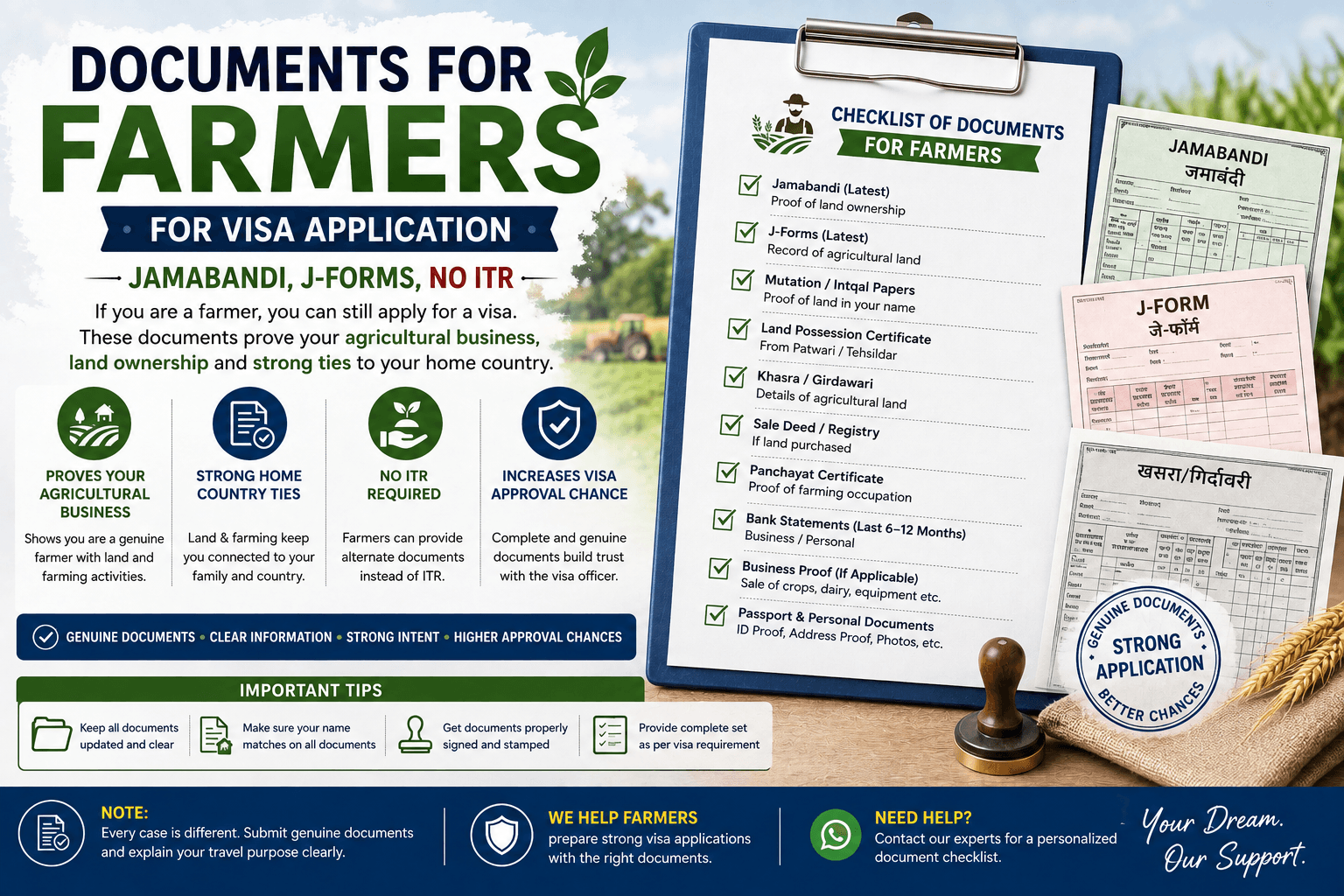
A farmer's visa document set — Jamabandi land record, J-Forms from the mandi and a bank passbook — laid out beside a passport

At a Glance

Document
Farmer's File
For
Any country
Visa Type
Visitor / family visit
Mistakes
5 to avoid

Why This Document Matters

Officers are assessing whether you can fund the trip and whether you will return. Land answers the second question better than almost anything else an applicant can show — it cannot be sold quickly, it is worked seasonally, and it ties a family to a place across generations. The problem is only ever presentation: an officer who receives a bundle of Punjabi-language revenue records with no explanation cannot read the story they tell, while the same records translated and ordered make one of the strongest visitor files there is.

Need the whole visa file done, not just this farmer's file?

We prepare and file visitor, tourist and study visas for 60+ countries from anywhere in India: documents, VFS slot, embassy filing, with published fees and one licensed office in Patiala. This farmer's file is one of the pieces we check before anything is submitted.

Format & Requirements

Land first: Jamabandi or record of rights showing your holding, with Khasra–Khatauni and the land revenue receipt. Then cultivation: Girdawari, the crop inspection record, showing what was actually grown. Then sale: J-Forms from the mandi, which are the arhtiya's record of your produce being sold, and which function as your income statement. Then money: the bank passbook or statement showing those sale proceeds arriving. Everything in a regional language needs an English translation. Where you do file a return — many farmers have other income — include it.

Sample / Template

Customize before submitting

Get your farmer's file checked by a licensed consultant — ₹999

Document Review — send us your own document and a licensed consultant tells you what an officer would question, and what to change. Credited in full if you go ahead with filing.

Get it checked

The sample below stays on this page to read. What you are paying for is the finished document with your own details in it — and a person who has read refused files checking it.

sample-farmer-visa-documents.pdf
THE FARMER'S FILE, IN ORDER 1. LAND — that you hold it • Jamabandi / record of rights (fard), current copy • Khasra–Khatauni extract • Land revenue receipt for the current year • Mutation certificate, where the land came by inheritance 2. CULTIVATION — that it is farmed • Girdawari (crop inspection record) for recent seasons • Where applicable: tubewell connection, electricity bill for agricultural supply 3. SALE — what it earned • J-Forms from the mandi for recent sales • Arhtiya's account statement, where available • Receipts for sale of milk, sugarcane to a mill, or other regular produce 4. MONEY — that it reached you • Bank passbook or statement, six months, showing sale credits • Kisan Credit Card statement, if held 5. THE REST OF THE PICTURE • Farmer ID / registration with the state portal, where issued • Property documents for house or other land • ITR, if you file one for non-agricultural income 6. TRANSLATION • Certified English translation of every document in Punjabi, Hindi or any regional language A COVERING NOTE, IN YOUR OWN WORDS State plainly that agricultural income is exempt from income tax under section 10(1) of the Income Tax Act, that this is why no return is enclosed for it, and that the J-Forms and bank credits show the income instead. Say what you grow, on how much land, and roughly what a season brings. One paragraph removes the question before it is asked.

The same letter, written the way that gets refused

This is not an exaggeration. It is the shape of letter most applicants actually bring us: polite, short, and answering none of the questions the officer has.

Too weak to help you
To Whom It May Concern, I am a farmer. I do not pay income tax because I am doing farming. I have 12 acres of land in my village. My income is around 8 lakh per year. Please consider my application. [Name]

What the officer sees missing

  • Says there is no ITR without saying why. The lawful reason — exemption under section 10(1) — is the single most useful sentence this letter could contain, and it is missing.
  • “12 acres” with no Jamabandi attached, so the holding is asserted and not evidenced.
  • Nothing showing the land is actually cultivated. Ownership and farming are two different claims.
  • “around 8 lakh” with no J-Forms. The mandi record is what turns an estimate into an income statement.
  • No bank passbook, so there is nothing showing the money ever arrived.
  • No mention of translation, and revenue records are almost always in a regional language.
  • Written as an apology for a gap rather than as an index to the evidence that fills it.

None of these are hard to fix. They are simply things nobody tells you before you hand the letter in.

A question about this farmer's file? Ask a licensed consultant on WhatsApp

Leave your number and we'll WhatsApp you back. No long forms, no obligation.

✓ The ₹499 report is fully refundable · our refund promise

Do's and Don'ts

Do

  • Say in writing why there is no ITR — cite section 10(1)
  • Get every Punjabi or Hindi document translated to English
  • Order the file: land, cultivation, sale, money
  • Include J-Forms — they are your income statement
  • Show sale proceeds arriving in the bank passbook

Don't

  • Don't leave the missing ITR unexplained
  • Don't submit untranslated revenue records
  • Don't send land papers alone with no sale or bank evidence
  • Don't inflate landholding beyond what the Jamabandi shows
  • Don't let a family member's land stand in for your own without explaining the relationship

Common Mistakes That Cause Rejections

1

Submitting the file with no explanation for the absent ITR

2

Revenue records in Punjabi with no English translation

3

Land documents with nothing showing the land is actually farmed

4

No J-Forms, so there is no record of produce being sold

5

Bank passbook showing no agricultural credits at all

Stop guessing. Get your farmer's file reviewed by experts.

We've prepared thousands of visa files. One mistake in your document can cost you a rejection.

Frequently Asked Questions

I have no ITR because farming income is tax-free. How do I explain that?+

In one sentence, in writing, at the front of the file. Agricultural income is exempt from income tax under section 10(1) of the Income Tax Act, which is why no return is enclosed for it — and the J-Forms and bank credits show the income instead. That single paragraph does more than any other document in the file, because it converts what an officer would otherwise read as a missing document into a lawful fact about how your income works. Applicants who leave the gap silent are asking the officer to guess, and the guess is rarely generous.

What is a J-Form and why does it matter so much?+

A J-Form is the record issued when your produce is sold through the mandi — the arhtiya's account of what was sold, in what quantity, and for how much. For a farmer without an ITR it is the closest thing to an income statement that exists, and it is official, dated and third-party. Collect them for recent seasons rather than one. Together with the bank credits that follow them, J-Forms let an officer trace a season from harvest to money in the account, which is exactly the chain a payslip provides for a salaried applicant.

My land records are in Punjabi. Do they need translating?+

Yes, and this is where more farmer files fall down than on any question of substance. A visa officer cannot read a Jamabandi in Gurmukhi, and an untranslated document is functionally a blank page — worse, it can look like padding. Get certified English translations of the Jamabandi, the Girdawari and the J-Forms, and submit the original alongside each translation so the pair can be matched. The cost is small and it is the difference between a strong file and an unreadable one.

The land is in my father's name, not mine. Does it still help?+

It helps, but it has to be explained rather than implied. Joint family holdings are the norm and officers understand that, so what matters is that the file is honest about whose name is on the record and what your interest is. Include the Jamabandi as it stands, state the relationship, and where the land is ancestral say so. If some part is in your name, lead with that. What causes difficulty is a file that presents family land as personal without saying so, because the record itself says otherwise and the officer will read the record.

How do I show income if I sell to a private buyer rather than the mandi?+

Build the same chain from what you do have. Receipts or account statements from the buyer, a dairy or sugar mill's payment record, weighbridge slips, and above all the bank credits that follow each sale. Regular payments from an identifiable buyer arriving in your account tell substantially the same story a J-Form would. Where sales are in cash, deposit them and let the passbook record them — an income that never touches a bank account cannot be evidenced to anybody, and that is a practical problem well before it is a visa problem.

Do I need a Girdawari as well as the Jamabandi?+

They answer different questions and a strong file has both. The Jamabandi says you hold the land; the Girdawari — the crop inspection record — says the land was cultivated, and with what. Ownership alone is compatible with land lying fallow or leased out, so an officer reading only a Jamabandi knows you have an asset but not that you have an occupation. The Girdawari turns the holding into a working farm, which is the thing your return intent actually rests on.

Is my landholding large enough?+

There is no threshold, and it is the wrong frame. Officers are not scoring acreage — they are asking whether your circumstances are consistent and whether you have reason to return. A modest holding that is demonstrably farmed, sold through the mandi and banked tells a complete story; a large holding with no cultivation record and no sale evidence tells an incomplete one. Consistency across the four stages beats size at any one of them.

Should I still open a bank account and keep statements if I mostly deal in cash?+

Yes, and start well before you apply. Six months of statements showing agricultural credits is the single most useful thing a farmer can add to a file, and it cannot be created retrospectively. If sale proceeds currently stay in cash, begin depositing them — into the account you will later submit — so that by the time you apply the passbook shows the pattern rather than a sudden deposit shortly before the application. A balance that appears late is read very differently from one that accumulated.

I also have a shop or other income. Should I mention it?+

Yes. Non-agricultural income usually is taxable, so if you file a return for it, include it — a farmer who also files an ITR is answering the checklist's question directly for part of their income and lawfully for the rest. Rental income, a shop, machinery hired out to other farmers, or a family member's salary all add to the picture. The aim is a complete household position, not a single heroic document.

Does my family's travel history matter?+

Your own matters most, and if you have travelled before and returned on time, put the visa pages and stamps in prominently. Family travel is weaker evidence but not irrelevant — a household where members have travelled and come back reads differently from one with no history at all. What is worth avoiding is the opposite: if a close relative has overstayed abroad, that is a fact the file has to be built around honestly rather than hoped past, and it is worth taking advice on before you apply.

Where does this fit with your farmers' page?+

This page is the folder — what to gather, in what order, and how to make it readable. Our farmers' visa page covers the wider question of how a farming applicant is assessed and what we do differently for one, including the ties that have nothing to do with paperwork. Most people need both: this one when they are assembling documents, that one when they are deciding whether to apply at all.

Can SureshotVisa help build a farmer's file?+

Yes, and this is a case where local knowledge counts — we are in Patiala, we read Jamabandis and J-Forms as a matter of routine, and we know what a Punjabi revenue record looks like when it is complete and when it is not. Send photographs of what you have on WhatsApp and a licensed consultant will tell you what is missing, what needs translating, and whether the chain from land to bank actually closes. It is and there is no obligation. No consultant can guarantee a visa; the officer always decides.

Send us the letter before you submit it.

A licensed consultant will check it against every point above — what is missing, whether the dates agree with the rest of your file, and whether the contact details would survive a verification call. If it is already fine, we will tell you that.

Related Document Guides

Ready when you are

The template is free. The checking is what you are missing.

Everything above costs you nothing, and you are welcome to it. What a template cannot do is read itself against the rest of your file — and that is where applications actually fail: a date that does not match the ticket, a salary that does not match the bank statement, a signatory the company cannot verify on a call. You are about to spend an embassy fee, a visa-centre fee and a trip on this application. Having a licensed consultant read the paperwork first costs a fraction of any one of them.

Filing it yourself? That is genuinely fine — most straightforward cases do not need anyone. If it comes back refused, bring us the letter. Reading the actual refusal ground is how a case gets recovered, and it is the work we do most. How refusal recovery works