Skip to content
Pet Export CertificateAny countryPet relocation

Taking Your Pet Abroad from India — AQCS Export Certificate & Checklist

A pet leaving India needs two sets of rules satisfied at once: India's exit paperwork — an export health certificate from Animal Quarantine and Certification Services — and the destination country's import rules, which vary enormously and are usually the harder half. The AQCS certificate itself is straightforward once you know its two clocks: the pet and its documents are presented seven days before travel, and the certificate is valid for ten days from issue.

Reviewed by Rohit Gir, SureshotVisa — a government-licensed consultancy (Licence 849/DC/PTA/PLA/LC-3/2024). Verify us.

Not sure about something on this page?

Ask a licensed consultant on WhatsApp — whether your employer's wording is acceptable, which format your country wants, what to do when a standard line does not apply to you. No obligation, and you will get a straight answer today. Want the document itself read and checked against the rest of your file? That is the paid check further down.

No obligation · A licensed consultant replies

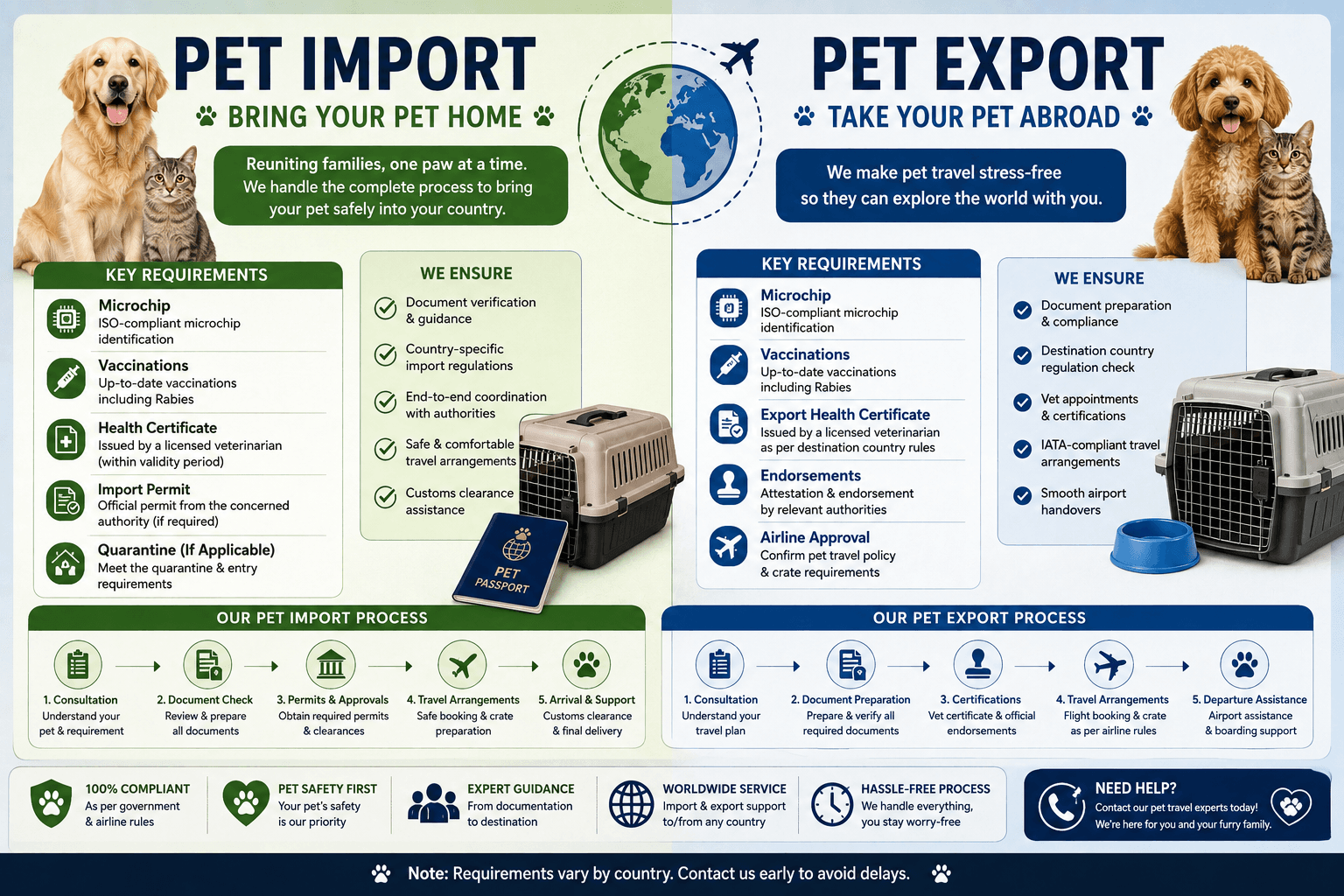
Infographic of the pet export process from India — microchip, vaccinations, export health certificate, endorsements and airline approval, with an IATA travel crate

At a Glance

Document
Pet Export Certificate
For
Any country
Visa Type
Pet relocation
Mistakes
5 to avoid

Why This Document Matters

The export certificate is what the airline and the destination's border officials expect to see from the Indian side, but it is the destination rules that decide the real timeline. Several major destinations treat India in ways that add months — a rabies antibody titer test with a waiting period for the EU and UK, changed CDC rules for dogs entering the USA — and none of that can be compressed at the end. Families who start from the flight date and work forwards miss this; the ones who start from the destination's rules and work backwards travel on schedule.

Need the whole visa file done, not just this pet export certificate?

We prepare and file visitor, tourist and study visas for 60+ countries from anywhere in India: documents, VFS slot, embassy filing, with published fees and one licensed office in Patiala. This pet export certificate is one of the pieces we check before anything is submitted.

Format & Requirements

For the AQCS certificate: a veterinary health certificate from a registered vet, the microchip certificate, the complete vaccination record (or the mother's record where the animal is too young), a copy of the owner's passport, the air ticket, two 4x6-inch photographs of the pet, and whatever the destination country specifically requires. The documents, self-attested, are submitted with the animal at the quarantine office seven days before travel; an authorised representative may attend with written authorisation. The certificate is valid for ten days from issue, so the AQCS visit is booked against the flight.

Sample / Template

Customize before submitting

Get your pet export certificate checked by a licensed consultant — ₹999

Document Review — send us your own document and a licensed consultant tells you what an officer would question, and what to change. Credited in full if you go ahead with filing.

Get it checked

The sample below stays on this page to read. What you are paying for is the finished document with your own details in it — and a person who has read refused files checking it.

sample-pet-export-certificate-india.pdf
TAKING A PET OUT OF INDIA — THE CHECKLIST 1. START FROM THE DESTINATION, MONTHS OUT • EU / UK: India is treated as unlisted — expect a rabies antibody titer test and a waiting period measured in months • UK dogs: tapeworm treatment in a fixed window before arrival • USA: CDC dog-import rules changed recently — current position confirmed per case • Gulf, Singapore, Australia and others: each has its own regime; Australia's is long and strict We check the current rules for your destination before anything is booked. 2. THE BASICS, EARLY • ISO microchip implanted, and quoted on every record • Rabies vaccination current, tied to the chip • Titer test done at an approved lab, where the destination needs it 3. THE AIRLINE • Cabin, checked baggage or manifested cargo — route and season dependent • IATA-compliant crate, sized to the animal • Some airlines and seasons refuse animal carriage — confirm early 4. THE AQCS VISIT — 7 DAYS BEFORE TRAVEL Bring, self-attested, with the pet: • Veterinary health certificate from a registered vet • Microchip certificate • Vaccination record (mother's record if the animal is too young) • Owner's passport copy and air ticket • Two 4x6-inch photographs of the pet • The destination country's specific requirements An authorised person may attend with written authorisation. 5. THE CERTIFICATE • Valid 10 DAYS from issue — book the AQCS visit against the flight, not the other way round 6. FLY • Certificate, records and crate documents travel with the animal

A question about this pet export certificate? Ask a licensed consultant on WhatsApp

Leave your number and we'll WhatsApp you back. No long forms, no obligation.

✓ The ₹499 report is fully refundable · our refund promise

Do's and Don'ts

Do

  • Start from the destination country's rules, months ahead
  • Do the titer test early where the destination requires one
  • Book the AQCS visit seven days before the flight
  • Carry two 4x6 photographs of the pet to the AQCS visit
  • Confirm the airline accepts animals on that route and season

Don't

  • Don't book flights before the destination's waiting periods are known
  • Don't let the 10-day certificate validity lapse before departure
  • Don't assume USA rules are what they were — they changed
  • Don't buy a crate the airline hasn't approved
  • Don't leave the titer test to the final month

Common Mistakes That Cause Rejections

1

Titer test discovered too late, adding months to an already-booked plan

2

AQCS certificate issued more than ten days before the rescheduled flight

3

Airline refuses carriage in summer months and no fallback exists

4

Crate not IATA-compliant, rejected at check-in

5

Destination forms missing because only the Indian side was prepared

Stop guessing. Get your pet export certificate reviewed by experts.

We've prepared thousands of visa files. One mistake in your document can cost you a rejection.

Frequently Asked Questions

What does India require before a pet can leave?+

One document, from one office: an export health certificate from Animal Quarantine and Certification Services. To get it, you present the animal and the paperwork at the quarantine office seven days before travel — a veterinary health certificate from a registered vet, the microchip certificate, the vaccination record, your passport copy, the air ticket, and two 4x6 photographs of the pet. The certificate is valid for ten days from issue. The Indian side is genuinely the easy half; it is the destination's rules that set your real timeline.

What is a rabies titer test and does my pet need one?+

It is a laboratory blood test proving the rabies vaccination actually produced antibodies, and whether you need it depends entirely on the destination. The EU and UK treat India as an unlisted country for pet travel, which means a titer test at an approved laboratory followed by a waiting period measured in months before the pet may enter. That waiting period is the single biggest surprise in this whole process, and it cannot be shortened, negotiated or done in parallel at the end. If your destination requires a titer, it is the first thing on the calendar and everything else fits around it.

We are moving to the USA. What changed?+

The CDC rewrote its dog-import rules, and the position for dogs arriving from any country now turns on rabies-risk classification, microchips, forms and age minimums that did not exist under the old regime. Because these rules have moved recently and can move again, we confirm the current CDC position for your specific case at the time you plan rather than publishing a snapshot here that will go stale. The practical advice stands regardless: for the USA, start with the destination's current rules before booking anything, and assume the process takes longer than the last person you spoke to remembers.

How early should we start for the UK or Europe?+

Four to six months is realistic, and the titer clock is the reason. The sequence is fixed: microchip, then rabies vaccination, then a waiting period before the titer blood draw, then the laboratory result, then the destination's mandatory wait after a successful test — and only then does the final stretch of health certificates and the AQCS visit begin. Families who allow six months do this calmly; families who allow six weeks discover the timeline is not theirs to set. If the move date is fixed and close, tell us immediately, because the options narrow fast.

Cabin, checked baggage or cargo — how does my pet actually fly?+

It depends on the airline, the route, the season and the animal's size, and the honest answer is that the airline's rules decide more of this than any government's. Small pets may be allowed in the cabin on some carriers; larger animals travel as checked baggage or manifested cargo in an IATA-compliant crate sized so the animal can stand and turn. Some airlines suspend animal carriage entirely in the hottest months, and some routes have no pet-friendly option at all. Confirm the airline's position before buying tickets — it is the one veto nobody can paperwork around.

What crate do I need?+

An IATA-compliant one, sized to the animal — big enough to stand at full height, turn around and lie naturally, with ventilation on the required sides, a secure metal-door mechanism, and food and water fixtures. Airlines check this at the counter and reject crates that fail, which at check-in time means the animal does not fly. Buy the crate early for a second reason: an animal that has spent a few weeks getting comfortable in its crate travels far better than one meeting it at the airport.

My puppy is too young for the full vaccination record. Can it travel?+

India's export side anticipates this — where the animal is too young, the mother's vaccination record is presented in place of its own. The destination is the harder question: most serious destinations set minimum ages and vaccination requirements that a very young animal simply cannot meet yet, and the EU/UK titer route effectively rules out young puppies until the clock has run. If the travel date cannot move, be prepared for the honest answer that the animal follows later, and plan who accompanies it.

Can someone else take my pet to the AQCS office for me?+

Yes — an authorised representative may submit the documents and present the animal, provided they carry your written authorisation. This matters in practice because the seven-days-before-travel visit often falls in the most compressed week of an international move. If a relative, friend or agent is doing the AQCS run, make sure they carry the full self-attested document set and the photographs, and that the authorisation is signed and unambiguous. A representative turned away for incomplete papers costs you the one week you did not have spare.

The certificate is valid ten days. What if my flight moves?+

Then the certificate may lapse before departure, and a lapsed certificate is not a document — the AQCS visit happens again. This is why the sequencing advice runs the direction it does: fix the flight, then book the AQCS visit seven days out, rather than collecting the certificate early for peace of mind. If a delay is forced on you inside the ten days, count the days first; if the new date still falls within validity you fly on the same paper, and if it does not, the re-visit is an inconvenience rather than a crisis — provided you learn of the change in time to book it.

Do both India's rules and the destination's rules apply at once?+

Yes, and they do not coordinate with each other. India's side clears the animal to leave; the destination's side decides whether it may enter, and each is indifferent to the other's requirements. In practice you build one combined checklist: the destination's rules set the long timeline — titer tests, waiting periods, treatment windows — and India's AQCS visit slots into the final week. The failure mode is preparing whichever side you happen to know about and discovering the other at the airport, in either direction.

Can SureshotVisa handle the export paperwork?+

Yes — this is a service we sell. We build the combined checklist for your specific destination, confirm its current rules rather than last year's, schedule the titer test where one is needed, prepare the AQCS visit so the certificate lands inside its ten-day validity, and run the pet's timeline alongside your family's own visa work so one move has one calendar. The limits, stated plainly: the destination's border officials and the airline make their own decisions, and nobody honest promises otherwise. Message or call any hour — a licensed consultant calls you back in your time zone within 12 hours.

Send us the letter before you submit it.

A licensed consultant will check it against every point above — what is missing, whether the dates agree with the rest of your file, and whether the contact details would survive a verification call. If it is already fine, we will tell you that.

Related Document Guides

Ready when you are

The template is free. The checking is what you are missing.

Everything above costs you nothing, and you are welcome to it. What a template cannot do is read itself against the rest of your file — and that is where applications actually fail: a date that does not match the ticket, a salary that does not match the bank statement, a signatory the company cannot verify on a call. You are about to spend an embassy fee, a visa-centre fee and a trip on this application. Having a licensed consultant read the paperwork first costs a fraction of any one of them.

Filing it yourself? That is genuinely fine — most straightforward cases do not need anyone. If it comes back refused, bring us the letter. Reading the actual refusal ground is how a case gets recovered, and it is the work we do most. How refusal recovery works