Skip to content
Pensioner's FileAny countryVisitor / family visit

Visa Documents for Retired People & Pensioners — PPO, Pension Proof & No-ITR Cases

A retired applicant has no employer, no payslip and no leave letter, and often no income tax return either — and the standard checklist asks for all four. The instinct is to treat this as a weak position. It is not. A pension is more stable than a salary because it cannot be resigned from or made redundant, and a retired person with a home, a family and a pension has a settled life that is easy to evidence once you know which papers do it.

Reviewed by Rohit Gir, SureshotVisa — a government-licensed consultancy (Licence 849/DC/PTA/PLA/LC-3/2024). Verify us.

Not sure about something on this page?

Ask a licensed consultant on WhatsApp — whether your employer's wording is acceptable, which format your country wants, what to do when a standard line does not apply to you. No obligation, and you will get a straight answer today. Want the document itself read and checked against the rest of your file? That is the paid check further down.

No obligation · A licensed consultant replies

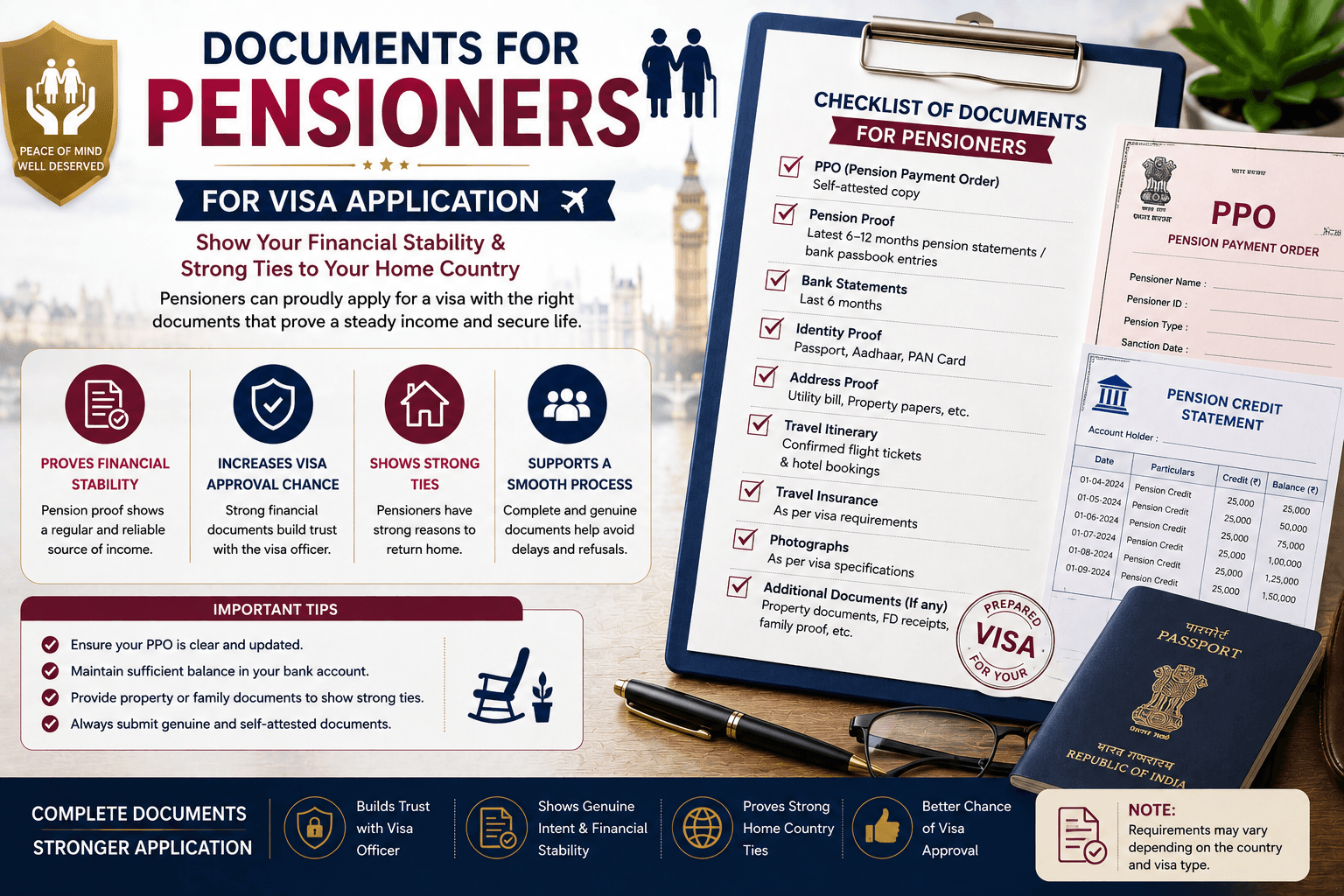
A pensioner's visa document set — pension payment order, bank passbook showing pension credits and property papers — beside a passport

At a Glance

Document
Pensioner's File
For
Any country
Visa Type
Visitor / family visit
Mistakes
5 to avoid

Why This Document Matters

Most visitor refusals turn on purpose and return intent rather than money, and retirement affects how both are read. The purpose is usually the strongest part of a retired applicant's case — visiting a child or grandchild abroad is specific, verifiable and entirely ordinary. Return intent is where files are lost, because an officer who cannot see what brings a retired person home may assume there is nothing. Property, pension, a spouse, medical care and the rest of the family are all answers, and they only work if the file states them.

Need the whole visa file done, not just this pensioner's file?

We prepare and file visitor, tourist and study visas for 60+ countries from anywhere in India: documents, VFS slot, embassy filing, with published fees and one licensed office in Patiala. This pensioner's file is one of the pieces we check before anything is submitted.

Format & Requirements

Income first: the PPO — pension payment order — which is the single most useful document a pensioner has, together with the bank statement showing the pension arriving each month. Then status: the retirement or service certificate from the former employer, and the pensioner identity card where one was issued. Then assets and ties: property documents, fixed deposit receipts, and where relevant the spouse's position. Then the return you may still file — many pensioners do, and it should be included where it exists. If a child abroad is inviting or funding the trip, their invitation and financial documents sit alongside.

Sample / Template

Customize before submitting

Get your pensioner's file checked by a licensed consultant — ₹999

Document Review — send us your own document and a licensed consultant tells you what an officer would question, and what to change. Credited in full if you go ahead with filing.

Get it checked

The sample below stays on this page to read. What you are paying for is the finished document with your own details in it — and a person who has read refused files checking it.

sample-retired-pensioner-visa-documents.pdf
THE RETIRED APPLICANT'S FILE 1. INCOME — that it arrives, and keeps arriving • PPO (Pension Payment Order) — the master document • Bank statement, six months, showing monthly pension credits • Pension slip, where your bank or department issues one • ITR, where you still file one 2. STATUS — who you were, and that you retired properly • Retirement / service certificate from the former employer • Pensioner identity card, where issued • Last drawn salary certificate, where available 3. TIES — what brings you home • Property documents for your house and any other holding • Fixed deposits, savings certificates, mutual fund statements • Spouse's pension or income, where applicable • Ongoing medical treatment with a doctor in India, where relevant 4. THE TRIP • Invitation from the child or relative you are visiting • Their status document and proof of address abroad • Their financial documents, if they are funding any part • Return flight booking matching the dates in the invitation 5. A COVERING NOTE, IN YOUR OWN WORDS Two short paragraphs. The first says who you are, when you retired, from where, and what your pension is. The second says why you are going, for how long, and what you are coming back to — the house, the spouse, the treatment, the rest of the family. Do not leave the officer to infer it.

The same letter, written the way that gets refused

This is not an exaggeration. It is the shape of letter most applicants actually bring us: polite, short, and answering none of the questions the officer has.

Too weak to help you
To Whom It May Concern, I am retired since 2019. I am getting pension every month. My son is in Canada and he has called me to visit him. He will take care of all my expenses there. Kindly grant the visa. [Name]

What the officer sees missing

  • No PPO attached, so the pension — the applicant's whole income position — is asserted and not evidenced.
  • No pension amount stated, and no bank statement showing the monthly credits arriving.
  • No retirement certificate, so the employment history that produced the pension is unverified.
  • “he will take care of all my expenses” with none of the son's financial documents, which moves the funds question abroad without answering it.
  • Nothing at all about what the applicant returns to — no house, no spouse, no ongoing commitments. For a retired applicant this is the question, and the letter is silent on it.
  • No dates and no return booking, so the length of the visit is unknown.
  • “Kindly grant the visa” — applicants cannot request a decision.

None of these are hard to fix. They are simply things nobody tells you before you hand the letter in.

A question about this pensioner's file? Ask a licensed consultant on WhatsApp

Leave your number and we'll WhatsApp you back. No long forms, no obligation.

✓ The ₹499 report is fully refundable · our refund promise

Do's and Don'ts

Do

  • Lead with the PPO — it is your strongest single document
  • Show six months of pension credits in the bank
  • State plainly what you are returning to
  • Include property and deposits as ties, not just as funds
  • Attach the inviting relative's documents where they are hosting you

Don't

  • Don't leave return intent to be inferred
  • Don't submit a bank balance funded by a recent transfer from abroad
  • Don't omit a spouse who is staying in India — that is a tie
  • Don't apologise for having no employer letter
  • Don't ignore medical needs; travel insurance and treatment continuity matter

Common Mistakes That Cause Rejections

1

No PPO, so the pension is asserted rather than evidenced

2

Balance funded by a large transfer from the child abroad shortly before applying

3

Nothing in the file explaining what the applicant returns to

4

Retirement certificate omitted, leaving the employment history unclear

5

Invitation from the child abroad with none of their supporting documents

Stop guessing. Get your pensioner's file reviewed by experts.

We've prepared thousands of visa files. One mistake in your document can cost you a rejection.

Frequently Asked Questions

I am retired with no payslip and no employer. Where do I start?+

With the PPO. The pension payment order is the single most useful document a retired applicant has: it is official, it names you, it states your entitlement, and it does not expire. Put it at the front, and behind it put six months of bank statements showing the pension actually arriving each month. Those two together do everything a payslip and an employer's letter would have done for a salaried applicant, and they do it more durably — a salary can stop next month, and a pension does not.

I do not file an income tax return any more. Is that a problem?+

Not in itself, and it is common — many pensioners fall below the threshold or have tax deducted at source with nothing further to file. What matters is that the absence is explained rather than left as a hole in the checklist. A line in your covering note saying that your income is pension, that it is credited monthly as the statements show, and that you do not file a return because of your income level, closes the question. Where you do still file, include it: a retired applicant with an ITR is simply answering the checklist directly.

My son abroad is paying for everything. What do I still need to show?+

Your own position, in full, alongside his. His invitation and financial documents answer whether the trip is funded; they do not answer whether you will come home, and that is the question retired applicants are actually assessed on. So the file still needs your PPO, your bank statements, your property documents and a clear statement of what you return to. The strongest version of this application has both halves: a well-evidenced host abroad and a well-evidenced life in India. Files that lean entirely on the child abroad leave the officer with nothing to weigh on the other side.

How do I show return intent when I have no job to go back to?+

By naming what you do have, explicitly, in the covering note. A house you own. A spouse who is staying. Other children and grandchildren in India. Ongoing medical treatment with a doctor here. Property, land, deposits, a pension that is paid into an Indian account. Community or religious commitments. None of these are exotic — most retired applicants have several — but they only count if the file says them. The mistake is assuming the officer will infer a settled life from the absence of a reason to leave. Return intent is evidenced, not assumed.

My child transferred money into my account for the trip. Does that hurt?+

It can, if it is unexplained and recent. A balance that appears shortly before an application is the pattern officers are trained to notice, and money arriving from the same person who has invited you sharpens the question rather than settling it. If the transfer has happened, explain it plainly — say who sent it, why, and attach their evidence — which turns an unexplained deposit into a documented sponsorship. Better still, where there is time, let your own pension credits accumulate and have your child sponsor formally with their own statements instead.

Do I need travel insurance, and does it affect the application?+

For Schengen it is mandatory and must meet the specified cover, and for other destinations it is strongly advisable — more so with age, because the cost of an untreated problem abroad is the thing an officer is entitled to consider. Beyond the requirement, insurance does quiet work in the file: it shows the trip has been planned properly by someone who has thought about what happens if they fall ill. Buy cover that genuinely matches your age and any existing conditions rather than the cheapest policy that satisfies the box.

I take regular medication and see a doctor in India. Should I mention it?+

Yes, and it helps on two fronts. Practically, a letter from your doctor covering your condition, your medication and your fitness to travel prevents difficulty at the border and with insurance. For the application, ongoing treatment with a named doctor in India is a genuine tie — it is a reason you return on a specific timescale, and it is verifiable. Applicants often leave health out of the file for fear it looks like a liability. Presented as continuity of care with a doctor you come back to, it does the opposite.

How long a visit should I apply for?+

The length you actually intend, matching the invitation and the return booking. Retired applicants are sometimes advised to ask for the maximum on the basis that it is free to do so; it is not free, because a request to stay six months when the invitation mentions a month invites the question of what the real plan is. If the intention is a long visit, apply for it and evidence it properly — the ties in India carry that weight when they are documented. What does not work is dates in the application that no other document in the file supports.

Does having travelled before help at my age?+

Considerably, and it is frequently the strongest thing in a retired applicant's file. Previous visas that were complied with — particularly to the same country or a comparable one — are direct evidence of the exact behaviour the officer is trying to predict. Include the passport pages with the visas and the entry and exit stamps, and if the old passport has been replaced, submit it alongside the new one. Many retired applicants have decades of travel history sitting in a drawer and submit only the current passport.

My spouse and I are applying together. Should we submit one file or two?+

Two complete applications, cross-referencing each other. Each of you needs your own PPO or income evidence, your own bank statements and your own passport documents — but the covering notes should say clearly that you are travelling together, and the invitation should name you both. Where one spouse has the pension and the other does not, say so plainly and show the joint position; a dependent spouse is entirely normal and causes no difficulty when it is explained. What causes difficulty is two files that look independent and happen to have the same dates.

Where does this fit with your senior citizens' page?+

This page is the folder — which documents, in what order, and how to evidence a pension. Our senior citizens' visa page covers the assessment itself: how a retired applicant is read, why return intent is the pivot, and what we do differently for older clients including how we handle appointments and biometrics. Use this while gathering papers, and that while deciding how to present the case.

Can SureshotVisa help a retired applicant?+

Yes, and it is work we do a great deal of — parents visiting children abroad is among the commonest cases we see. Send us your PPO, your statements and the invitation on WhatsApp and a licensed consultant will tell you what is missing, whether the funding position is presented in a way that helps rather than raises questions, and how to state your return intent so it lands. We will also tell you plainly if we think the case needs strengthening before you apply. It is free. No consultant can guarantee a visa; the officer always decides.

Send us the letter before you submit it.

A licensed consultant will check it against every point above — what is missing, whether the dates agree with the rest of your file, and whether the contact details would survive a verification call. If it is already fine, we will tell you that.

Related Document Guides

Ready when you are

The template is free. The checking is what you are missing.

Everything above costs you nothing, and you are welcome to it. What a template cannot do is read itself against the rest of your file — and that is where applications actually fail: a date that does not match the ticket, a salary that does not match the bank statement, a signatory the company cannot verify on a call. You are about to spend an embassy fee, a visa-centre fee and a trip on this application. Having a licensed consultant read the paperwork first costs a fraction of any one of them.

Filing it yourself? That is genuinely fine — most straightforward cases do not need anyone. If it comes back refused, bring us the letter. Reading the actual refusal ground is how a case gets recovered, and it is the work we do most. How refusal recovery works