Skip to content
Sponsorship LetterUnited Kingdom flag — visa destinationUnited KingdomStandard Visitor

Sponsorship Letter for UK Visitor Visa Sample, Format & PDF

A sponsorship letter is what a UK-based relative or friend writes when they are paying for your trip. It is not the same as an invitation letter, and the difference matters more than most applicants realise: the moment somebody promises to fund your visit, their finances join your application and have to stand up to the same scrutiny yours would.

Reviewed by Rohit Gir, SureshotVisa — a government-licensed consultancy (Licence 849/DC/PTA/PLA/LC-3/2024). Verify us.

Not sure about something on this page?

Ask a licensed consultant on WhatsApp — whether your employer's wording is acceptable, which format your country wants, what to do when a standard line does not apply to you. No obligation, and you will get a straight answer today. Want the document itself read and checked against the rest of your file? That is the paid check further down.

No obligation · A licensed consultant replies

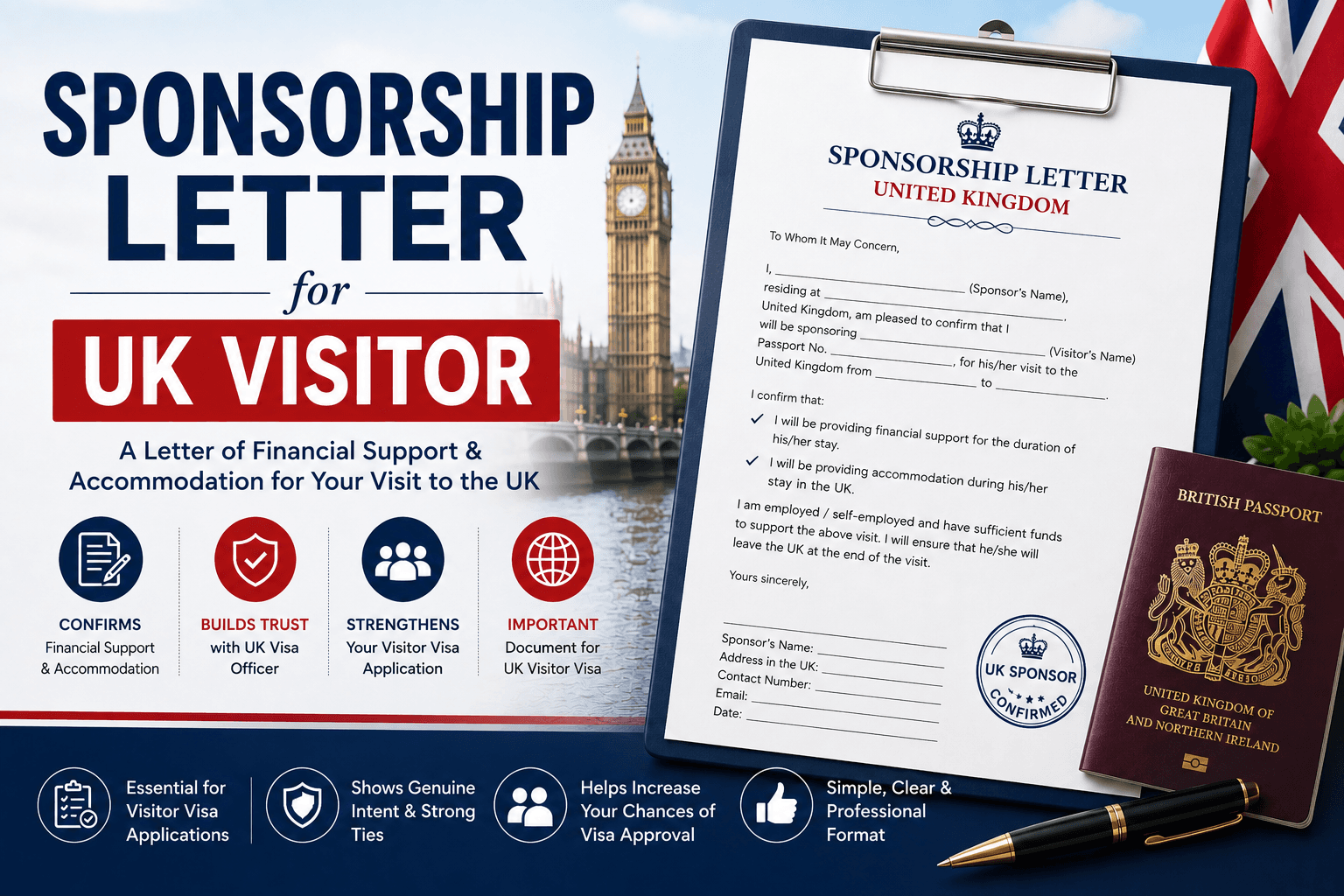
A sponsorship letter for a UK visitor visa on a desk with bank statements and a passport, showing the financial sponsorship format

At a Glance

Document
Sponsorship Letter
For
United Kingdom
Visa Type
Standard Visitor
Mistakes
5 to avoid

Why This Document Matters

UKVI has to be satisfied you can meet the cost of your trip. Where a sponsor is covering it, the officer stops asking whether you can afford it and starts asking whether they can — and whether the money they are promising actually exists, arrives regularly, and stays in the account. A sponsorship letter with no financial evidence behind it does not neutralise the funds question; it moves the question to someone who has not answered it.

Need the whole United Kingdom file done, not just this sponsorship letter?

We prepare and file United Kingdom standard visitor applications from anywhere in India: documents, VFS slot, embassy filing, with published fees and one licensed office in Patiala. This sponsorship letter is one of the pieces we check before anything is submitted.

Format & Requirements

One page from the sponsor, signed and dated, submitted with their financial evidence. It must state who they are and their status in the UK, their relationship to you, exactly what they are paying for — flights, accommodation, living costs, or all of it — and confirm they can do so without hardship. It should reference the enclosed evidence explicitly. Plain paper is fine; UK visitor applications are uploaded digitally, so a clear scan is all that is needed. No notarisation and no apostille.

Sample / Template

Customize before submitting

Get your sponsorship letter checked by a licensed consultant — ₹999

Document Review — send us your own document and a licensed consultant tells you what an officer would question, and what to change. Credited in full if you go ahead with filing.

Get it checked

The sample below stays on this page to read. What you are paying for is the finished document with your own details in it — and a person who has read refused files checking it.

sample-sponsorship-letter-uk-visitor-visa.pdf
[Sponsor's Name] [Sponsor's UK Address] [Date] To the Entry Clearance Officer, UK Visas and Immigration Subject: Financial sponsorship for [Applicant Full Name], passport no. [XXXXXXX] Dear Sir or Madam, I, [Sponsor Full Name], [British citizen / holder of settled status], residing at [full UK address], confirm that I will be financially responsible for the visit of [Applicant Full Name], holder of passport no. [XXXXXXX], who is my [exact relationship]. [Applicant] intends to travel to the United Kingdom from [Arrival Date] to [Departure Date]. I will meet the following costs in full: • Return airfare • Accommodation at my home, [address], at no cost to [Applicant] • All living expenses during the stay, including food and local travel • Travel insurance for the period of the visit I am employed as [Designation] at [Employer] with a gross annual income of £[Amount]. I confirm I can meet these costs from my own resources without recourse to public funds and without hardship to my household. I enclose: 1. Copy of my passport / online status share code 2. My last six months' bank statements 3. My last three payslips 4. Proof of my address I understand that this undertaking is given in support of a visa application and I am willing to be contacted to confirm it. Yours faithfully, [Signature] [Sponsor Full Name] [Phone] · [Email]

The same letter, written the way that gets refused

This is not an exaggeration. It is the shape of letter most applicants actually bring us: polite, short, and answering none of the questions the officer has.

Too weak to help you
To Whom It May Concern, I am sponsoring my uncle Mr. Rajesh Kumar for his UK trip. I will pay for everything during his stay. I am working in London and earning well. Thanks, Amit

What the officer sees missing

  • “everything” is not a list. The officer cannot tell whether that means flights, or a spare room, or nothing specific at all.
  • “earning well” instead of a figure — and no payslips, so there is nothing to check it against.
  • No bank statements. A funding promise with no account behind it transfers the funds question rather than answering it.
  • No UK address, so the accommodation half of the promise is unevidenced too.
  • No dates, so the officer cannot work out how much this trip actually costs.
  • Nothing about the sponsor's own status in the UK, which decides whether their income is even relevant.
  • No contact details, so the undertaking cannot be confirmed with the person giving it.

None of these are hard to fix. They are simply things nobody tells you before you hand the letter in.

A question about this sponsorship letter? Ask a licensed consultant on WhatsApp

Leave your number and we'll WhatsApp you back. No long forms, no obligation.

✓ The ₹499 report is fully refundable · our refund promise

Do's and Don'ts

Do

  • List exactly which costs you are covering
  • Enclose six months of bank statements, not one
  • State your income and your relationship plainly
  • Say the funds are available without hardship
  • Reference each enclosed document by name

Don't

  • Don't promise sponsorship you cannot evidence
  • Don't send a statement showing a sudden large deposit
  • Don't sponsor and then submit no payslips
  • Don't confuse this with the licensed-sponsor system for work visas
  • Don't get it notarised — UKVI does not ask for that

Common Mistakes That Cause Rejections

1

Sponsor writes “I will cover everything” and attaches nothing

2

Bank statement covers one month instead of six

3

A large deposit lands days before the statements are printed

4

Sponsor's income clearly cannot support their own household plus the trip

5

Applicant submits no financial evidence at all, relying entirely on the sponsor

Stop guessing. Get your sponsorship letter reviewed by experts.

We've prepared thousands of visa files. One mistake in your document can cost you a rejection.

Frequently Asked Questions

What is the difference between an invitation letter and a sponsorship letter?+

An invitation letter says “come and stay with me” — it evidences the purpose of your visit and where you will sleep, and you still show your own money. A sponsorship letter says “I will pay” — and that single sentence pulls the sponsor's finances into your application. The two are often written as one letter, which is fine, but you should know which promise you are making. The worst outcome is a sponsor who adds “I will take care of all expenses” as a friendly closing line and attaches nothing: the officer now has an unevidenced financial claim sitting next to your own funds, which you have implicitly said are not enough.

What financial evidence must my sponsor actually send?+

Six months of bank statements, their last three payslips, and something establishing their status in the UK. Six months matters because one month shows a balance and six months show a pattern — regular income arriving, ordinary spending, and a balance that survives the month. An officer reading a single statement cannot tell the difference between a sponsor who always has that money and one who borrowed it last week. If the sponsor is self-employed, business accounts and their tax return do the same job.

My sponsor received a large deposit recently. Is that a problem?+

It can be, and it is worth getting ahead of. A balance that appeared shortly before the statements were printed prompts the obvious question of where it came from and whether it will still be there. If there is a legitimate explanation — a bonus, a property sale, a matured deposit — say so in the letter and attach whatever shows it. Unexplained, a large recent credit makes an otherwise strong sponsor look like somebody who assembled a balance for the application. The same logic applies to your own account, which is why we tell applicants not to move money about in the weeks before applying.

Do I still need my own bank statements if someone is sponsoring me?+

Yes, and you should send them. UKVI assesses you as a genuine visitor, and part of that is whether your circumstances make sense — an applicant with no financial footprint of their own is harder to place, sponsored or not. Your statements do not have to cover the whole trip when the sponsorship is properly evidenced, but they should show ordinary, consistent activity that matches the life you have described. An empty account, or one funded by a single deposit shortly before applying, undoes much of the good the sponsorship does.

Can more than one person sponsor me?+

Yes, and it is common in family cases — two siblings splitting the cost, for instance. If they do, each writes their own letter stating precisely which costs they are covering, and each encloses their own financial evidence. What does not work is two vague letters that both say “I will help with expenses”, because between them they still do not add up to a funded trip. Divide the costs explicitly: one covers the airfare, the other covers accommodation and living costs. The officer should be able to add the promises together and reach the full cost of the visit.

Does the sponsorship letter need to be notarised or on stamp paper?+

No. For a UK visitor application this is a private letter, and UKVI does not ask for it to be notarised, apostilled or executed on stamp paper. That last one causes confusion because an affidavit of support — a different document, used in some other contexts — is sworn on stamp paper before a notary. A UK sponsorship letter is not that. Save the money and put the effort into the bank statements, which is what the officer will actually read.

Is this the same as being a “licensed sponsor”?+

No, and confusing the two causes real anxiety. The licensed-sponsor system applies to work and study routes: an employer or university holds a sponsor licence from the Home Office and issues a Certificate of Sponsorship. Nothing like that exists for visitor visas. Your uncle in Manchester does not need a licence, a reference number, or permission from anyone to fund your holiday — he needs a letter and his bank statements. If a consultant tells you a family visitor needs a “sponsor licence”, they are describing a different visa route entirely.

How much money should my sponsor show?+

There is no published figure for visitor sponsorship, which is exactly why applicants get this wrong in both directions. The test is whether the costs can be met without hardship, so the sensible measure is the actual cost of your trip — flights, insurance, and reasonable living costs for the days you will be there — set against the sponsor's income and what they normally have left after their own commitments. A sponsor earning modestly with a mortgage and children who promises to fund a six-week visit invites scrutiny; the same sponsor funding a two-week stay in their own home does not.

My sponsor is not a relative. Does that weaken the application?+

It raises a question that has to be answered, rather than being fatal. Officers see sponsorship between relatives constantly and understand the motivation. A friend funding a trip is less obvious, so the letter should explain the relationship and how long it has existed, and it helps if there is anything ordinary showing the history — a previous visit either way, a shared employer, a course you both attended. Unexplained generosity between people with no evident connection is the pattern that concerns officers, not friendship itself.

What if my sponsor is self-employed or runs a business?+

The evidence changes shape but the principle holds: show income arriving and staying. Instead of payslips, send the business's tax return, six months of business and personal bank statements, and — where applicable — the company registration. If they draw from the business rather than taking a salary, say so in the letter, because a personal account with irregular credits looks odd until it is explained. Self-employed sponsors are perfectly acceptable; they simply have to do slightly more work to make the picture legible.

Should the sponsorship letter state that I will return to India?+

It can note the return date, and it should, because the dates need to match your booking and your form. But be careful about how it is phrased. A sponsor cannot vouch for your intentions and an officer knows it, so a line like “I guarantee he will return” adds nothing and can read as overreach. What the sponsor can usefully say is factual: the dates they are funding, that the accommodation is available only for that period, and that they will inform the authorities of any change. Your intention to return is evidenced by your own ties in India, not by somebody else's promise.

Can SureshotVisa check my sponsorship letter and my sponsor's documents?+

Yes, and this is the one worth asking for, because sponsorship applications rarely fail on the letter's wording — they fail on the evidence behind it. Send both on WhatsApp and a licensed consultant will tell you whether the promise and the statements actually match, whether six months of activity supports the figure being offered, and whether anything in the account will prompt a question you would rather answer in advance. It is and there is no obligation. No consultant can guarantee a visa; the officer always decides.

Send us the letter before you submit it.

A licensed consultant will check it against every point above — what is missing, whether the dates agree with the rest of your file, and whether the contact details would survive a verification call. If it is already fine, we will tell you that.

Related Document Guides

Ready when you are

The template is free. The checking is what you are missing.

Everything above costs you nothing, and you are welcome to it. What a template cannot do is read itself against the rest of your file — and that is where applications actually fail: a date that does not match the ticket, a salary that does not match the bank statement, a signatory the company cannot verify on a call. You are about to spend an embassy fee, a visa-centre fee and a trip on this application. Having a licensed consultant read the paperwork first costs a fraction of any one of them.

Filing it yourself? That is genuinely fine — most straightforward cases do not need anyone. If it comes back refused, bring us the letter. Reading the actual refusal ground is how a case gets recovered, and it is the work we do most. How refusal recovery works