Skip to content
Apostille / LegalisationUnited Kingdom flag — visa destinationUnited KingdomStandard Visitor

Do You Need to Apostille a UK Invitation Letter? No — Here's What UKVI Actually Wants

No. A UK invitation letter does not need an apostille, and it does not need notarisation, attestation or a solicitor's stamp either. It is a private letter from your host to a visa section, not a public document, and nothing in the UK visitor rules asks for it to be legalised. If somebody has quoted you a price for apostilling one, you are being sold a stamp that UKVI will not look for.

Reviewed by Rohit Gir, SureshotVisa — a government-licensed consultancy (Licence 849/DC/PTA/PLA/LC-3/2024). Verify us.

Not sure about something on this page?

Ask a licensed consultant on WhatsApp — whether your employer's wording is acceptable, which format your country wants, what to do when a standard line does not apply to you. No obligation, and you will get a straight answer today. Want the document itself read and checked against the rest of your file? That is the paid check further down.

No obligation · A licensed consultant replies

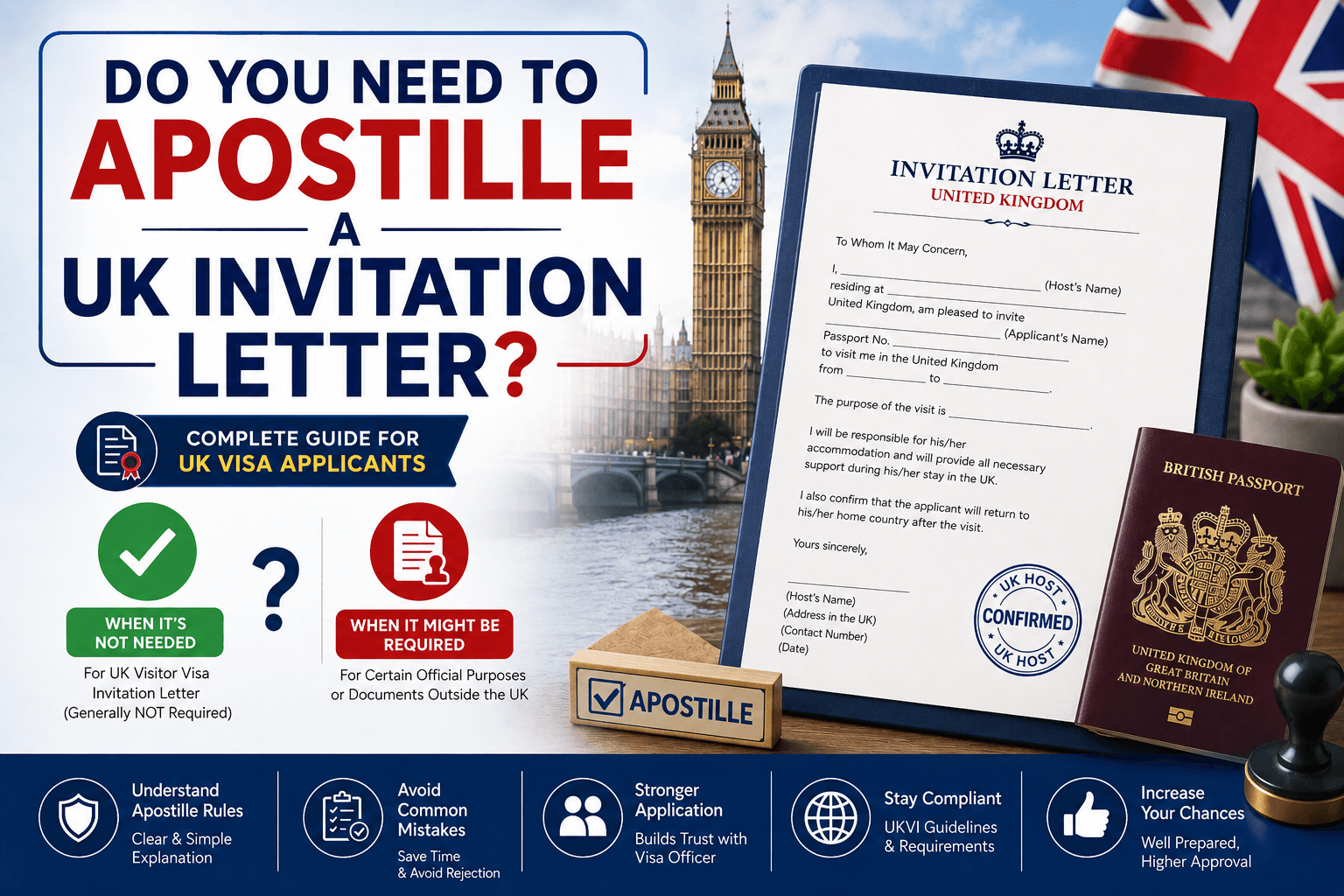
An apostille certificate beside a UK invitation letter, illustrating that a private invitation letter does not require legalisation

At a Glance

Document
Apostille / Legalisation
For
United Kingdom
Visa Type
Standard Visitor
Mistakes
4 to avoid

Why This Document Matters

This matters because the money and the fortnight spent chasing a legalisation stamp are usually taken from the part of the application that would actually have helped — the host's status evidence, their proof of address, and where they are paying, their bank statements. Applicants routinely arrive with a beautifully apostilled letter and no evidence that the person who wrote it lives in the UK. The stamp is not what the officer is checking.

Need the whole United Kingdom file done, not just this apostille / legalisation?

We prepare and file United Kingdom standard visitor applications from anywhere in India: documents, VFS slot, embassy filing, with published fees and one licensed office in Patiala. This apostille / legalisation is one of the pieces we check before anything is submitted.

Format & Requirements

The letter itself needs no legalisation of any kind: signed, dated, and uploaded as a clear scan with your online application. What must accompany it is evidence — the host's passport copy or online status share code, proof of the address they have invited you to, and, where they have offered to fund any part of the trip, payslips and bank statements. Apostille exists for public documents such as birth, marriage and degree certificates, and only where the receiving body specifically asks for it.

Sample / Template

Customize before submitting

Get your apostille / legalisation checked by a licensed consultant — ₹999

Document Review — send us your own document and a licensed consultant tells you what an officer would question, and what to change. Credited in full if you go ahead with filing.

Get it checked

The sample below stays on this page to read. What you are paying for is the finished document with your own details in it — and a person who has read refused files checking it.

sample-uk-invitation-letter-apostille.pdf
WHAT AN APOSTILLE IS An apostille is a certificate issued under the Hague Convention confirming that a signature or seal on a PUBLIC document is genuine — that the registrar, notary or official who signed it really holds that office. WHAT IT IS NOT It is not a statement that the contents of the document are true. That distinction is the whole point: a visa officer is judging whether the contents are credible, which is precisely the thing an apostille never certifies. DOCUMENTS THAT NEVER NEED IT FOR A UK VISITOR VISA • Invitation letter from a host • Sponsorship letter • Employer NOC or leave letter • Your own cover letter • Bank statements DOCUMENTS THAT SOMETIMES NEED IT, ON OTHER ROUTES • Birth certificate • Marriage certificate • Degree and transcript • Police clearance certificate ...and only where the receiving authority asks. For a standard visitor application, none of the above is normally required to be legalised. WHAT TO SEND INSTEAD, WITH THE INVITATION LETTER 1. Host's passport bio page, or their online immigration status share code 2. Host's proof of address — council tax bill, utility bill or tenancy agreement 3. If the host is paying: six months of bank statements and recent payslips

A question about this apostille / legalisation? Ask a licensed consultant on WhatsApp

Leave your number and we'll WhatsApp you back. No long forms, no obligation.

✓ The ₹499 report is fully refundable · our refund promise

Do's and Don'ts

Do

  • Send the letter as a plain signed scan
  • Spend the effort on the host's status and address evidence
  • Ask for a share code — BRP cards are no longer issued
  • Read the checklist for your specific route before legalising anything

Don't

  • Don't pay anyone to apostille an invitation letter
  • Don't notarise it either — it is not required
  • Don't assume a stamp compensates for missing evidence
  • Don't apply the rules for degree or birth certificates to private letters

Common Mistakes That Cause Rejections

1

Paying an agent to apostille a letter UKVI never asked for

2

Delaying the application by two weeks waiting for a legalisation stamp

3

Submitting an apostilled letter with no host status evidence at all

4

Confusing apostille (for public documents) with notarisation (a witnessed signature)

Stop guessing. Get your apostille / legalisation reviewed by experts.

We've prepared thousands of visa files. One mistake in your document can cost you a rejection.

Frequently Asked Questions

So an invitation letter definitely does not need an apostille?+

Correct, for a UK visitor application. An apostille legalises a public document — one issued by an official body — by confirming that the signature and seal on it are genuine. An invitation letter is a private letter written by an individual, so there is no official signature for an apostille to authenticate in the first place. UKVI's document requirements for the visitor route do not ask for the letter to be legalised, notarised or attested. What they ask for is that it be genuine and supported, which is a different problem and one a stamp cannot solve.

Which documents ever do need an apostille?+

Public records, and then only when the receiving authority asks. Birth and marriage certificates, degree certificates and transcripts, and police clearance certificates are the usual candidates — typically for settlement, study or employment routes rather than visitor ones, and typically because a university or a registrar wants them rather than the visa section. The rule that saves you money is simple: legalise what the checklist names, and nothing else. For a standard visitor application, it is normal for nothing at all to require legalisation.

What is the difference between apostille, notarisation and attestation?+

They are three different things and the words get used interchangeably, which is how people end up buying the wrong one. Notarisation is a notary witnessing a signature and recording it — it says the person signed in front of them, not that the contents are true. Attestation is a body confirming a document is authentic, often a ministry or embassy. An apostille is a specific certificate under the Hague Convention confirming that the official who signed a public document really holds that office, accepted between member countries without further embassy involvement. None of the three certifies that what the document says is correct.

An agent quoted me a price to apostille my invitation letter. Should I pay it?+

No, and you should treat the quote as information about the agent. This is one of the clearest cases where a fee is charged for something the receiving authority has not asked for and will not check. If you want to test it, ask them to show you where UKVI requires an invitation letter to be legalised. There is no such requirement to show. Put the same money and the same fortnight into getting your host's status evidence and address proof right, which is where invitation-based applications actually fall down.

Then what should I send with the invitation letter?+

Three things, and they matter far more than any stamp. Your host's proof of status — a passport bio page if they are British, or an online immigration status share code otherwise, since biometric residence permit cards were replaced by digital eVisas. Their proof of address for the property they have invited you to: a council tax bill, utility bill or tenancy agreement. And where they have offered to pay for any part of the trip, six months of bank statements and recent payslips. A plain letter with those three behind it beats an apostilled letter with none of them, every time.

My host's country is not in the Hague Convention. Does that change anything?+

Not for this document, because the letter needs no legalisation regardless. The Hague question only becomes relevant when a public document genuinely does need legalising and the issuing country is outside the Convention — in which case the route is embassy attestation rather than apostille. For a UK visitor application supported by an invitation letter, neither applies. If you are also submitting a public document that the checklist specifically asks to be legalised, check the route for that document alone.

Does a Schengen or Canadian invitation letter need an apostille?+

Generally no, on the same reasoning. Schengen missions ask for an invitation or accommodation proof and the host's supporting documents, not a legalised letter — though a few member states have their own formal invitation or “Verpflichtungserklärung” procedure that the host completes at their local authority, which is a different thing altogether and is not something you arrange in India. Canada asks for an invitation letter and does not require it notarised. As always, the country's own checklist decides; a general rule that “letters must be apostilled” is simply not one that exists.

Will an apostille hurt my application if I have already paid for one?+

No. A legalised letter is not penalised — it is simply not read as adding anything, and the money is gone. If you have already done it, submit the letter as normal and put your remaining effort into the supporting evidence. What you should not do is delay a submission waiting for a stamp to come back, or skip the host's status and address documents on the basis that the apostille covers them. It does not, and that substitution is the version of this mistake that actually costs applications.

Does the letter at least need to be signed by hand?+

Yes, and dated. UK visitor applications are submitted online and documents are uploaded, so a clear scan or photograph of a hand-signed letter is what you send — there is no requirement for a posted original, a wet-ink copy in your file, or a courier. What matters is that it is legible, that the signature is genuine, and that the date is close to your submission. A typed name where a signature should be is the one shortcut worth avoiding.

Where can I see the actual UK requirements myself?+

Read the guidance for the visit route on GOV.UK and the Appendix V rules it links to, which set out what an officer must be satisfied of and what documents support that. It is worth doing, because seeing that legalisation is simply absent from the requirements is more convincing than being told. It is also the best defence against being sold services you do not need — most of the additional stamps and attestations quoted to Indian applicants for visitor visas are not in the rules at all.

I still want somebody to look at my letter before I send it. Can you?+

Yes, free. Send it on WhatsApp and a licensed consultant will read it against what UKVI actually assesses, tell you what supporting documents your host still needs to produce, and confirm whether anything in your file genuinely requires legalisation — usually nothing does. If the letter is already fine we will say so and you can submit. No consultant can guarantee a visa; the officer always decides.

Send us the letter before you submit it.

A licensed consultant will check it against every point above — what is missing, whether the dates agree with the rest of your file, and whether the contact details would survive a verification call. If it is already fine, we will tell you that.

Related Document Guides

Ready when you are

The template is free. The checking is what you are missing.

Everything above costs you nothing, and you are welcome to it. What a template cannot do is read itself against the rest of your file — and that is where applications actually fail: a date that does not match the ticket, a salary that does not match the bank statement, a signatory the company cannot verify on a call. You are about to spend an embassy fee, a visa-centre fee and a trip on this application. Having a licensed consultant read the paperwork first costs a fraction of any one of them.

Filing it yourself? That is genuinely fine — most straightforward cases do not need anyone. If it comes back refused, bring us the letter. Reading the actual refusal ground is how a case gets recovered, and it is the work we do most. How refusal recovery works