Which Schengen Country to Apply Through from India
Last reviewed: 10 September 2026 · Verified against current VFS Global India fees
Learn the Schengen main-destination rule and discover which country to apply through from India for your visa application.


Booking a Europe trip that touches three or four countries? Before you pick a consulate, you must know one thing: you cannot simply apply through the country with the easiest appointment. Schengen rules decide your consulate for you — and applying at the wrong one is one of the fastest ways to get a rejection.
The short answer: the main-destination rule
The Schengen area has 29 countries but one shared visa. When your trip covers more than one member state, EU Visa Code Article 5 tells you exactly where to apply. There are only two questions that matter, and you check them in order.
Your consulate is decided by where you spend the most nights — not by appointment availability.
How to work out your main destination
The Visa Code lays out a clean decision order. Apply it honestly against your actual itinerary, not the one that gets you a faster slot.
Count your nights
Whichever Schengen country you stay in for the most nights is your main destination. Apply through that country's consulate or its appointed VFS.
Tie? Use first entry
If two or more countries have an equal number of nights, your main destination becomes the country where you first cross into Schengen.
Just transiting?
If you only pass through a country to reach your real destination, it does not count. A 2-hour layover in Frankfurt does not make Germany your main destination.
No clear main destination?
For a genuinely equal multi-country trip with no dominant stay, apply through the country of first entry. This is the fallback, not the default.
Here is a worked example. Say your 12-day itinerary is: fly into Paris (3 nights), train to Amsterdam (2 nights), then Rome (5 nights), then Barcelona (2 nights). Italy wins with 5 nights, so you apply through the Italian consulate / Italy VFS — even if France was your entry point and even if Spain has quicker slots.

The country-of-first-entry confusion
Many applicants mix up two different rules and end up at the wrong consulate. Let us separate them clearly.
- Main-destination rule decides which consulate you apply through.
- First-entry rule only kicks in as a tie-breaker, or governs which country you must physically enter first once you have the visa.
A common myth is "always apply through your first-entry country." That is wrong. First entry only decides the consulate when nights are tied or there is no dominant stay. If Italy has your most nights, you apply through Italy even if you land in Frankfurt.
Rule of thumb: nights first, entry second. If you remember only one line from this article, remember that one.
Single-country trips are the easy case
If you are visiting only one Schengen country, there is no debate — you apply through that country. All the confusion is created by multi-city Europe tours, which are exactly what most Indian tourists book. If your whole trip is 8 nights in Switzerland, you apply through Switzerland. Done.
Why the "easy consulate" shortcut backfires
You will hear friends say "apply through Country X, they approve everyone." Even if a particular consulate has a reputation for smoother processing, deliberately routing through the wrong one is risky and often self-defeating.
Itinerary mismatch. Visa officers cross-check your hotel bookings and flight tickets. If you apply through Country A but 80% of your nights are in Country B, the file contradicts itself.
Rejection on grounds of "justification of purpose." A wrong consulate can refuse and forward a note, and the reason gets recorded in the shared VIS database that every Schengen state can see.
Re-application delay. If refused, you must re-apply through the correct consulate anyway — losing your fee, your slot, and often your travel dates.
Consulate transfers. Some consulates simply return files that clearly belong to another country, wasting weeks you did not have.
Which VFS handles which country in India?
Once you know your main-destination country, you apply through its official visa partner in India. Most Schengen countries in India use VFS Global; a few use BLS or TLScontact. Here is a quick orientation for popular destinations.
| Main destination | Applies through (India) | Typical decision time |
|---|---|---|
| France | VFS Global | 10–15 working days |
| Germany | VFS Global | 10–15 working days |
| Italy | VFS Global | 15 working days |
| Spain | BLS International | 15 working days |
| Netherlands | VFS Global | 15 working days |
| Switzerland | TLScontact / VFS | 15 working days |
| Greece | VFS Global | 15 working days |
Always confirm the current visa partner on the destination country's embassy website before booking, as these arrangements are updated from time to time. Decision times also stretch during peak summer season (May–August), so apply 4–6 weeks ahead.
Schengen Visa Processing by Country
Average processing times and approval rates for Indian applicants
Fastest processing, high approval for Indian tourists
Popular for business visas, slightly longer wait
Tourism hub, moderate processing with fair approval
Slower processing, more documentation requirements
Quickest approvals, emerging choice for Indian applicants
Source: SureshotVisa consultant desk
Do this vs avoid this
Avoid
- Choosing a consulate because it has the earliest slot
- Booking flights before you have finalised your nights per country
- Claiming a fake main destination to route through an "easy" country
- Treating a transit stop as a destination
- Submitting an itinerary that does not match your hotel bookings
Do this
- Count nights per country first, then pick the consulate
- Keep hotel bookings that clearly show your longest stay
- Apply through the correct main-destination VFS/BLS
- Enter Schengen through the country you told the consulate
- Match flights, hotels and cover letter into one clean story
The documents that prove your main destination
Your claim about the main destination is not just a tick-box — it must be backed by evidence. The officer wants to see that your longest stay genuinely sits where you say it does.
- Confirmed hotel bookings showing check-in and check-out dates per city — the totals must add up to your claimed nights.
- Return flight tickets (a reservation, not necessarily paid) showing entry and exit points.
- Internal travel — train or intra-Europe flight bookings that show your movement between cities.
- Day-wise cover letter spelling out the itinerary and clearly stating your main destination.
- Travel insurance covering the entire Schengen area, minimum €30,000 medical cover.
A cover letter you can adapt
A clear cover letter removes ambiguity for the visa officer. Adjust the cities and nights to your real plan — never invent numbers.
Date: [DD/MM/YYYY]

To,
The Visa Officer
[Consulate of Italy], India

Subject: Short-stay Schengen visa application — statement of main destination

Respected Sir/Madam,

I, [Full Name], holder of Indian passport no. [XXXXXXX],
am applying for a Schengen short-stay (Type C) visa for a
tourist trip from [DD/MM] to [DD/MM/YYYY].

My itinerary is as follows:
  - France  (Paris)    : 3 nights
  - Netherlands (Amsterdam): 2 nights
  - Italy (Rome, Florence): 5 nights
  - Spain (Barcelona)  : 2 nights

As my longest stay is in Italy (5 nights), Italy is my main
destination, and I am therefore applying through the Italian
consulate as per the Visa Code.

I will enter the Schengen area via [entry city] on [DD/MM]
and exit via [exit city] on [DD/MM]. Confirmed hotel
bookings, return flights, internal travel bookings, travel
insurance and financial documents are enclosed.

I confirm that I will return to India before my visa expires
and that the purpose of my visit is purely tourism.

Thank you for considering my application.

Sincerely,
[Full Name]
[Phone] | [Email]
Special cases worth knowing
Business trips across countries
For business travel, your main destination is usually the country where the core purpose sits — the main meeting, conference or client. The invitation letter from that country strengthens the claim, even if nights are split.
Cruises and open itineraries
For a Mediterranean cruise touching several ports, the main destination is generally the country of embarkation or where you spend the most time on land. Keep the cruise booking as proof.
When you genuinely have no main destination
If you truly spend equal nights across several countries with no dominant stay, apply through your country of first entry. But be ready to justify this — equal-night trips are rarer than people claim.
How long does the whole process take?
Plan backwards from your travel date. A realistic timeline for an Indian applicant looks like this:
Week 1–2
Finalise itinerary, count nights, book refundable hotels and flight reservations, buy insurance.
Week 2
Book your VFS/BLS appointment for the correct main-destination country.
Week 3
Attend biometrics and submit the file with the cover letter and financials.
Week 4–6
Decision arrives — usually 15 working days, longer in peak summer. Collect passport.
The general Schengen short-stay visa fee is €90 for adults (around ₹8,300 depending on exchange rate), plus VFS service charges of roughly ₹1,800–₹2,500. Children aged 6–11 pay a reduced €45. Fees are revised periodically, so check before you pay.
Costs to budget for
| Item | Approx. cost |
|---|---|
| Visa fee (adult) | €90 / ~₹8,300 |
| VFS/BLS service charge | ₹1,800–₹2,500 |
| Travel insurance (10 days) | ₹1,000–₹1,800 |
| Courier / SMS / premium lounge (optional) | ₹500–₹1,500 |
Common mistakes that sink good applications
Nights that don't add up. Hotel bookings show 3 nights in Italy but the cover letter claims Italy is the main destination with 5. Contradictions read as fabrication.
Applying through the entry country by habit. You land in France but stay longest in Spain — apply through Spain, not France.
Weak financials. Regardless of consulate, thin bank statements and no salary slips raise doubts about your ability to fund the trip.
Entering through the wrong country. After approval, always first enter Schengen via the country you told the consulate, unless your main-destination country is different — plan your first landing accordingly.
The bottom line
The main-destination rule is not bureaucratic red tape — it is a simple, honest test. Count your nights. The country with the most nights is your consulate. Ties go to first entry. Everything else — flights, hotels, insurance, cover letter — should tell that same story without contradiction. Get this right and you remove one of the most common, most avoidable reasons for a Schengen refusal from India.
Remember, no consultant, agency or officer can guarantee a visa. What you can control is a clean, consistent, correctly-routed application — and that is exactly what tips the odds in your favour.
Not sure which consulate is yours?
Send us your itinerary and we'll confirm your correct main destination and check your file for contradictions before you submit.
Need help?
We'll handle your visa file end-to-end.
Documents, VFS slots, embassy filing — by a licensed consultant.
We answer within 5 minutes

Written by
Sherbir Singh GrewalDirector, Pro Lifeset Overseas Pvt Ltd · B.Tech, Information Technology (2007)
Sherbir Singh Grewal supports applicants across visa-file preparation, document organisation and case coordination. His approach is practical: understand the applicant's real situation first, then build the documents around a consistent, believable story.
Full profileRelated Guides
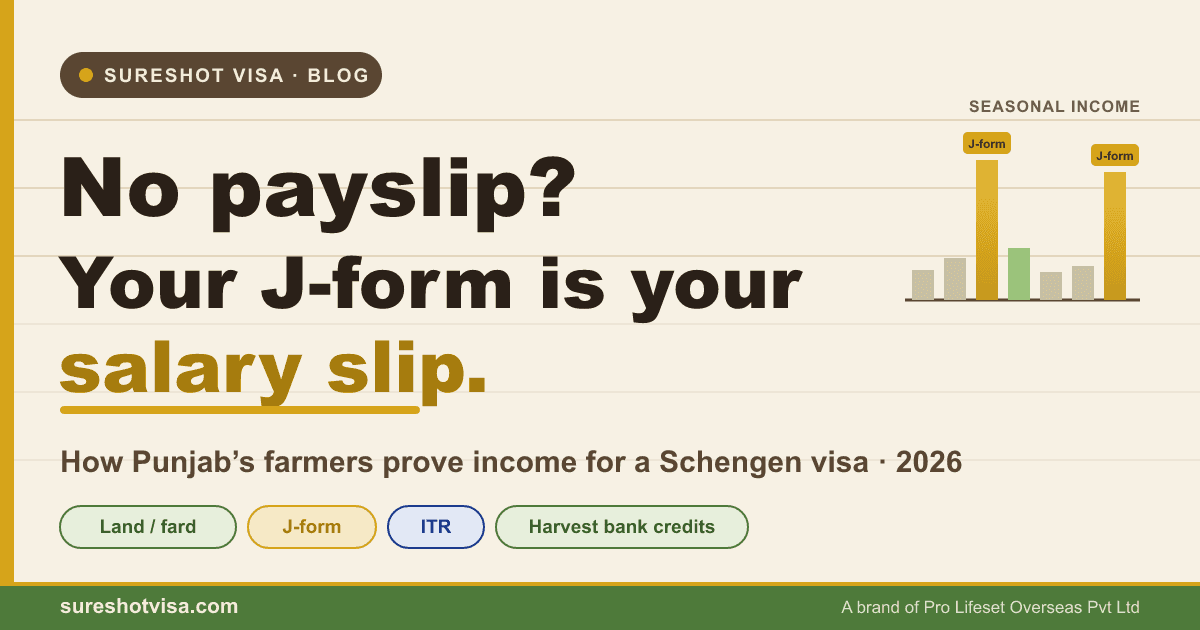
No Salary Slip? How Punjab’s Farmers Prove Income for a Schengen Visa (2026)
A farmer has no salary slip — and still gets the visa. Your J-form, fard, and harvest-season bank credits ARE your income proof. How to build a money story an officer trusts.
Read guide
Schengen Visa Refused — Insufficient Means of Subsistence: The Budget Lab
Schengen visa refused for insufficient means? A finance guide for Indians: trip-budget table, bank-statement credibility, sponsor proof, affordability and how to reapply.
Read guide
Schengen Visa Rejection Reasons for Indians: The Travel Evidence Board
Schengen visa rejected? A forensic visual guide for Indian applicants — main-destination logic, the refusal-code decoder, hotel-night and funds checks, return proof and a reapply self-audit.
Read guide
VFS ਅਪੌਇੰਟਮੈਂਟ / ਸਲਾਟ ਹੰਟਰ 2026 — ਅਸੀਂ ਤੁਹਾਡਾ ਸਲਾਟ ਫੜੀਏ
ਪਰਫ਼ੈਕਟ ਫ਼ਾਈਲ ਅਪੌਇੰਟਮੈਂਟ ਬਿਨਾਂ ਬੇਕਾਰ ਹੈ — ਤੇ ਸਲਾਟ ਸਕਿੰਟਾਂ 'ਚ ਗ਼ਾਇਬ ਹੋ ਜਾਂਦੇ। ਸਾਡੀ ₹1,999 ਅਪੌਇੰਟਮੈਂਟ / ਸਲਾਟ ਹੰਟਰ ਤੁਹਾਡੇ ਪ੍ਰਾਇਓਰਿਟੀ VFS/ਐਂਬੈਸੀ ਸੈਂਟਰ ਨੂੰ ਵਰਕਿੰਗ ਘੰਟਿਆਂ 'ਚ ਵਾਚ ਕਰਦੀ ਤੇ ਸਲਾਟ ਖੁੱਲ੍ਹਦੇ ਹੀ ਫੜਦੀ, 30 ਦਿਨ ਤੱਕ। ਸਾਡੇ ਨਾਲ ਫ਼ਾਈਲ ਕਰੋ ਤਾਂ FREE।
Read guide